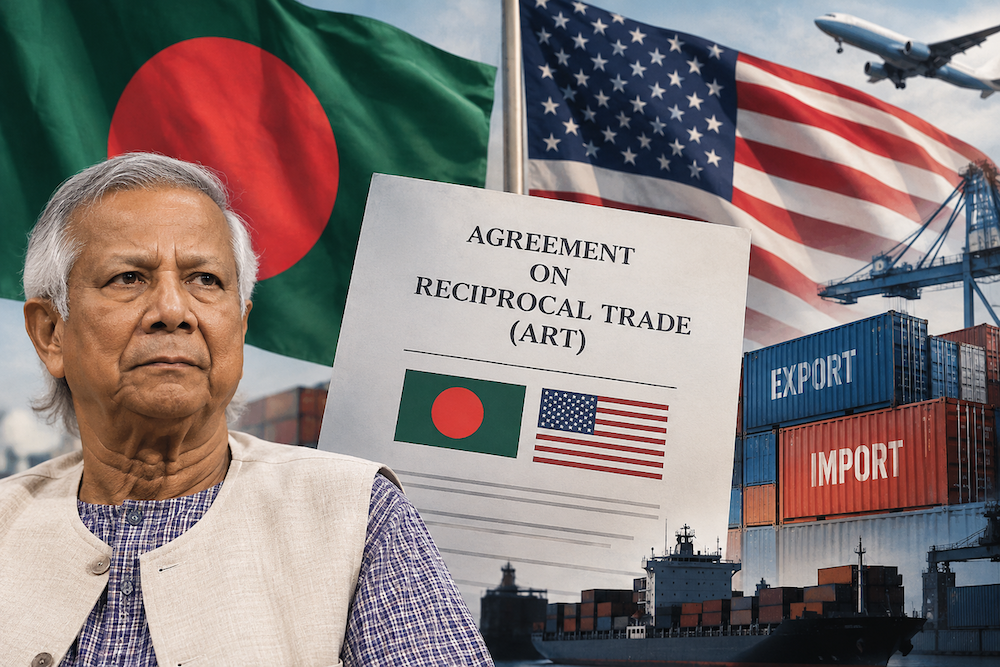
Bangladesh media has renewed scrutiny of the Agreement on Reciprocal Trade signed with the US under the interim government led by Muhammad Yunus…reports Asian Lite News Desk
Bangladesh media has renewed scrutiny of the Agreement on Reciprocal Trade signed with the United States under the interim administration led by Muhammad Yunus, with questions being raised over its terms, timing and the extent of commitments made by Dhaka.
More than seven months after the agreement was signed, a report in The Daily Star has urged the current government led by Prime Minister Tarique Rahman to reconsider the deal, arguing that Bangladesh’s obligations appear significantly greater than those undertaken by Washington.
Of the 10 countries that have actually signed the ART, “Bangladesh’s agreement has the strongest claim to being the most one-sided”, an article published on The Daily Star said on Tuesday. “Not because any single clause is exotic; most of its mechanisms exist, in some form, in some other countries’ agreements too. It is the aggregate, how the obligations stack up and the peculiar circumstances under which Dhaka signed at all, that sets it apart,” it stressed.
Wondering why Bangladesh rushed to sign first among the South Asian nations, it said “Looking back, it’s hard to identify what that haste bought”. It pointed to “the puzzle is the timing” where the interim administration signed it just three days before the national election “that would replace it”, thus, without an elected Parliament debating or approving it before it was signed, “and the new one has not scrutinised it since taking office,” the article added.
Reports earlier quoted independent Parliamentarian Rumeen Farhana seeking its parliamentary scrutiny, also saying that the agreement should have waited for an elected government to assume office to sign it. Student unions and various organisations mid April held protests in Dhaka, denouncing the treaty as a “treaty of subjugation”.
According to protesters, the agreement undermines Bangladesh’s autonomy in tariff and labour regulations, while the government fears that renegotiating the terms could strain relations with Washington, separate reports added.

“One textual count in the Bangladeshi press noted that the ART uses 179 instances of the mandatory ‘shall’, most of which are attached to Bangladeshi commitments,” The Daily Star article added. Such counts are an imperfect measure of substantive burden, but the broader text leaves little doubt about the direction of the obligations: Bangladesh promises considerably more than Washington does, it said, adding, “No comparable analysis has been published for the other ARTs, so this is suggestive rather than a verified ranking.”
Incidentally, Bangladesh has made large scale purchases, reportedly raising its planned Boeing purchase from 14 to 25 aircraft in July 2025. However, the article added that Bangladeshi officials subsequently said that no separate agreement beyond Biman’s 14 aircraft order had been signed. It did acknowledge US envoy Sergio Gor, saying in late August that Bangladesh had committed “billions of dollars” to buy still more Boeing aircraft, “significantly increasing” its initial order, without identifying the number.
Additionally, Bangladesh’s Cabinet last month cleared a 12 year liquefied natural gas (LNG) deal with Gunvor USA covering 117 cargoes, nearly 7.5 million tonnes, through 2038, the article also said. It claimed that the “contract was awarded without competitive bidding, through an unusual state to state pricing formula negotiated with a private trading firm, and the government has defended it as prudent hedging against Qatar’s own difficulties in meeting its LNG commitments amid regional tensions”.
Meanwhile, the reciprocal side of the bargain remains thin to the point of translucence, it stressed, alleging Bangladesh’s garment exports, its largest trade sector, now face effective tariffs in the mid 20 per cent range due to stacked duties, while the US has only promised a “mechanism” for zero tariff access tied to US cotton, without guarantees.
“Bangladesh is executing binding, multi billion dollar purchase commitments in real time against a promise that, more than half a year after signing, remains entirely undrawn and vague,” the article added, also adding legal and political issues.