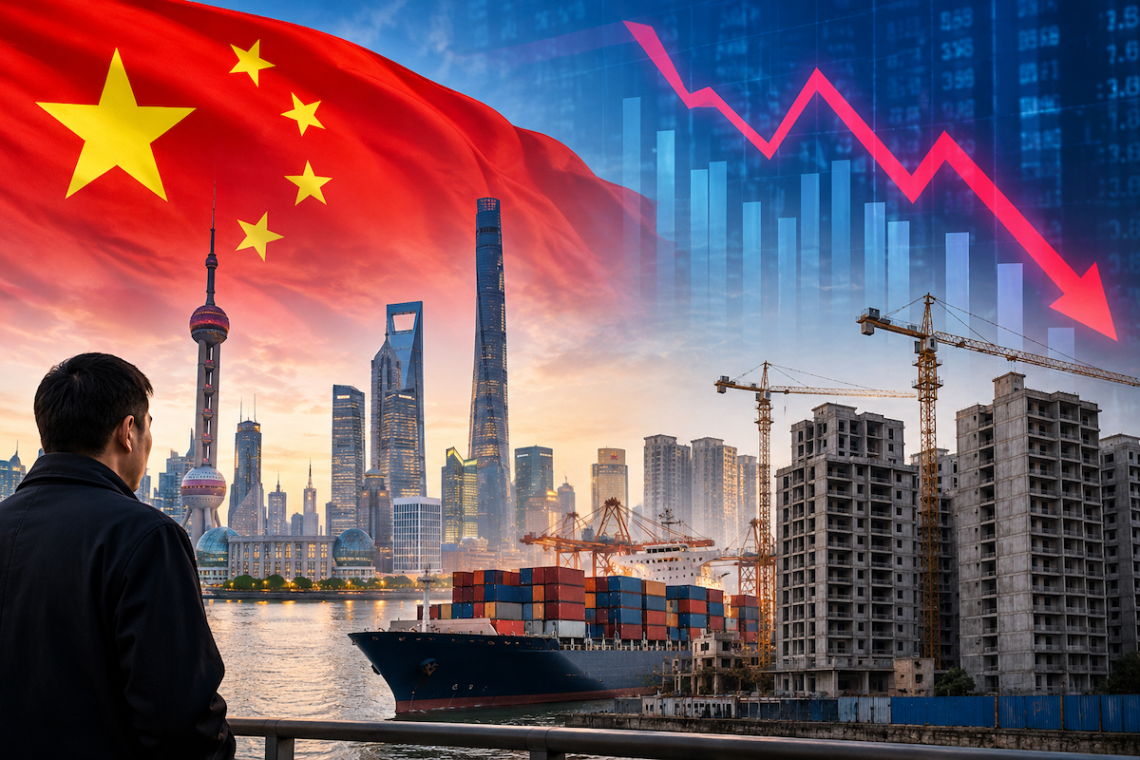
China’s economy grew 4.5 per cent in the third quarter, but weak consumer spending, falling investment and a prolonged property crisis continue to cloud its outlook…reports Asian Lite News Desk
China’s economy grew by 4.5 per cent year-on-year in the July-September quarter, up from 4.3 per cent in the previous quarter, but weak consumer demand, falling investment and a prolonged property crisis continue to weigh on growth. An export boom driven partly by artificial intelligence-related demand has helped support economic activity, masking underlying weaknesses in domestic consumption and investment.
According to data from China’s National Bureau of Statistics (NBS), the third-quarter growth rate comes as Beijing targets annual economic expansion of 4.5 to 5 per cent, its lowest growth goal in decades.
NBS deputy head Mao Shengyong described the international environment as “complex and volatile” and said domestic demand remained “insufficient”.
The government introduced mortgage subsidies for certain home purchases and additional infrastructure support in late September in an effort to boost economic activity amid sluggish consumer spending and weakening investment.
However, signs of subdued domestic demand persisted. Retail sales rose 1.1 per cent in September, but analysts cited in a France 24 report said real retail sales barely increased year-on-year after adjusting for inflation.
The better-than-expected GDP figures could also reduce pressure on Beijing to introduce significant policy changes in the fourth quarter to meet its annual growth target.
Industrial production offered a more positive signal, expanding 5.5 per cent year-on-year in September, compared with 5.2 per cent in August. An expert cited in the report attributed the improvement partly to strong overseas demand.
Investment slump and energy costs add pressure
Despite the improvement in industrial output, investment remained a major concern. Fixed-asset investment fell 7.2 per cent during the first nine months of the year, highlighting continuing weakness in business and property-related activity.
China’s property sector has struggled with a prolonged downturn, while subdued consumer confidence has limited the recovery in domestic demand. The strength of exports has helped cushion the economy, but the reliance on foreign demand leaves growth exposed to changes in the global economic environment.
Higher energy costs have added to the challenges. China, the world’s largest crude oil importer, is facing pressure from rising energy prices linked to the Iran war, which has disrupted shipping from the oil-rich Gulf, according to the report.
The International Monetary Fund downgraded its forecast for China’s economic growth in 2026 to 4.5 per cent last week. It cited higher energy prices, “protracted uncertainty and structural headwinds” as factors affecting the outlook.
The latest figures suggest that while China’s economy continues to expand, weak household demand, falling investment and structural problems remain obstacles to a stronger and more balanced recovery.