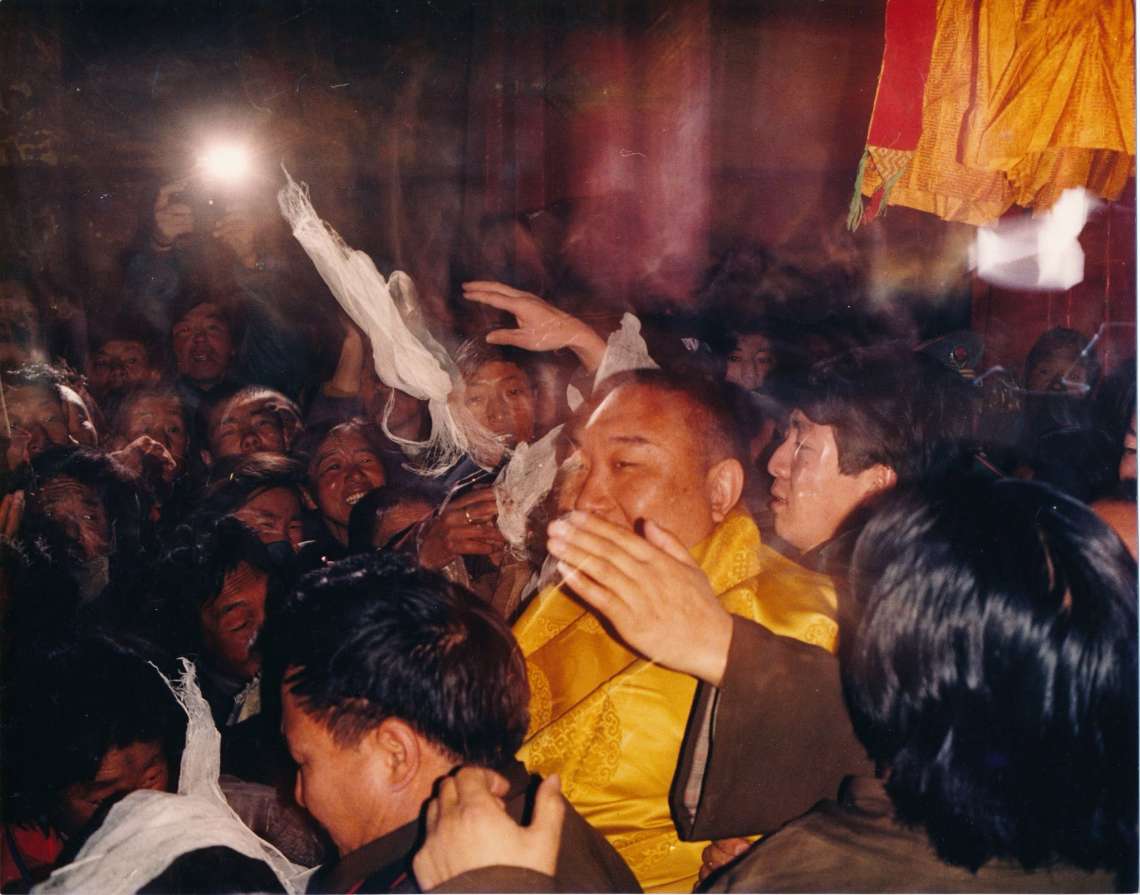
The 10th Panchen Lama questioned whether the benefits of development in Tibet justified the human and cultural costs, days before his death in 1989….reports Asian Lite News Desk
The 10th Panchen Lama’s final public address, delivered days before his death in 1989, remains one of the most compelling critiques of Chinese rule in Tibet, according to a recent opinion article. In his speech, he acknowledged that development had taken place under Chinese Communist Party rule but argued that the costs borne by Tibetans had outweighed the benefits.
The assessment was highlighted by Khedroob Thondup, nephew of the 14th Dalai Lama, in an opinion piece published by The Tibet Express. He recalled the address delivered by the 10th Panchen Lama, Choekyi Gyaltsen, on January 23, 1989, in Shigatse, Tibet. The religious leader died five days later.
“In that speech, he offered one of the most remarkable and courageous assessments ever made by a senior Tibetan leader who had worked within the People’s Republic of China,” Thondup wrote.
Reflecting on decades of Chinese Communist Party administration in Tibet, the Panchen Lama acknowledged that development had taken place but questioned whether its benefits justified the price paid by the Tibetan population.
His central observation was that “the price paid for this development has been greater than the gains”.
The significance of the address, according to Thondup, lies partly in the Panchen Lama’s position within the Chinese political system. He was not an external critic speaking from exile, but one of the highest-ranking religious figures in Tibetan Buddhism who had spent years attempting to work with Chinese authorities.
The Panchen Lama held several positions within China’s political establishment and repeatedly advocated cooperation. His criticism therefore carried particular weight, especially given his earlier efforts to raise concerns about the treatment of Tibetans through official channels.
One of his most significant interventions was the submission of the ‘70,000 Character Petition’, which documented the suffering and hardships faced by Tibetans under Chinese policies. The petition became an important expression of his concerns about the consequences of Beijing’s approach to Tibet.
Thondup argued that the Panchen Lama’s assessment challenged the idea that development should be judged solely through economic growth or physical infrastructure. Roads, buildings and rising incomes, he suggested, cannot by themselves establish whether a society has benefited.
Development, the article argued, must also be assessed through human dignity, social stability, cultural survival and freedom of belief. A society may experience economic improvements while simultaneously losing aspects of its identity that its people consider essential.
The timing of the Panchen Lama’s address also added to its significance. Tibet experienced unrest between 1987 and 1989, reflecting widespread dissatisfaction among sections of the population. Against this backdrop, his speech offered a critical assessment of the changes taking place under Chinese rule.
Rather than dismissing all development, he acknowledged that some gains had been made while questioning whether they outweighed the broader consequences for Tibetan society.
“More than three decades later, his assessment remains one of the most concise and compelling critiques of Chinese rule in Tibet. He did not deny that development occurred. Rather, he questioned whether the benefits outweighed the costs. Coming from a figure who had sought accommodation rather than confrontation, this judgment was especially difficult to dismiss,” Thondup wrote.
He added that the lasting importance of the speech lay in its challenge to the conventional understanding of progress.
“The lasting significance of the Panchen Lama’s final speech lies in this simple but profound proposition: development is not a success when a people believe they have paid more for it than they received in return,” he wrote.
The debate over Tibet’s cultural and political future has continued in recent years, with Tibetan representatives raising concerns about China’s policies on education, language, religion and cultural identity.
Earlier this month, Sikyong Penpa Tsering, the elected political leader of the Central Tibetan Administration (CTA), alleged that China was seeking to reshape Tibetan identity, particularly among children, through policies affecting language, education and religious traditions.
In an exclusive interview with IANS during a visit to Washington, Tsering said Chinese policies in Tibet had moved beyond visible security restrictions towards what he described as an extensive system of surveillance, political control and cultural assimilation.
“It’s getting worse and worse,” he said of the situation in Tibet. “So there’s no political space whatsoever.”
Tsering identified education as a key instrument in what he described as China’s efforts to transform Tibetan society. He alleged that Tibetan-medium schooling was increasingly being replaced by institutions in which Mandarin was the dominant language.
He also claimed that children as young as four were being sent to residential schools where the environment discouraged the use of Tibetan. According to Tsering, the consequences extended beyond classroom instruction, affecting how younger generations understood their language, religion and cultural heritage.
He said some children returning home were increasingly reluctant to speak Tibetan, raising concerns about the future transmission of the language between generations.
Tsering also linked these developments to China’s new ethnic unity and progress law, which he said was adopted on March 12. He argued that the legislation provided formal backing for assimilation policies that had been pursued for more than a decade.
The concerns raised by Tsering echo the broader questions about development, identity and cultural preservation highlighted in the Panchen Lama’s final address more than three decades ago.
While the 1989 speech acknowledged the material changes taking place in Tibet, its central criticism focused on the human and cultural costs associated with those changes. Thondup’s article argues that the Panchen Lama’s warning remains relevant because the measure of progress cannot be separated from the dignity, identity and freedoms of the people affected by it.