As India prepares for a post Covid phase with a focus on economic revival, reliance on the blue economy, which has not been leveraged fully, will inevitably be amplified, reports Mahua Venkatesh
India’s blue economy “essentially the ocean economy” is making a healthy 4 per cent contribution to India’s gross domestic product.
Yet, this a proverbial drop in the ocean. Unfortunately, India’s marine policy has remained fragmented, notwithstanding the ambitious Sagarmala project.
But as India prepares for a post Covid phase with a focus on economic revival, reliance on the blue economy, which has not been leveraged fully, will inevitably be amplified.
India, with a 7517 km long coastline and1382 islands, has a unique maritime position but it is yet to carve out a well thought-out holistic marine strategy encompassing issues pertaining to economic opportunities and security while maintaining ecological balance.
The draft policy on the framework of the blue economy, taking a 360-degree view was submitted in September last year, but work on it is yet to begin.
ALSO READ – India shifts focus on doers not talkers to boost post-Covid economy
At a time, when a belligerent China is increasing its activities on the South China Sea and elsewhere, India’s marine policy that looks at all angles would be key, experts said.
“With such expanded coastlines, we need to think of the economy along with security. But unlike many other countries with coastlines, India has not leveraged its maritime position as much as it should have,” Nirupama Soundararajan, Senior Fellow and Head of Research, Pahle India Foundation told India Narrative.
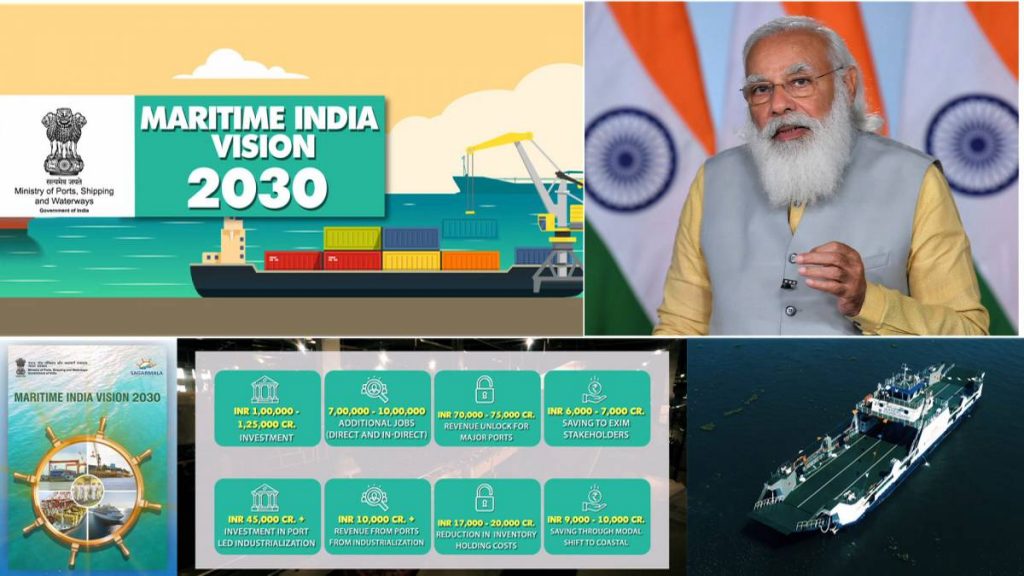
The draft framework noted that about 1400 million tonnes of cargo is handled by 12 major and 187 non-major ports every year.
The Sagarmala project
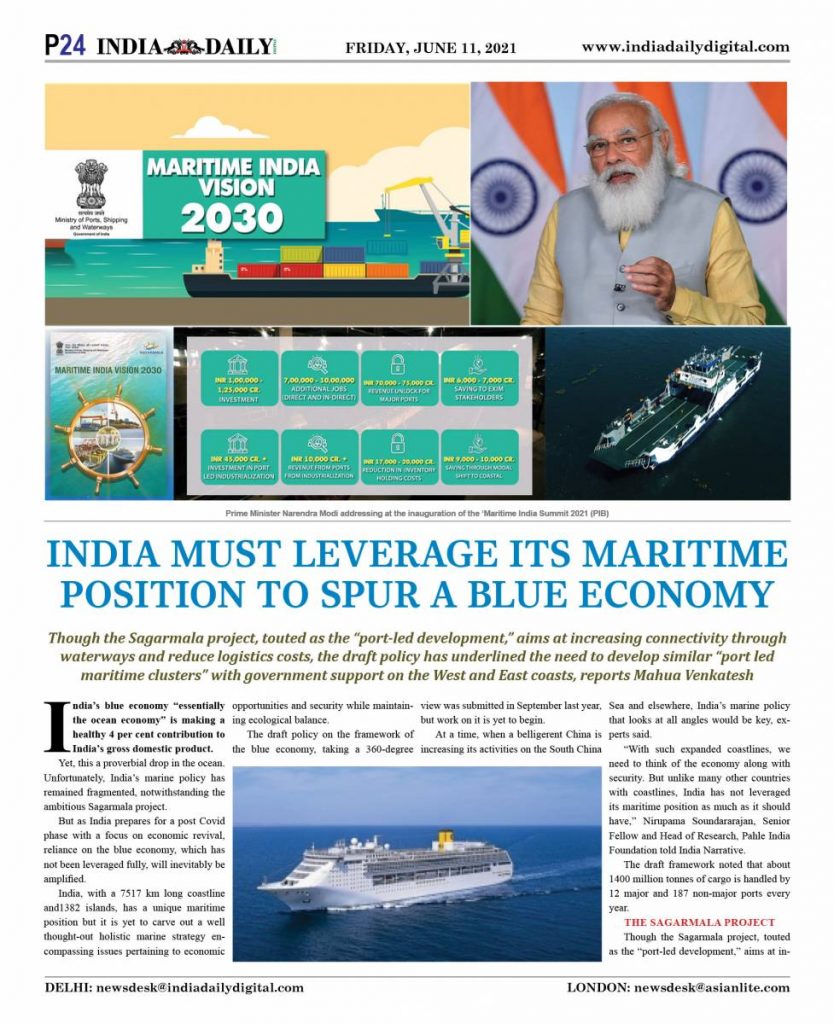
Though the Sagarmala project, touted as the “port-led development,” aims at increasing connectivity through waterways and reduce logistics costs, the draft policy has underlined the need to develop similar “port led maritime clusters” with government support on the West and East coasts.
Marine tourism is another important sector. The Energy and Resources Institute (TERI) in its research — Blue economy: An ocean of livelihood opportunities in India�pointed out that India’s marine tourism is one of the fastest growing in the world though it has been brutally hit by the Covid 19 pandemic.
In states like Kerala, Karnataka, and Tamil Nadu, marine tourism contributed largely to both the state economies and livelihood creation before the pandemic hit, it said. “In Kerala, the total number of jobs created directly and indirectly by the sector between 2009 and 2012 turned out to be around 23 per cent of the total employment. In 2016, the total share of tourism in Tamil Nadu’s employment was more than 22 per cent and 23 per cent in Karnataka’s,” TERI said.
Maldives – how the country used its oceans for economic growth
Many countries in the world have relied on marine tourism to boost their economy. The Research and Information System for Developing Countries (RIS) in March highlighted that Maldives, an archipelago state “embarked on the blue economy paradigm to shape its development strategies in order to put the economy on the high growth path.”
“As a Small Island Developing State (SIDS), Maldives advanced its development journey from a poor state of less than $100 per capita income in the early 1970s to an Upper-Middle income country of $12,500 per capita income in 2020 on account its strong adherence to blue economy sectors,” the study said.
Importance of protecting marine life
Analysts underlined the need to ensure that the ecological balance is maintained while economic activities are increased.
“The ocean framework is not very well regulated and therefore it can easily lead to imbalance. Ocean life is critical and the need to balance the benefits of the blue economy without damaging the ecological balance is crucial,” Soundararajan said.
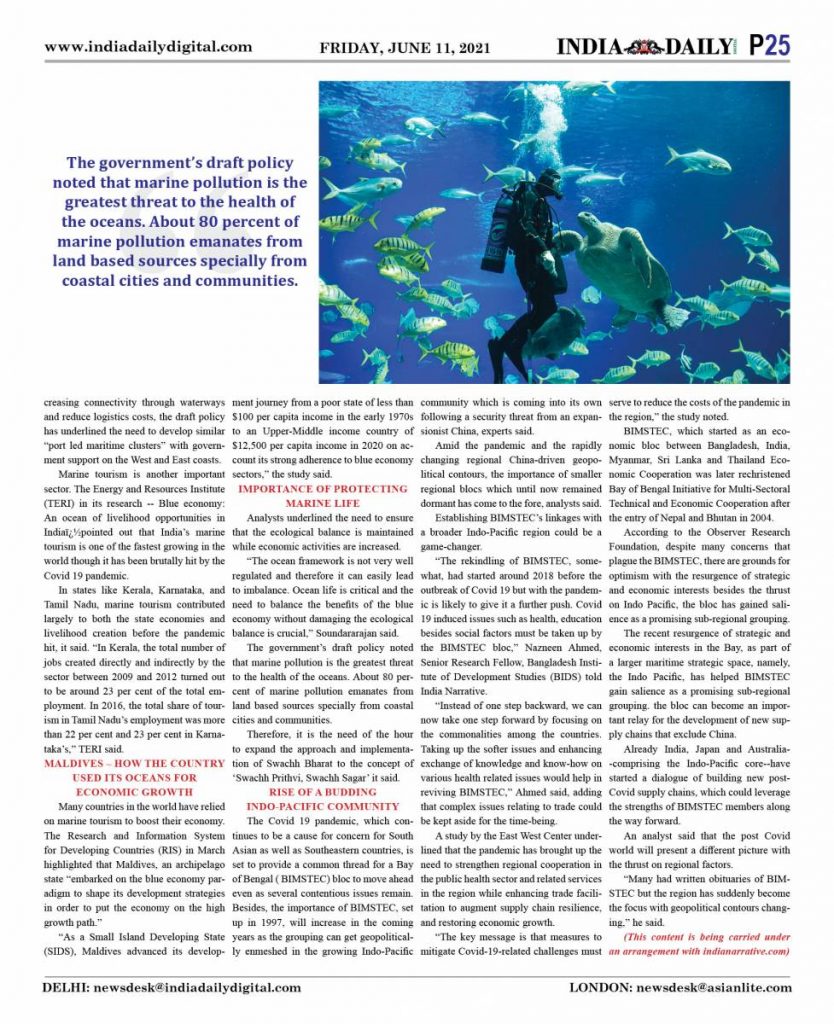
The government’s draft policy noted that marine pollution is the greatest threat to the health of the oceans. About 80 percent of marine pollution emanates from land based sources specially from coastal cities and communities. Therefore, it is the need of the hour to expand the approach and implementation of Swachh Bharat to the concept of �Swachh Prithvi, Swachh Sagar’ it said.
(This content is being carried under an arrangement with indianarrative.com)
ALSO READ – Indian economy to grow at historic 12.5%, says IMF
ALSO READ – Indian companies’ contribution to UK economy grows