June 3, 2023
4 mins read

‘Guilty won’t be spared’: Modi after meeting Odisha train crash survivors

The death toll in the tragic train derailment in Odisha’s Balasore district has increased to 288, with around 800 people injured, the South Eastern Railway (SER) said.

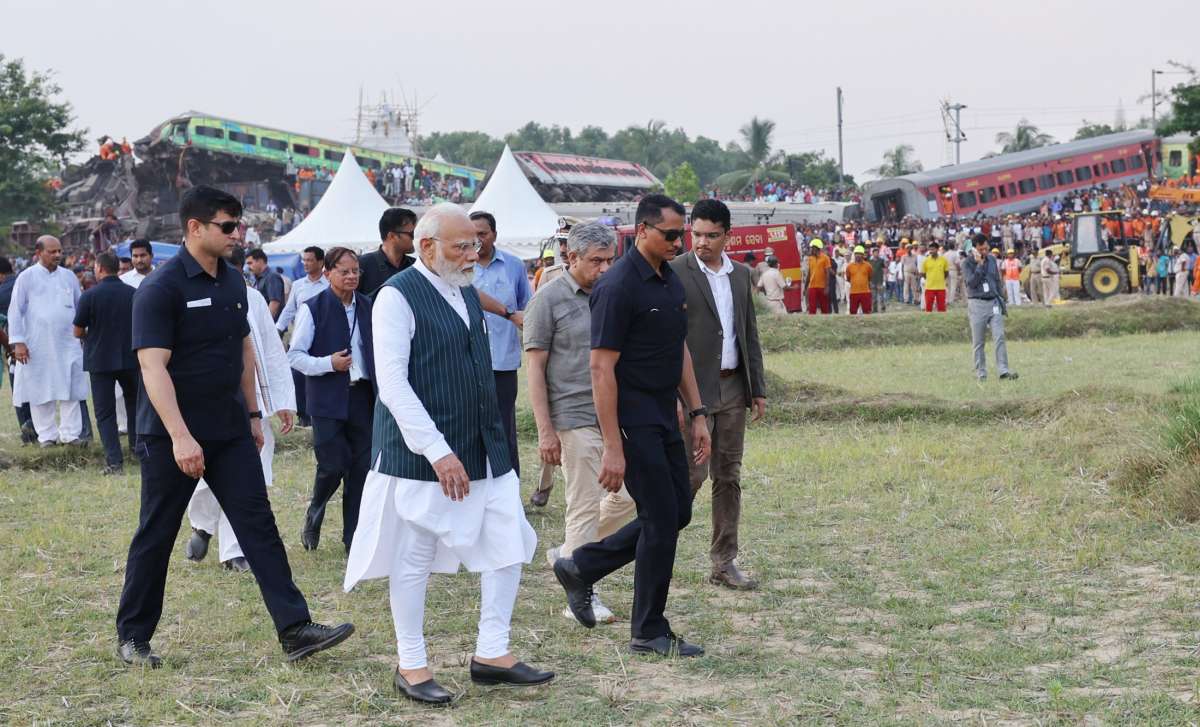
Prime Minister Narendra Modi on Saturday visited the accident site and took stock of the rescue and relief operations and also met with the accident survivors.
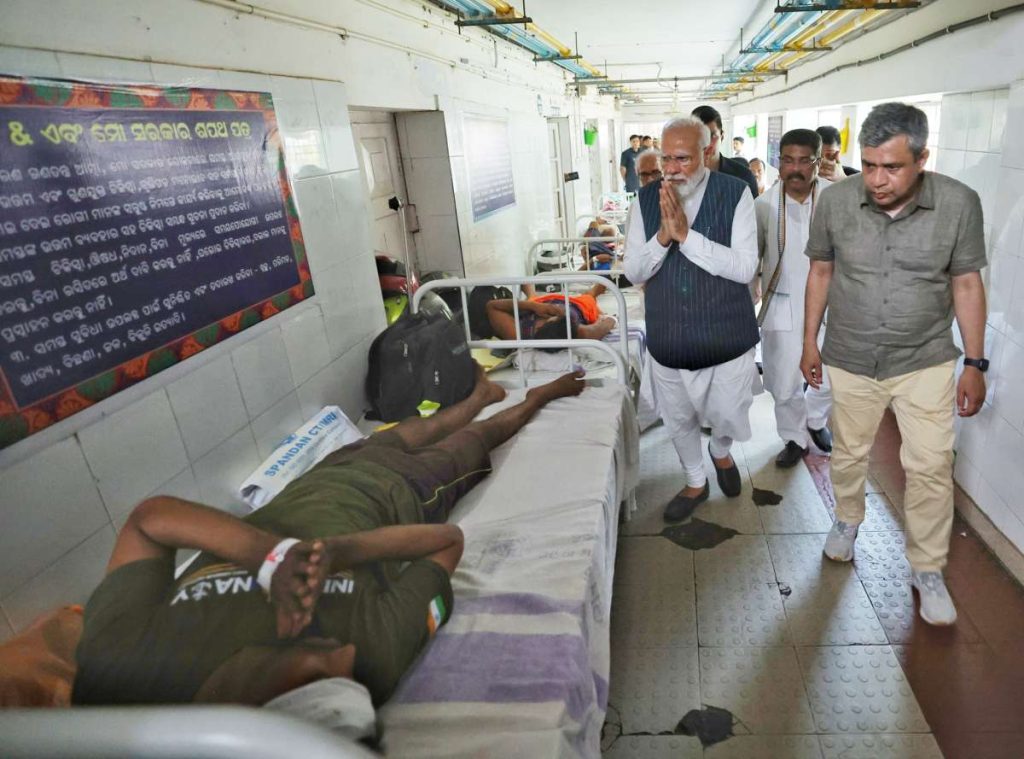
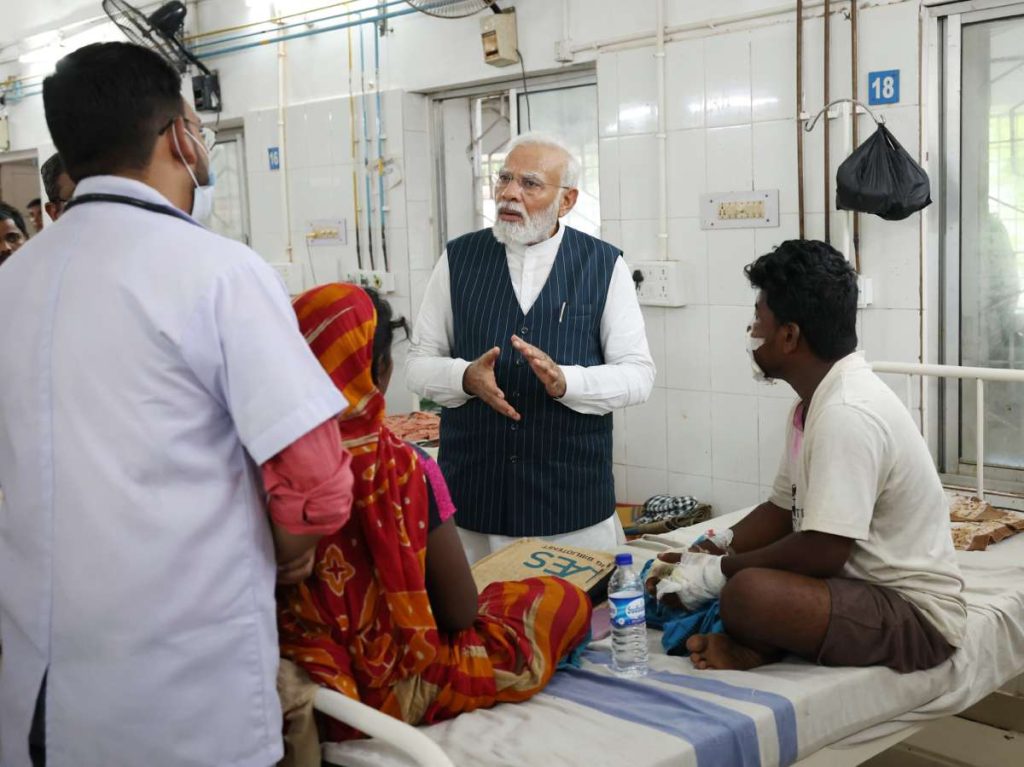
PM Modi meets victims of train accident at hospital, in Balasore, Odisha on June 03, 2023.

Modi said that the government will provide best medical treatment to the injured, adding that those found guilty for the mishap will not be spared.

“It’s a painful incident. The government will not be able to bring them back, who lost their lives [in the accident], but the government is with their kin in this grief. This incident is very serious for the government. The government will leave no stone unturned for the treatment of those injured. Instructions have been given for every type of investigation and whoever is found guilty will not be spared,” PM Modi said.

“I also thank the Government of Odisha and all the officers of the administration here who tried to help the people with limited resources,” he said, adding that Railway is working towards track restoration.

He also thanked the people of Odisha, who came forward to help crash survivors, whether by donating blood or providing assistance in the rescue operation.
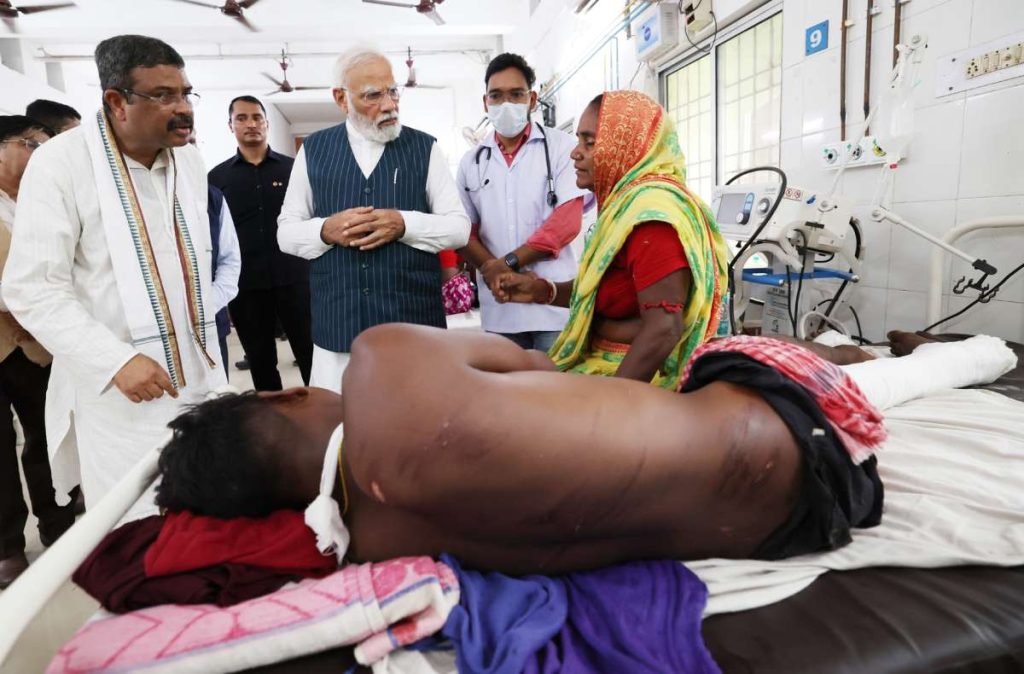
The PM visited the hospital after reviewing the situation at the site of the June 2 incident in which at least 261 people were killed and over 1,000 people injured.

PM Modi flew down to the crash site in an IAF chopper at Bahanaga Bazar Station in Balasore district and was briefed by Railway Minister Ashwini Vaishnaw about the train accident.

At the site of the accident, PM Modi reviewed relief works that are underway. He interacted with local authorities, personnel from the disaster relief forces and railways officials. He emphasised on the ‘Whole of Government’ approach to mitigating the monumental tragedy, according to government sources.

Earlier in the day, Railway Minister Ashwini Vishnaw also said that a detailed high-level inquiry will be conducted by the rail safety commissioner.

On Friday evening, 21 coaches of the Coromandel Express and SMVT-Howrah Super Fast Express derailed, leading to one of the worst railway accidents in the country in over two decades.

In a bulletin, the SE Railway said: “Train number 12841 Shalimar-Chennai, Coromandel Express and Train number 12864 Sir M Visvesvaraya-Howrah Superfast Express got derailed near Bahanaga Bazar Railway station at around 6.55 p.m. on June 2.

“Accident relief trains with medical equipment, doctors and paramedics were rushed to the site from Kharagpur and Bhadrak. As per the information received till now, there are 288 casualties. At least 56 people have grievous injuries while 747 have simple injuries who have been taken to the hospitals.”

PM Modi visits train accident site at Balasore, in Odisha on June 03, 2023.

It also said that the SER has run one special train from Howrah to Balasore at 4 p.m. on Saturday carrying the relatives of the affected passengers.

“Railways is taking every initiative to complete the restoration work. Meanwhile, a high-level inquiry has been ordered into the incident, which is to be conducted by the Commissioner of Railway Safety, South Eastern Circle,” it said.

About 16 hours after the accident, which involved two Express trains — Coromandel and SMVP-Howrah Superfast Express — and a goods train, the rescue operation was announced to be complete on Saturday afternoon by the Railways, following which restoration work commenced.

According to the Railways, the Coromandel Express with over 1,200 passengers was heading towards Chennai, while the SMVP-Howrah Superfast Express was coming towards Howrah with 1,000 passengers.
A senior Railway Ministry official said that the massive accident happened after coaches of Coromandel Express derailed and hit a standing goods train on one side while some fell on the opposite rail track on which SMVP-Howrah Superfast Express was coming from the Yeshwantpur side and going towards Howrah.

The SMVP-Howrah Express hit the capsized coaches near the Bahanaga Bazar railway station.

According to railway sources, the initial investigation has showed that the Coromandel Express was put on loop line minutes before the accident, where it hit a stationary goods train. However, railway officials have denied the charge and said that a detailed inquiry is on and all the angles of sabotage, mechanical error or human error will be probed extensively.

The visuals from the accident site showed how the coaches of the two trains capsized on each other even as the locomotive of the Coromandel Express jumped on one of the wagons of the goods train. Several teams of NDRF and other agencies used gas cutters to bring out the survivors from the mangled coaches.

PM Modi visits train accident site at Balasore, in Odisha on June 03, 2023.

Since the accident of Friday evening, more than 200 ambulances along with 30 buses have been pressed into service, Odisha Chief Secretary Pradeep Jena said.

The Railways has also announced an inquiry by A.M. Choudhary, CRS/SE Circle.

Railways has cancelled several trains on the Chennai-Howrah route, which is one the busiest routes of the national transporter.

ALSO READ: World leaders condole deaths in Odisha train accident

Newsdesk

Newsdesk

Aravind Rajeev is Deputy News Editor at Asian Lite, mostly covering the Middle East and GCC. He has over eight years of experience as a journalist, with a background in ground-level reporting, crime reporting, as well as international and regional news.

Previous Story

Sikh Workers Enslaved on Italian Farms

Next Story

UAE wins bid to host World Conservation Congress

Previous Story

Sikh Workers Enslaved on Italian Farms

Next Story

UAE wins bid to host World Conservation Congress

Latest from -Top News

Nepal Floods Cause $1.66 Billion In Damage, Says World Bank

Nepal’s August 2026 floods caused an estimated US$1.66 billion in direct physical damage, with infrastructure accounting for 83 per cent of the total…reports Asian Lite News Desk Nepal’s devastating floods in August 2026 caused an estimated US$1.66 billion in direct physical damage, with infrastructure accounting for 83 per cent of the total, according to a World Bank report. The estimate, included in the World Bank’s Nepal Development Update unveiled this week, is close to the Nepal government’s preliminary Rapid Damage and Needs Assessment (RDNA), which put physical damage at US$1.81 billion. The government’s assessment also estimated losses beyond physical assets at US$883.32 million, taking the total economic effects of the disaster to approximately US$2.7 billion. The World Bank’s Global Rapid Post-Disaster Damage Estimation (GRADE) found that infrastructure suffered the greatest damage, estimated at US$1.38 billion, or 83 per cent of the total. Residential buildings accounted for US$185 million, or 11 per cent, while non-residential buildings sustained damage worth US$101 million, or 6 per cent. The floods along the Bhotekoshi and Trishuli rivers caused extensive damage to hydropower projects, solar energy facilities, electricity transmission infrastructure and transport networks. The energy sector, particularly hydropower, was among the worst affected. The August 2026 floods affected 12 hydropower projects and one solar project, involving 281.1 MW of operational capacity and 395.02 MW of capacity under construction. Damage to transmission lines and substations also disrupted the transmission of 149.6 MW of electricity to the national grid. The total affected capacity reached approximately 430.7 MW, equivalent to 10.6 per cent of Nepal’s installed hydropower and solar capacity at the end of fiscal year 2025-26, which concluded in mid-July. The disaster also severely damaged transport infrastructure along the 82-km Rasuwa trade corridor, which connects Kathmandu with the Rasuwagadhi border point with China. More than 55 km of the corridor was damaged, including 40 km that was completely destroyed. The floods also damaged 37 motorable bridges and 68 suspension bridges. The disaster resulted in significant human losses along the affected corridor and beyond. According to Nepal’s National Disaster Risk Reduction and Management Authority, 1,455 people had been confirmed dead, while 5,285 remained missing following the disaster. The World Bank report found that the physical damage was concentrated in three districts in central Nepal: Rasuwa, Nuwakot and Dhading. Rasuwa was the worst-affected district, accounting for US$1.07 billion, or 64 per cent, of the total direct damage. Nuwakot recorded an estimated US$551 million in damage, while Dhading suffered approximately US$39 million. “The findings highlight the concentration of physical damage in a small number of districts and the disproportionate impact on infrastructure, underscoring the scale of the reconstruction challenge facing the affected areas,” the World Bank said. The global development financier said the floods had demonstrated the scale and complexity of disaster risks in Nepal’s Himalayan environment. The event also showed how a single extreme weather event could trigger cascading impacts across sectors and geographical areas. The report said recovery efforts should extend beyond restoring infrastructure to its pre-disaster condition. While the principle of “Build Back Better” remained relevant, the World Bank stressed that rebuilding infrastructure to higher engineering standards in the same locations might not always be sufficient. “In some cases, simply rebuilding the same infrastructure in the same location to a higher engineering standard may not be sufficient. Nepal may need to build differently — based on a better understanding of risk, more careful decisions about location and design, greater redundancy in critical networks, stronger monitoring and early warning, and a more integrated approach to infrastructure development in the Himalayas,” the report said. The World Bank said Nepal’s recovery strategy should incorporate improved risk assessment, more informed infrastructure planning, stronger monitoring systems and better early warning mechanisms. The report emphasised that reconstruction should not only restore damaged assets but also reduce the impact of future disasters, particularly in the country’s vulnerable Himalayan regions.

Vaccine Delays Fuel Bangladesh Measles Outbreak

More than 32,000 suspected cases and over 250 deaths have been reported since mid-March, with children making up most of the fatalities….reports Asian Lite News Desk Bangladesh’s measles outbreak has intensified, with

Tsai: Stand With Taiwan, Strengthen The Indo-Pacific

The former president said stronger international partnerships would help Taiwan withstand mounting military, cyber and economic pressure while reinforcing democratic resilience….repots Asian Lite News Desk Former Taiwan President Tsai Ing-wen has called
Go toTop

Don't Miss

India participates in SCO counter-terrorism exercise in Russia

The multilateral exercise is conducted biennially as part of military

132 Padma Awards This Year

PM Modi congratulated those who have been honoured with the