One of the most profound revelations at Zhuhai Air Show 2024 is the J-35A stealth fighter. With the arrival of the J-35 platform alongside the J-20, China will have two operational fifth-generation stealth fighter types in service. This makes it the second country in the world to do so, following in the footsteps of the USA that operates both the F-35 Lightning II and the F-22 Raptor….reports Asian Lite News
The extraordinary energy and innovation of China’s military-industrial complex show few signs of waning, if exhibits at this year’s spectacular Zhuhai Air Show in southern China, not far from Hong Kong, are anything to go by.
More formally known as the China International Aviation and Aerospace Exhibition, the 2024 edition is being held in the coastal city of Zhuhai 12-17 November.
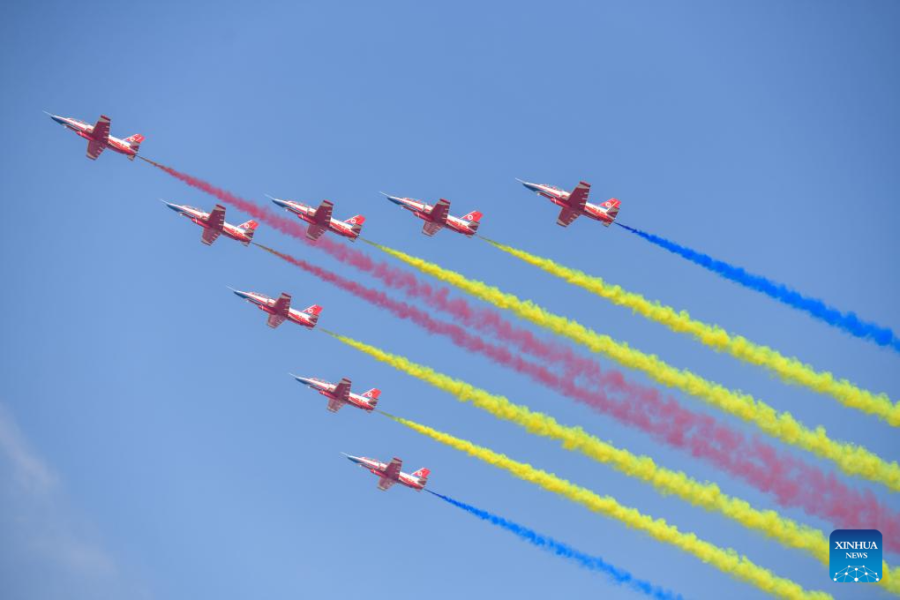
Whether it is jet engines screaming overhead during aerobatic demonstrations, diesel engines propelling heavy armoured vehicles over obstacles, or missiles, drones and other technology sitting resplendent in exhibition halls, this air show is the occasion where China shows off its military and technological prowess.
However, the biennial show is still in recovery mode after the impact of COVID-19 and an increasingly authoritarian attitude towards foreign companies and overseas media.
The largest ever iteration of the show occurred in 2018, when 150,000 trade visitors and 300,000 members of the general public flocked to the six-day show. In the same year, 425 members of the media attended.
However, this year foreign media are not welcome, a similar case to the preceding 2022 edition when just 193 journalists, all from China, attended. Figures for this year’s event are not yet available, but organizers were talking it up as the largest show ever in Zhuhai.
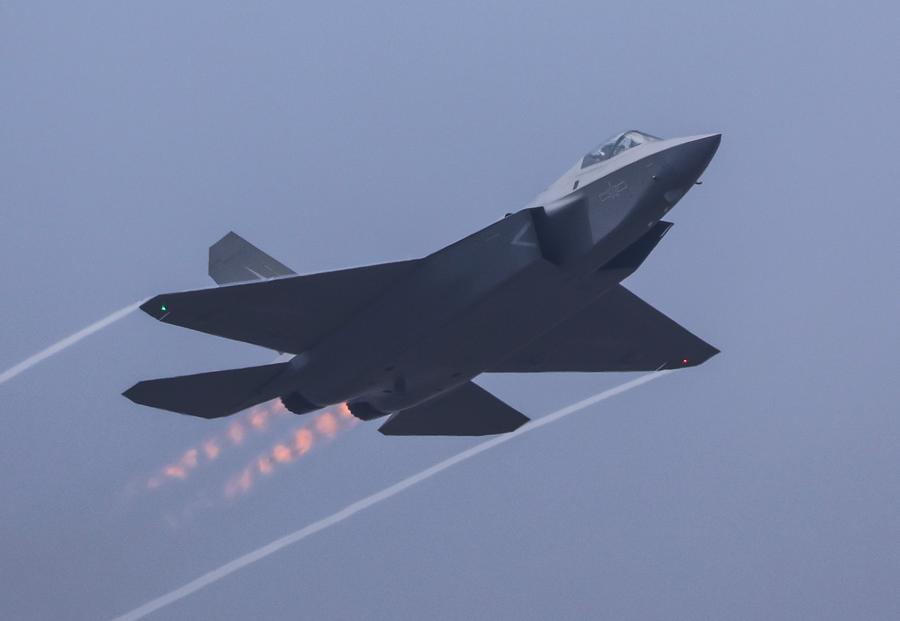
One of the most profound revelations at Zhuhai Air Show 2024 is the J-35A stealth fighter in People’s Liberation Army Air Force (PLAAF) markings. There had been rumours last year that the PLAAF was interested in this brand new fighter platform, and the examples that are appearing this week in Zhuhai are likely to be initial operational training and evaluation aircraft, according to Rick Joe, an expert on the PLA and a regular contributor to The Diplomat publication. He told ANI that he doubts the J-35A is yet operational in any frontline capacity.
The J-35A bears a lot of external similarities to the American-designed and built F-35 from Lockheed Martin. With the arrival of the J-35 platform alongside the J-20, China will have two operational fifth-generation stealth fighter types in service. This makes it the second country in the world to do so, following in the footsteps of the USA that operates both the F-35 Lightning II and the F-22 Raptor.
What then is the role of the J-35A in the PLAAF?
Joe told ANI, “I see the J-35A as a lower-cost, medium-weight, not-quite-as-long-range complement to the J-20/J-20A. However, its role does not particularly differ, i.e. the J-35A is likely still an air superiority aircraft primarily, with a secondary strike role like the J-20.”
The analyst also expects the J-35A to be as well-equipped as the J-20/J-20A in terms of sophistication of weapons, avionics and prioritization of signature reduction. The twin-engine J-35A is slightly smaller than the J-20, and some manufacturing techniques should ensure it is cheaper to build than its brethren.
With the arrival of the J-35A developed and manufactured by the Shenyang Aircraft Corporation, Joe does not expect J-20/J-20A procurement to slow at all, however. Indeed, the arrival of the J-35A “may be due to a desire to further increase fifth-gen procurement rates as soon as possible, on top of the expansion of J-20/J-20A procurement rates that we’ve seen CAC [Chengdu Aircraft Industry Group] undergo in recent years”.
Of course, the PLAAF’s J-35A fighter is piggybacking on the J-35 for the PLA Navy (PLAN). The navy will acquire the carrier-borne J-35 version to operate off its growing fleet of aircraft carriers. Joe speculated that, by procuring a conventional J-35A, then the air force can leverage development and future operational costs otherwise borne solely by the PLAN.
An export version of the J-35A is also likely (perhaps to be called the J-35AE), with Joe saying that such a version “may be more appealing to overseas customers, because PLA procurement guarantees an upgrade and sustainment pathway”. Many in Pakistan have been claiming for some time that Islamabad will buy the J-35A, even though there has been no hard evidence or announcements from official sources that the platform has been procured to date.
Returning to the PLAN’s J-35 version, Joe believes it is currently in advanced testing.”They’re very secretive, so it is hard to say what they are doing at this stage, but I would not be surprised if the PLAN had a couple of airframes in initial operational test and evaluation, and it probably will not take too long for carrier compatibility flight testing to commence at sea.” This commentator said the J-35 would be compatible with new catapult-equipped carriers as well as two older Russian-style carriers that have only a ski jump ramp.
The J-35A was not the only fighter to debut at this year’s Zhuhai Air Show.
Another making its maiden appearance was a J-15T fighter of the PLAN. The latest in a family line of carrier-borne fighters, the J-15T is designed to operate on catapult-assisted take-off but arrested recovery (CATOBAR) carriers such as the newest Fujian, which is yet to be commissioned into the Chinese navy.
The J-15T appearing at Zhuhai appears to be a late prototype, according to Joe, as it uses domestically manufactured WS10 engines rather than Russian AL-31 jets. Also in attendance at this year’s extravaganza is the J-15D, which is a specialist carrier-borne electronic warfare version of this fighter. Indeed, PLAN aviation is out in force in Zhuhai, for a Z-20J anti-submarine warfare helicopter also participated.
The Z-20, a Chinese copy of the successful American Black Hawk helicopter family, is expanding into a number of different variants, and the Z-20J is important to the navy as it slots in size between the compact Z-9 and large Z-8 families.
Of interest, Russia sent its new fifth-generation Su-57 fighter to perform an aerial display in the skies over Zhuhai too. The Russian Air Force also dispatched its Russian Knights aerobatic display team to perform for the Chinese public. The appearance of the former, especially, speaks of the close relations between China and Russia, as well as cash-strapped Moscow’s attempts to find buyers of the aircraft.
Some were hopeful that China’s mysterious H-20 stealth bomber would put in an appearance, but it is probably too early in its development for this to occur. Instead, to tease and tantalize, computer-generated images showed a video of a hypothetical H-20 working alongside J-35A fighters.
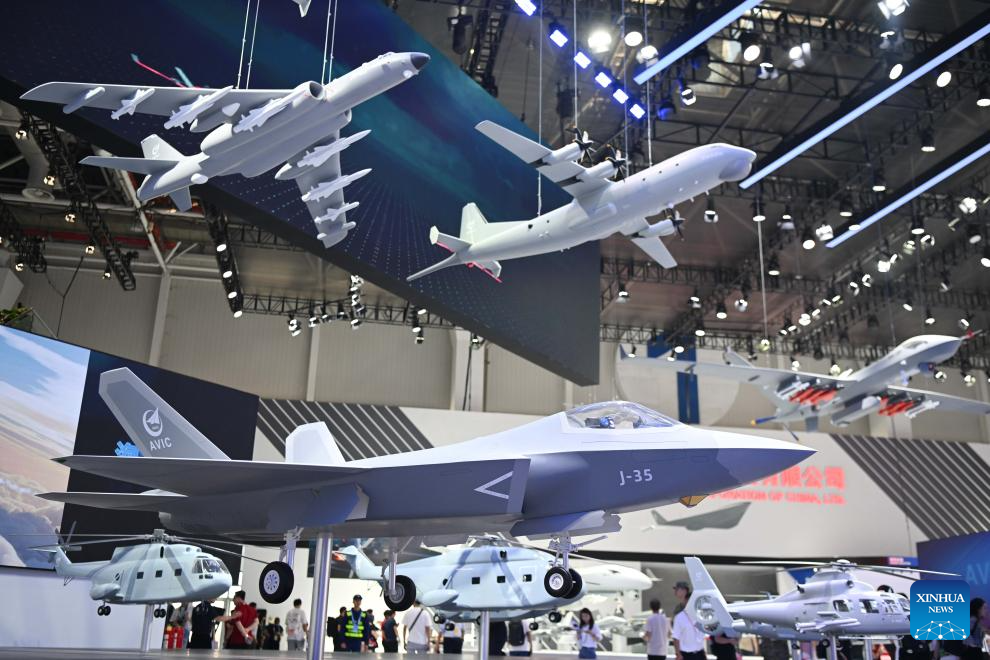
AVIC, China’s premier state-owned aerospace company, displayed a full-size mock-up of a sixth-generation fighter at Zhuhai, but this was nothing more than a fantasy item.
China is known to be working on a sixth-generation fighter, tentatively called the J-XD, but it is so secretive that visitors can be certain it does not resemble the fake fighter on display this year at Zhuhai.
Also new was a mock-up of a PL-15E air-to-air missile with a folding tail. This is significant, Joe said, because it would enable the J-20 and J-35 to carry six such missiles in their internal weapons bay, rather than the current four that they can accommodate. It is unclear if the PL-15E has been updated in terms of propulsion and guidance, but China is known to be developing another new beyond-visual-range air-to-air missile. Again, up to six such missiles are expected to be carried by the J20 and J-35.
China is renowned for producing a dazzling array of drones, and one highlight this year is a CH-7 stealthy flying-wing unmanned combat aerial vehicle (UCAV) developed by the China Aerospace and Technology Corporation (CASC). Video footage of one undergoing flight testing at some unknown location was the first definitive evidence of the CH-7 since a model of the design with 22m wingspan appeared at Zhuhai 5-6 years ago. A mock-up of the CH-7 was exhibited alongside a YJ-21E anti-ship missile, a hypersonic weapon that can be launched by the UCAV and which was unveiled at Zhuhai Air Show 2022.
Whilst on the topic of unmanned technology, China State Shipbuilding Corporation (CSSC) sailed its high-speed 500-ton unmanned surface vessel (USV) to Zhuhai for the show. This adds a new dimension to the air show, since vessels can now tie up in the water at the venue.
Christened the Orca and officially known as the JARI-USV-A, this USV is 58m long, has a beam of 23m and can sail more than 4,000nm. It employs a trimaran hull, and can be used for missions such as strike, air defence, missile interception, anti-submarine warfare and autonomous combat.
Its armaments include a remote-controlled weapon station, a vertical launch system for anti-ship missiles and air defence missiles, as well as rockets.
The Orca even has a stern flight deck that can land a drone or perhaps a small helicopter. Returning to land, another important debut is the HQ-19 air defence system belonging to the PLAAF. This is the Chinese equivalent of the American THAAD system, which stands for Terminal High Altitude Area Defence.
Mounted on a heavy 8×8 truck chassis, the HQ-19 is a Chinese system designed to intercept incoming ballistic missiles. Six missiles are carried in cylindrical canisters on each launcher vehicle, and the weapons are launched from a near vertical angle.
Hyping it up, Chinese commentators claim the HQ-19 has robust countermeasures capabilities, and that it can intercept both ballistic and hypersonic missiles. However, China remains coy on its range and intercept altitude. The fact that it is appearing in Zhuhai indicates that it has already entered PLA service.
Another interesting air defence system on display is the HQ-17AE unmanned ground vehicle. This 8×8 chassis is bristling with dozens of two different types of surface-to-air missiles, as well as radars and electro-optic system to pinpoint incoming targets. It seems optimized for defending against drones and loitering munitions. China is also pursuing other armaments to counter drones.
One is the CS/SS2A land-based close-in weapon station, a self-propelled PLB-625E antiaircraft gun, and an 8×8 truck that boasts a high-energy microwave weapon system.
Elsewhere, other land systems from state-owned Norinco also appeared at Zhuhai Air Show 2024. Based on a common 8×8 chassis is a variety of new vehicles.
The SH16A is a 155mm self-propelled howitzer variant, while the VN23 is an 8×8 fire support vehicle armed with a 125mm cannon in a turret. The VN22B is a 6×6 vehicle armed with a 105mm cannon.
China has enjoyed a lot of success selling armoured vehicles, particularly to Asia, Africa and the Middle East, and Iraq was recently confirmed as a buyer of the VN22 6×6 armoured personnel carrier.
Whilst on the topic of artillery, Norinco showed a new 8×8 truck-mounted multiple rocket launcher. It features two pods, each with five 300mm long-range rockets.
Summarizing the event in Zhuhai, Joe commented, “Overall, we are seeing the usual pattern where the aircraft and systems they display at Zhuhai are ones that we have mostly known about for a while and/or are either in service for a while or on the cusp of entering service.”
However, that does not diminish the unique chance at Zhuhai to get close up to new in-service PLA equipment as well as future technology, in a country that jealously guards military secrets and displays a sense of paranoia when it comes to revealing its latest defence equipment. (ANI)
ALSO READ: India-Philippines celebrate 75 years of diplomatic ties
ALSO READ: India, China to patrol once every week in Demchok and Depsang