Dr. Sultan affirmed the aspiration to continue cooperation to implement the “UAE Consensus” and deliver a new era of positive, tangible climate action…reports Asian Lite News
Dr. Sultan bin Ahmed Al Jaber, Minister of Industry and Advanced Technology and Managing Director and Group CEO of ADNOC, and Patrick Pouyanné, Chairman and CEO of TotalEnergies, co-chaired, on Monday in Paris, the second plenary meeting of the UAE-France High-Level Business Council, in the presence of Bruno Le Maire, French Minister of Economy, Finance, and Industrial and Digital Sovereignty.
Dr. Sultan Al Jaber conveyed the greetings of the UAE leadership to the French side and affirmed the leaderships’ keenness to enhance further the longstanding and strategic bilateral relations between the two countries. “I would like to emphasise the pivotal role the Council plays in reinforcing both leadership commitments to elevating the existing vibrant economic ties between the two countries and the importance of mobilising the private sectors on both sides to deliver sustainable economic development collaboration opportunities and partnerships,” said Dr. Al Jaber.
Bruno Le Maire stressed the importance of business dialogue between key French and UAE players. “The ambition we share is to develop very concrete joint projects, contributing to our countries’ strategic goals in terms of innovation, industrial development, and ecological transition,” said the Minister. “I am particularly delighted to see that climate transition is becoming a central focus of economic cooperation between our two countries. Businesses have a central to play in this area, which must translate into larger volumes of green investments, and therefore more green projects developed between French and Emirati companies,” he added.
“I am pleased to welcome our colleagues from the UAE here in Paris, to reinforce the dialogue initiated last year in Abu Dhabi and celebrate the Council’s first achievements. They have been made possible by the strong commitment of the private sector in key domains, ranging from energy to transport, and beyond. I look forward to witnessing further strengthening of these collaborations, as I am convinced that the Council is a fruitful platform for the development of mutually beneficial sustainable investments”, stated Patrick Pouyanné, Chairman and CEO of TotalEnergies.
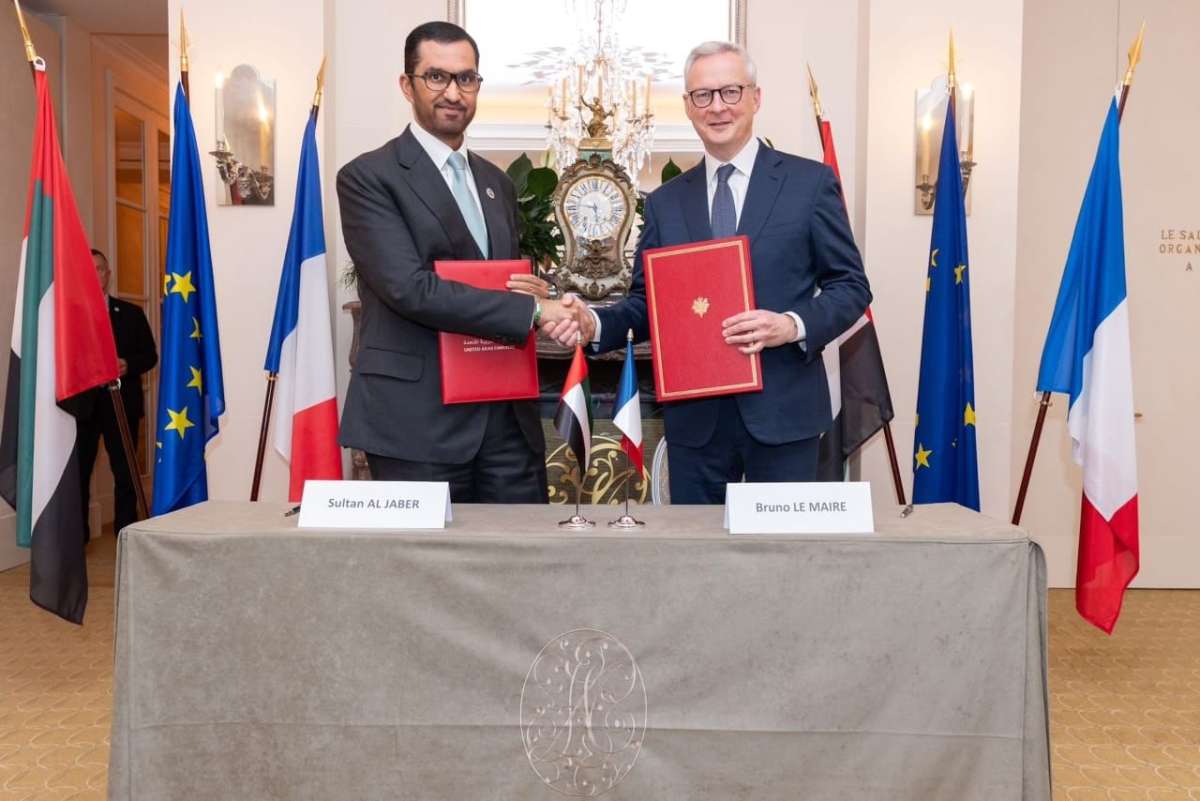
The meeting witnessed the signing of the MoU to establish the “UAE-France Bilateral Climate Investment Platform”, a pragmatic investment framework that will enable French and Emirati investors to accelerate the deployment of joint projects and investments of mutual interest in the clean energies sectors, with a particular focus on advancing the decarbonisation of Hard-to-Abate (HTA) Industries. T
The Platform includes French and Emirati Anchor Partners, ADNOC and Masdar from the Emirati side; TotalEnergies, Bpifrance, and CMA-CGM from the French side. The Platform is aimed to attract additional investment partners over time. The MoU was signed by Dr. Sultan Ahmed Al Jaber and Bruno Le Maire, French Minister of Economy, Finance, and Industrial and Digital Sovereignty.
In addition, TotalEnergies Renewables and Masdar signed an MoU for partnership in the development of Renewable Energy Projects in emerging markets. The MoU aims to explore potential collaborations and development of joint projects in the field of solar and wind energy in emerging markets of common interest in Central Asia and Africa, as part of the two countries’ efforts to develop joint projects and contribute to supporting global goals for reducing emissions and achieving climate neutrality and confirming their commitment to supporting efforts seeking to achieve a well-organised, responsible, fair, and realistic transition to a zero-carbon energy sector. The MoU was signed between Mohammed Jamil Al Ramahi, CEO of Masdar, and Patrick Pouyanné, CEO of TotalEnergies.
The Council reviewed the progress of the working groups during the past year and praised ongoing joint projects between Emirati and French companies in several strategic sectors, including energy and climate, transport and logistics, and financial investments.
The main partnerships highlighted during the meeting were:
1- The cooperation between TotalEnergies and Masdar to produce Sustainable Aviation Fuel (SAF) from methanol and the successful first demonstration flight on the sidelines of COP28 in the UAE.
2- The Airbus-Masdar wide-ranging collaboration to enable the development of the sustainable aviation fuel market.
3- The collaboration between ADNOC and Tabreed (Engie/ Mubadala JV) on delivering the first Geothermal Cooling Plant (G2COOL) project in the Gulf region, introducing geothermal energy into the UAE’s energy mix to decarbonise the cooling of buildings, covering 10 percent of Masdar City’s cooling needs.
4- The partnership between Masdar and CMA CGM on long-term supply of green alternative fuels linked to their shipping routes with a focus on e-Methanol, as well as Ammonia and Hydrogen.
5- Launch of the ‘GO to UAE’ initiative by Tawazun and Thales, with UAE Ministry of Industry and Advanced Technology support, to boost national Industrial capabilities.
6- The collaboration between Abu Dhabi Sustainable Water Solutions (SWS), SUEZ Group, and Marubeni focused on implementing key infrastructure projects worth $1.5 billion in the water supply and water treatment sector in Uzbekistan.
7- The CMA CGM and Abu Dhabi Ports on sustainable terminal operations focused on the operation of CMA Terminals Khalifa Port from 2025.
8- The partnership of Schneider Electric and e& enterprise to enhance operational efficiencies across Grid Network.
9- The strategic partnership between Masdar and Hy24 (Ardian JV) to co-invest and develop carbon-free hydrogen projects in various regions globally.
On COP28, Dr. Sultan Al Jaber praised France’s efforts in advancing climate action and its support for COP28 and its endorsement of the COP28 Action Agenda initiatives. He commended France’s pledge of €100 million to the “loss and damage” fund and €10 million to the “adaptation” fund. Dr. Al Jaber also commended France and French companies’ endorsement of the Global Decarbonisation Accelerator (GDA), which is designed to speed up the energy transition and drastically reduce global emissions, and its key pledges including the Global Renewables and Energy Efficiency Pledge to triple worldwide renewable energy capacity and double global energy by 2030, and the Global Cooling Pledge to reduce global cooling emissions by 2050.
Dr. Al Jaber also praised TotalEnergies’ climate action efforts and for being among the first to endorse the Oil and Gas Decarbonisation Charter (OGDC), where Oil and Gas companies worldwide agreed to aim for zero methane emissions, to end routine flaring by 2030, and to ambition net-zero operations by 2050.
In addition, Dr. Sultan praised their pledge to contribute $25 million to the Global Flaring and Methane Reduction (GFMR) trust fund, an initiative of the World Bank with COP28, as well as their partnerships with National Oil and Gas companies to detect and quantify methane emissions by making available their pioneering AUSEA technology.
Dr. Sultan affirmed the aspiration to continue cooperation to implement the “UAE Consensus” and deliver a new era of positive, tangible climate action.
The meeting concluded with the approval of the Council’s roadmap for 2024 and the Chairs’ call to the working groups to continue mobilising and accelerating new projects and initiatives that will support the delivery of the Council’s objectives.
Attending the meeting from the Emirati side were Omar Suwaina Al Suwaidi, Under-Secretary of MoIAT; Hend Al Otaiba, UAE Ambassador to the Republic of France; Majid Al Suwaidi, Director-General of COP28; Hana Al Rostamani, CEO of First Abu Dhabi Bank; Khaled Al Huraimel, Vice Chairman of the Board of Directors of Bee’ah; Mohamed Al Ramahi, CEO of Masdar; Shareef Al Hashmi, CEO of Operations at Tawazun Council; Meera Sultan Al Suwaidi, Head of Sovereign Partnerships of Mubadala; and Mohamed Kaissi, Executive Director of Strategic Projects at ADQ’s CEO and MD office.
The French side was represented by Frédéric SANCHEZ, President MEDEF International and Chairman of Fives Group; Guillaume FAURY, CEO of Airbus; Jean Lemierre, Chairman of BNP Baripas; Jean-Pierre Clamadieu, Chairman of Engie; Marie-Ange Debon, Chairwoman and CEO of Keolis; Slawomir Krupoa, CEO of Societe Generale; Geoffroy Bunetel, Chairman of CCI France-UAE2, and Nicolas Niemtchinow, French Ambassador to the UAE.
It is worth noting that the non-oil trade between the two countries increased by 12.5 percent during the first nine months of 2023 compared to the same period in 2022, reaching approximately AED 25.1 billion (€6.3 billion). In 2022, non-oil bilateral trade exceeded pre-pandemic levels, reaching about AED 30.4 billion, 20.5 percent higher than in 2021 and 53.4 percent over 2020.
Additionally, the UAE hosts the largest number of French companies operating in the Middle East, with about 600 companies employing more than 30,000 employees. Conversely, the UAE is France’s second-largest investor in the GCC.
ALSO READ-UAE affirms commitment to clean energy, Paris deal