Kyrgios defeats Sabalenka in Dubai’s eye-catching “Battle of the Sexes”, but the exhibition’s entertainment spectacle overshadowed sport, sparking debate on its meaning and legacy….reports Asian Lite News
Nick Kyrgios emerged victorious in Dubai’s much-hyped “Battle of the Sexes” exhibition against women’s world No.1 Aryna Sabalenka, but long after the final ball was struck, the match continued to provoke debate about what, exactly, it was meant to represent.
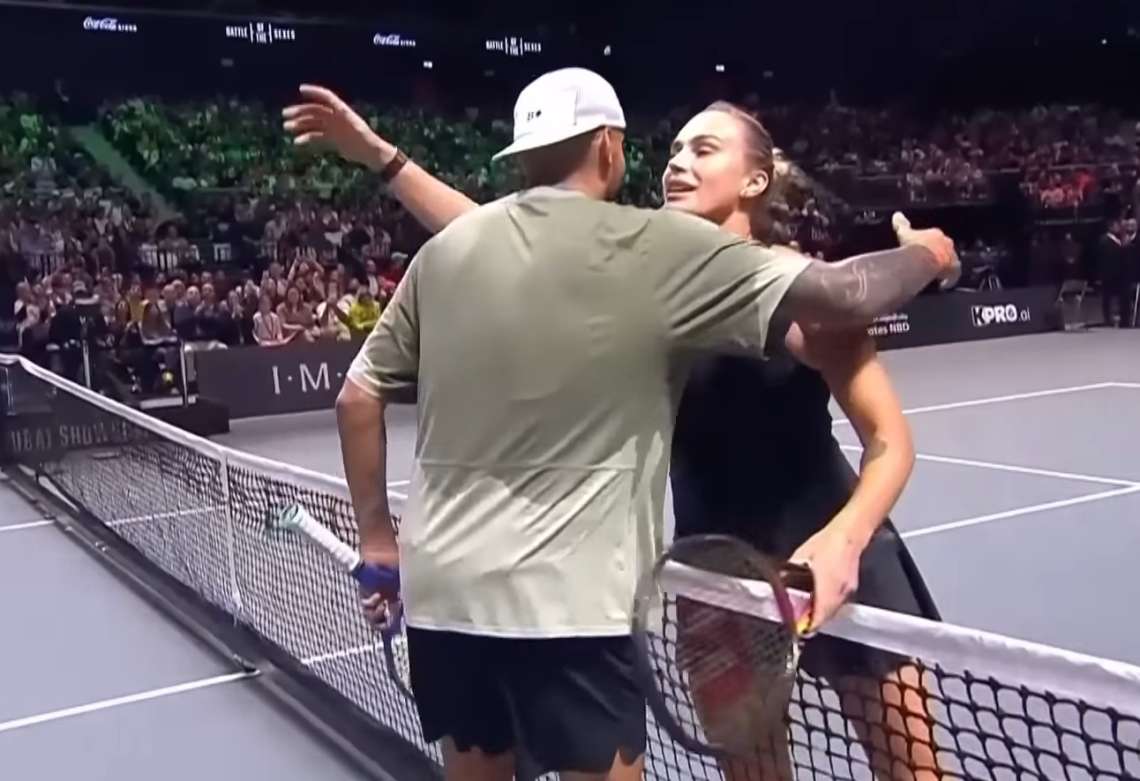
Played in front of a sold-out crowd of around 17,000 at the Coca-Cola Arena, the exhibition ended with Kyrgios winning 6-3, 6-3. On paper, it was a straight-sets result. In reality, the evening unfolded less as a sporting contest and more as a carefully choreographed spectacle, blending elite tennis with showmanship, celebrity appeal and a generous dose of theatre.
The billing inevitably evoked memories of the iconic 1973 showdown between Billie Jean King and Bobby Riggs, a match that carried profound cultural and political significance and reshaped conversations around gender equality in sport. The Dubai version, however, was never framed as a moral statement or a referendum on women’s tennis. From the outset, organisers and players made it clear that entertainment, not ideology, was the central aim.
That intention was reflected in the modified rules introduced for the match. Sabalenka competed on a court reduced in size by roughly nine per cent, while both players were limited to a single serve per point. The adjustments were designed to create balance and keep rallies competitive, but they also reinforced the sense that this was an exhibition first and a sporting contest second. For purists, the tweaks felt unnecessary and faintly contrived.
Kyrgios, true to his reputation, adapted quickly. Despite having played limited competitive tennis in 2025 due to wrist and knee injuries, the Australian displayed enough tactical awareness and flair to control proceedings. He relied on sharp angles, disguised drop shots and his familiar array of improvised winners to disrupt Sabalenka’s rhythm, breaking serve early in both sets and rarely relinquishing momentum.
Sabalenka, by contrast, appeared less comfortable with the format and the flow of the match. One of the most powerful and consistent players on the women’s tour, she struggled to impose her usual baseline dominance against Kyrgios’s variety and unorthodox shot selection. When rallies extended, she occasionally found her range, but those moments were fleeting.
Yet Sabalenka embraced the spirit of the occasion. She entered the arena to dramatic music, smiled and joked with her opponent, and at one point broke into a Macarena during a second-set timeout, drawing cheers from the crowd. The gesture captured the essence of the evening: a willingness to entertain, even if it came at the expense of competitive edge.
Around them, the atmosphere felt closer to a pop-culture event than a traditional tennis match. Ticket prices climbed into the high hundreds of dollars, underscoring the commercial appeal of the concept and the appetite for novelty. Fans were treated to under-arm serves, exaggerated grunts, playful exchanges and moments of genuine shot-making, all delivered with a wink rather than intensity.
Reaction to the event was predictably divided. Supporters praised the relaxed tone, arguing that exhibitions like this help broaden tennis’s audience and bring the sport into new spaces. Seeing two global stars share the court, they said, was reason enough to celebrate.
Critics, however, were less convinced. Some felt the match diluted the historic weight carried by the “Battle of the Sexes” label, reducing it to a marketing hook devoid of deeper meaning. Others questioned whether such exhibitions risk reinforcing stereotypes rather than challenging them, particularly when competitive balance is managed through rule changes rather than natural contest.
Both players, for their part, appeared untroubled by the criticism. Kyrgios was complimentary afterwards, describing Sabalenka as an elite competitor and suggesting he would be open to a rematch. Sabalenka said she enjoyed the experience and viewed it as a chance to test herself in an unusual environment, rather than a measure of her standing in the sport.