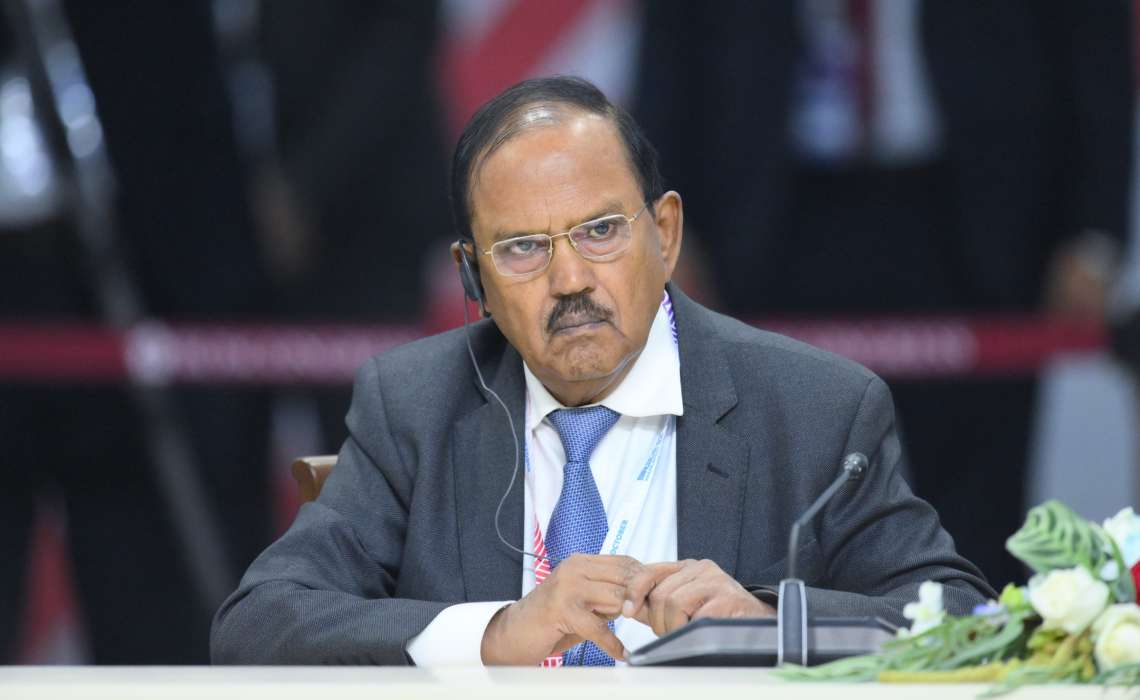
Doval–Rahman talks mark rare high-level engagement as Dhaka navigates political turmoil, Hasina’s death sentence and an approaching election, with both sides stressing stability, security and regional cooperation….reports Asian Lite News
Bangladesh’s National Security Adviser Dr Khalilur Rahman met India’s NSA Ajit Doval in New Delhi on Wednesday, marking the highest-level security engagement between the two neighbours since the dramatic political upheaval in Dhaka last year. The meeting, confirmed by the Bangladesh High Commission, comes at a sensitive moment, with bilateral ties strained by the ouster and subsequent death sentence handed to former Prime Minister Sheikh Hasina, and with Bangladesh’s general election only months away.
Dr Rahman is in Delhi to lead Bangladesh’s delegation to the Seventh NSA-level meeting of the Colombo Security Conclave (CSC), the Indian Ocean security grouping that brings together India, Sri Lanka, the Maldives, Mauritius and Bangladesh, with Seychelles participating as an observer and Malaysia invited as a guest country. But his bilateral engagement with Ajit Doval stood out as a strategically important conversation, given the political and security volatility in Bangladesh.
According to the Bangladesh High Commission, Rahman and Doval reviewed the functioning of the CSC, discussed its ongoing cooperation pillars, and took up “key bilateral issues”. Rahman also extended a formal invitation to Doval to visit Bangladesh at a mutually convenient time.
“The Bangladesh delegation… met with the National Security Adviser of India, Mr Ajit Doval, and his team today in Delhi. They discussed work of CSC and key bilateral issues. Dr Rahman invited Mr Doval to visit Bangladesh,” the High Commission said in a statement.
Engagement despite strains
The meeting takes place against the backdrop of a sharp downturn in India–Bangladesh ties following Sheikh Hasina’s fall from power during the July–August 2024 uprising. The International Crimes Tribunal-1 in Bangladesh on Monday sentenced Hasina to death after finding her guilty of “crimes against humanity” linked to the unrest—an outcome that has sparked global concern and placed New Delhi in a diplomatic bind.
Bangladesh’s interim government, led by Chief Adviser Muhammad Yunus, has formally requested India to extradite Hasina, who fled the country at the height of the crisis. New Delhi has not commented on the extradition plea directly, but the Ministry of External Affairs (MEA) issued a carefully worded response on Monday, signalling caution and calling for stability and democratic due process in Bangladesh.
“India has noted the verdict… concerning former Prime Minister Sheikh Hasina. As a close neighbour, India remains committed to the best interests of the people of Bangladesh, including in peace, democracy, inclusion and stability,” the MEA said. It added that India would “engage constructively with all stakeholders”.
The judgement and its fallout have placed unusual pressure on India’s relations with Dhaka. For decades, security cooperation, border management and counterterrorism coordination have been built on strong political alignment with Hasina’s government. With a new interim authority in place, and elections due in about three months, New Delhi is recalibrating its approach while signalling that it supports a transparent, inclusive and credible democratic process.
CSC meet to focus on regional security roadmap
The broader purpose of Rahman’s visit is participation in the CSC meeting, which Ajit Doval will host on Thursday. According to the MEA, the conclave aims to deepen cooperation across a range of security concerns vital to the Indian Ocean region: maritime safety, counterterrorism and radicalisation, transnational organised crime, cyber security and the protection of critical infrastructure, as well as humanitarian assistance and disaster relief.
The Seventh NSA-level meeting will allow member states to review progress across these pillars and discuss the roadmap and action plan for 2026. For Bangladesh, the CSC offers an avenue to strengthen regional security ties at a moment when its internal political transitions have unsettled its traditional diplomatic alignments.
The Rahman–Doval conversation is therefore being read as an important signal that both sides are willing to maintain dialogue, despite the political turbulence and unresolved questions surrounding Hasina’s legal fate. With regional security cooperation growing increasingly important, especially in the Indo-Pacific context, India and Bangladesh appear keen not to allow current frictions to derail institutional engagement.
As Dhaka moves towards elections, New Delhi has made clear that it wants a stable, democratic and inclusive outcome, while Bangladesh’s interim administration is seeking international cooperation to navigate a fraught political year. Wednesday’s meeting suggests that, even in a period of uncertainty, both governments want to keep channels open—an indication of the depth and strategic weight of the relationship.