From Gandhi’s visit in 1920 to Prime Minister Modi’s call for Swadeshi today, Mahoba’s weavers show how khadi continues to weave empowerment, pride and self-reliance….reports Asian Lite News
In the dusty lanes of Jaitpur village in Uttar Pradesh’s Mahoba district, the rhythmic hum of the charkha still carries forward Mahatma Gandhi’s century-old dream of self-reliance. More than 100 years after Gandhi himself visited this small region in 1920 to set up a Khadi Gramodyog centre, local weavers continue to sustain the spirit of ‘Swadeshi’ that became the backbone of India’s freedom movement.
The Shri Gandhi Ashram Utpadan Kendra, founded during that visit, remains the heart of this quiet revolution. Gandhi, accompanied by Gandhian leader Acharya J. B. Kripalani, had urged villagers to embrace khadi as both an economic lifeline and a moral statement against colonial rule. What began as a freedom struggle initiative quickly evolved into a livelihood for hundreds of families. At its peak, nearly every household in Jaitpur had its own charkha, spinning not just yarn but a shared sense of national pride.
Even after Independence, khadi did not lose relevance in Mahoba. For generations, it remained the primary source of income for local families, sustained by government subsidies and the enduring demand for handspun cloth. Today, the centre continues to process raw cotton, turning it into fine yarn and weaving it into khadi fabric that is washed, finished and supplied to markets.
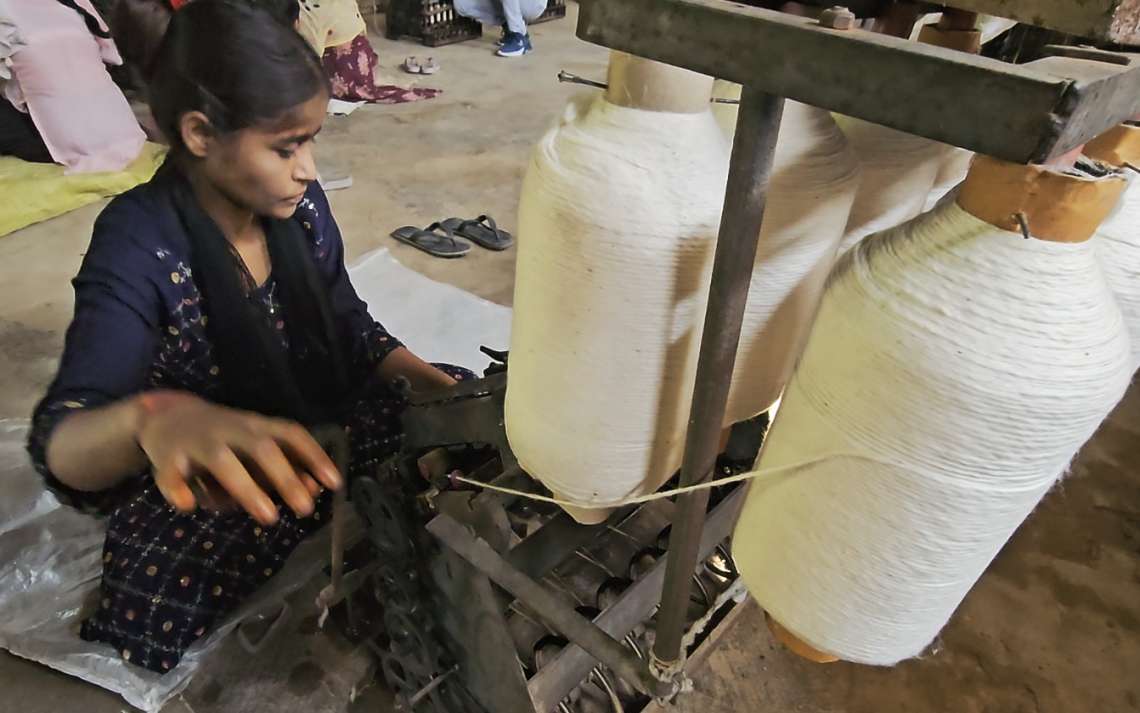
For the artisans, this work is more than a profession—it is a way of life. Shivani, a weaver, says, “After finishing household chores, I come here to spin yarn. It helps me earn and support my family.” Parveen, another artisan, explains that the charkha keeps her “connected to roots” while also providing dignity. Sonia, who works alongside them, agrees: “It has become an important part of our daily lives.”
The entire production process remains deeply traditional. Women spin yarn by hand, which is then taken up by weavers on handlooms. After weaving, the fabric is washed and distributed to shops. Shyamle, who oversees the operations, says: “This is not just work, it is a discipline. Everyone in the village has grown up around the charkha.”
At present, the centre has 15 to 20 charkhas operational, mostly run by women who arrive after finishing household responsibilities, explains manager Dhanprasad Vishwakarma. “We spin wool and cotton into yarn, give it to weavers, and then prepare the final fabric for the market. The process has not changed much over the decades.”
For Gandhian activists, the survival of this centre symbolises more than just weaving cloth. Brajmohan Nayak of Khadi and Village Industries stresses: “Gandhiji’s idea was to empower the poor through self-employment. This centre is proof that his legacy is still alive.”
The relevance of khadi in modern India was also highlighted by Prime Minister Narendra Modi in the latest edition of his radio address Mann Ki Baat. Calling for renewed adoption of Swadeshi ahead of Gandhi Jayanti on October 2, he urged Indians to buy at least one khadi product as a mark of pride. “The charm of khadi was fading after Independence, but in the last 11 years, it has seen a resurgence,” he said, noting a sharp surge in sales.
Modi also highlighted examples of innovation rooted in tradition—from Tamil Nadu’s Yaazh Naturals producing yoga mats from grass and banana fibre, to Jharkhand’s Johargram brand bringing tribal weaving to global platforms, and Bihar’s Sankalp Creations transforming Mithila painting into a sustainable livelihood for rural women.
These stories, Modi said, show how tradition fused with innovation can power self-reliance. For Mahoba’s weavers, the Prime Minister’s words resonate deeply. Their work continues to be a living testament to Gandhi’s vision of dignity through labour, self-employment, and economic independence.
In Jaitpur, the charkha is not just a relic of the past—it remains the thread that ties together history, culture and livelihood. More than a century later, khadi is still alive, not as nostalgia but as a working reality of rural India.