Shared security threats, cyber challenges and Afghanistan’s instability are driving India and Central Asia into closer defence cooperation, reshaping regional partnerships across an increasingly contested Eurasian landscape.
India is steadily strengthening its defence and security engagement with the five Central Asian republics as shared concerns over terrorism, regional instability and emerging cyber threats push New Delhi and the region closer together. The growing cooperation reflects a strategic convergence shaped by geography, history and an increasingly complex Eurasian geopolitical landscape.
At the heart of India’s outreach to Kazakhstan, Kyrgyzstan, Tajikistan, Turkmenistan and Uzbekistan lies a common anxiety over security spillovers from Afghanistan. With the situation there remaining fragile, both India and Central Asian states face heightened risks from cross-border terrorism, extremist networks and narcotics trafficking. These threats are viewed not only as security challenges but as obstacles to long-term economic growth and political stability.
Indian policymakers see Central Asia as an essential part of the country’s extended neighbourhood, while Central Asian governments are keen to diversify their security partnerships beyond traditional power centres. This mutual interest has translated into sustained dialogue, intelligence exchanges and regular military-to-military engagement aimed at building capacity and trust.
Counter-terrorism cooperation has emerged as a central pillar of this relationship. India and the Central Asian republics have expanded information sharing on extremist movements, strengthened training programmes for security personnel and coordinated positions on regional security forums. Officials on both sides have repeatedly stressed that tackling radicalisation and the illicit flow of arms and drugs is vital for safeguarding development gains and attracting investment.

Beyond traditional security threats, the partnership has also widened to address non-conventional challenges, particularly in cyberspace. As digital infrastructure becomes integral to governance, finance and defence systems, cyberattacks have emerged as a shared vulnerability. In a significant step, India hosted a major strategic cyber exercise in 2025 that brought together national cybersecurity agencies and Computer Emergency Response Teams from all five Central Asian countries. The exercise underscored a shared recognition that modern security cooperation must extend beyond borders and battlefields into emerging domains such as cyber defence and artificial intelligence.
India’s engagement also unfolds against the backdrop of intensifying geopolitical competition in Eurasia. Central Asia sits at the crossroads of competing strategic interests, making regional stability both fragile and critical. Multilateral platforms such as the Shanghai Cooperation Organisation have provided space for dialogue, but India’s growing bilateral and minilateral defence ties add an important dimension to its broader pursuit of strategic autonomy.
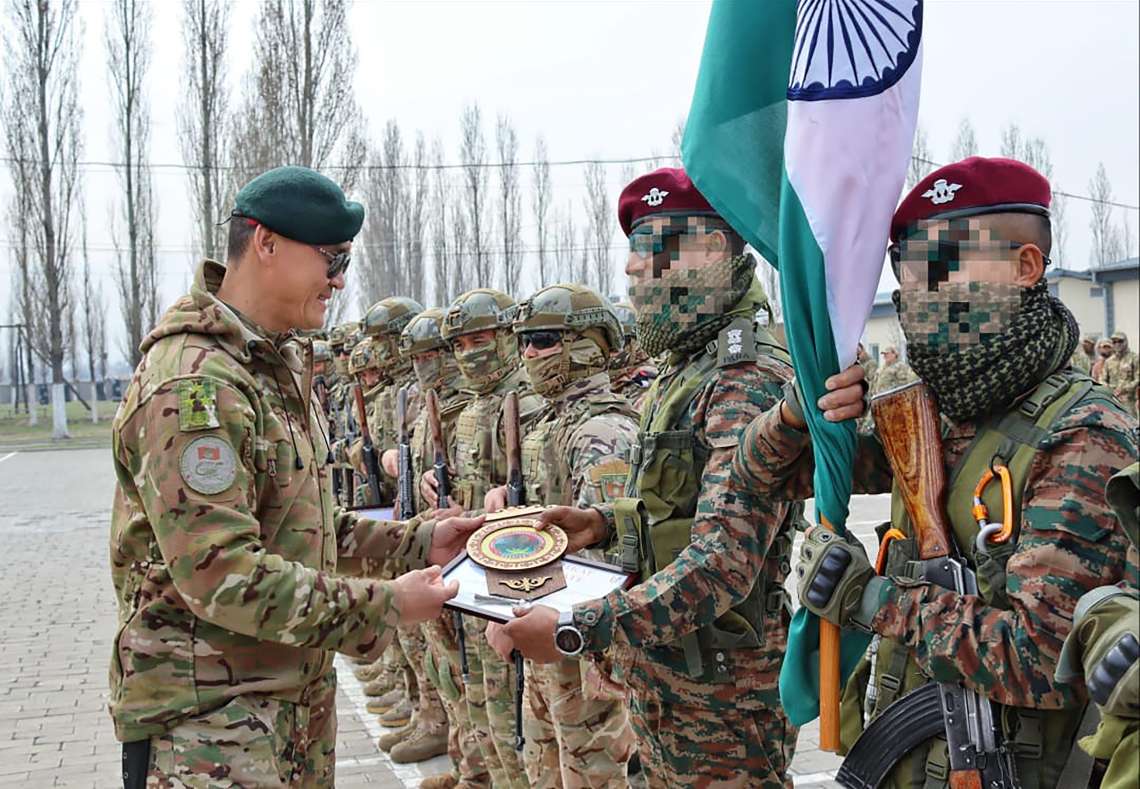
Despite lacking direct land access to the region, India has steadily carved out a role in Central Asian security discussions. Regular meetings of national security advisers and defence officials have helped maintain momentum, while joint military exercises have enhanced interoperability and confidence. India’s ongoing exercises with Kazakhstan, Kyrgyzstan and Uzbekistan reflect a practical commitment to defence cooperation rather than mere diplomatic signalling.
Recent developments within Central Asia itself have also created opportunities for deeper collaboration. The first-ever meeting of defence ministers from the five republics and the launch of their joint military exercise, Birlik 2025, point to a growing regional appetite for collective security frameworks. India’s engagement complements these efforts by offering an additional balancing presence without challenging the region’s desire for strategic independence.

Connectivity and infrastructure have further strengthened the security dimension of India–Central Asia ties. The landlocked nature of the region makes transport corridors crucial not only for trade but also for strategic resilience. India’s participation in initiatives such as the Ashgabat Agreement and the International North-South Transport Corridor reflects its interest in creating reliable overland routes linking Central Asia with South Asia, the Middle East and Europe. While primarily economic, these projects carry clear security implications by reducing isolation, curbing illicit networks and reinforcing legitimate state control over trade routes.
Afghanistan remains a central concern tying these strands together. In October 2025, national security advisers from India and Central Asian countries met to discuss coordinated approaches to stabilising Afghanistan through engagement with the Taliban authorities. The talks focused on countering terrorism, extremism and narcotics trafficking, while also exploring ways to promote connectivity and economic activity to prevent security vacuums. Infrastructure links such as Chabahar Port and the INSTC were highlighted as tools to anchor Afghanistan within a broader regional framework.
For India, deeper defence cooperation with Central Asia serves multiple strategic objectives. It strengthens regional counter-terrorism efforts, protects connectivity initiatives and supports a multipolar security architecture that discourages domination by any single power. For Central Asian states, closer ties with India offer diversification, capacity-building and reassurance in a volatile neighbourhood.
As institutional linkages expand through regular dialogues, joint exercises and shared policy frameworks, India and Central Asia appear set to move from episodic engagement to a more durable security partnership. In a region shaped by uncertainty and competition, their growing alignment signals a collective bet on stability, sovereignty and balanced cooperation.