Wong visit aims to push India–Australia ties into next phase amid wider regional shifts…reports Asian Lite News
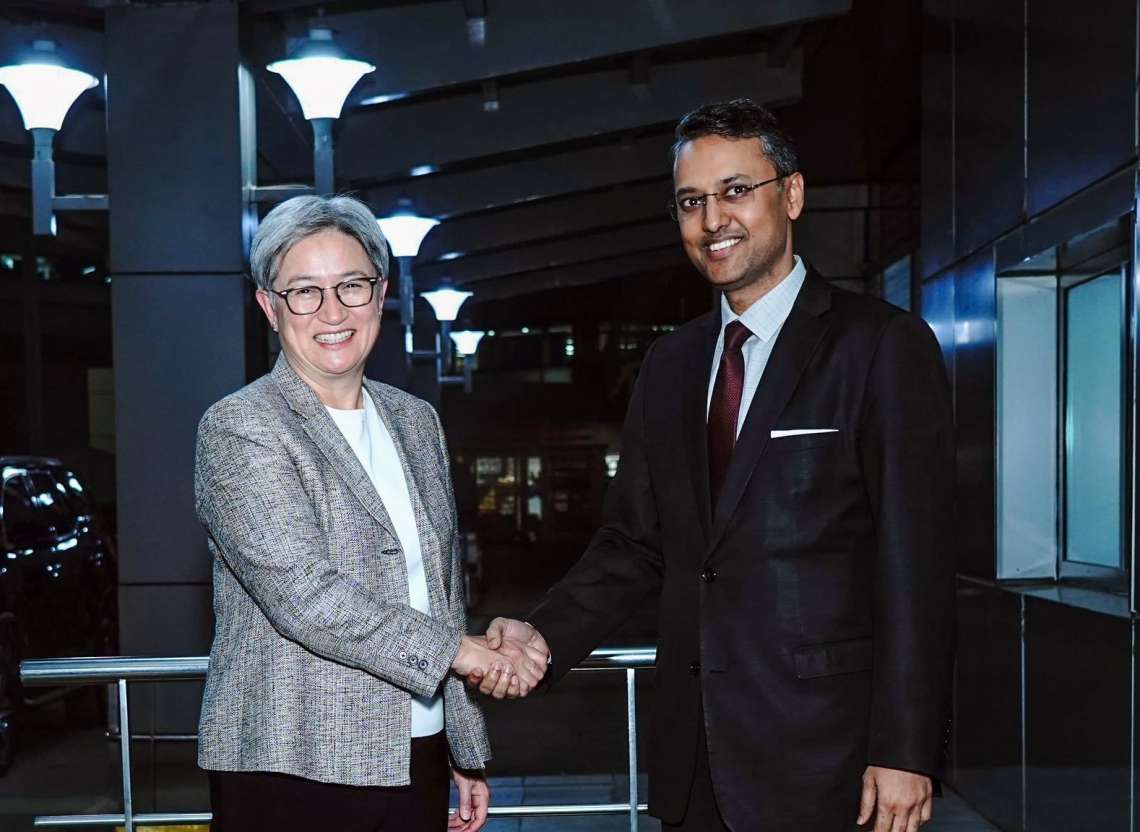
Australian Foreign Minister Senator Penny Wong arrived in New Delhi on Wednesday to co-chair the 16th Foreign Ministers’ Framework Dialogue with External Affairs Minister S Jaishankar, marking the 26th meeting between the two leaders. Her visit, welcomed publicly by the Ministry of External Affairs (MEA), is positioned as an opportunity to strengthen the India–Australia Comprehensive Strategic Partnership at a time of heightened regional competition and expanding bilateral engagement.
The MEA, in a post on X, said, “Warm welcome to FM Senator Wong of Australia as she arrives in New Delhi to co-chair the 16th Foreign Ministers’ Framework Dialogue with EAM S Jaishankar. The visit offers an opportunity to build on the various facets of India-Australia Comprehensive Strategic Partnership.” The message underscored the government’s framing of the dialogue as part of a wider push to deepen cooperation across multiple sectors.
Discussions during the visit are expected to span cyber and strategic technology, trade, maritime security, defence cooperation, sport, and broader people-to-people ties. Officials described the agenda as wide-ranging, reflecting the expansion of the bilateral relationship from its earlier security-heavy focus to a more comprehensive platform that includes economic and societal engagement.
In her pre-departure statement, Wong said, “Australia and India have never been closer and our partnership never more consequential – it is crucial for us and crucial for the region in a sharper and more competitive world.” Her remarks signal Canberra’s view that the partnership has strategic significance beyond the bilateral context, particularly in light of evolving geopolitical dynamics in the Indo-Pacific.
She added that the visit builds on the “high momentum” generated by a series of recent engagements between the two countries and “reflects the ongoing work of the Albanese Government to deepen our relationships and strengthen our resilience.” The emphasis on resilience has been a notable theme in Australia’s foreign policy under the Albanese administration, particularly as it seeks to recalibrate relationships across the region.
Wong further noted that cooperation under the Comprehensive Strategic Partnership reflects a “deepening alignment and shared vision for a peaceful, stable and prosperous Indo-Pacific region.” The Indo-Pacific framework has become central to both countries’ diplomatic strategies, particularly through their roles in the Quad and other aligned multilateral bodies. While neither government has framed the partnership explicitly in terms of counterbalancing China, analysts have described the India–Australia relationship as one of the region’s most rapidly evolving security and economic alignments.
During her visit, Wong said she looks forward to discussions with Jaishankar “to set the course for an even more ambitious, future-focused agenda, as our partnership enters its next phase,” reiterating that the two sides would “look to enhance our cooperation across cyber and strategic technology, trade, maritime security, defence, sport, and people-to-people ties.” The repetition of these priority areas from both sides indicates a deliberate attempt to show alignment and continuity, suggesting the agenda has been carefully coordinated in advance.
She also noted, “Together, Australia and India are working bilaterally, through the Quad, and through multilateral institutions to advance our collective security and prosperity.” While the Quad has grown in visibility in recent years, the two countries have also expanded their bilateral engagement independently of that grouping, including new dialogues on technology, climate, and supply-chain resilience.
The timing of Wong’s visit is notable, coming soon after Defence Minister Rajnath Singh travelled to Australia in October. During that visit, Singh held delegation-level talks with Wong and met Prime Minister Anthony Albanese. Australia characterised the discussions as substantive, while Singh described the meetings as providing a fillip to bilateral defence ties. The two sides reviewed their defence cooperation roadmap, joint exercises, and broader maritime collaboration, highlighting a trend of increasingly frequent high-level interactions.
While both governments publicly underline areas of agreement, the broader relationship includes complex elements, including trade negotiations that have moved slowly. The countries signed an interim trade deal in 2022, but talks on a more ambitious long-term agreement remain ongoing. Analysts suggest that political will remains strong on both sides, but differing expectations on market access and regulatory frameworks continue to present hurdles.
People-to-people ties are another cornerstone of the relationship, with India now one of the largest sources of international students in Australia. Both sides regularly highlight the value of educational cooperation, though it is occasionally accompanied by concerns about visa processing backlogs, recognition of qualifications, and student safety. Wong’s reference to strengthening people-to-people links suggests these issues will form part of the broader conversation.