Leaders adopt the Kazan Declaration and a five year action plan covering energy, digitalisation, artificial intelligence and regional connectivity….reports Asian Lite News Desk
Russia and the Association of Southeast Asian Nations (ASEAN) have unveiled an ambitious roadmap for cooperation through 2030, signalling a renewed push to deepen engagement in areas ranging from energy and food security to artificial intelligence, digitalisation and regional connectivity.
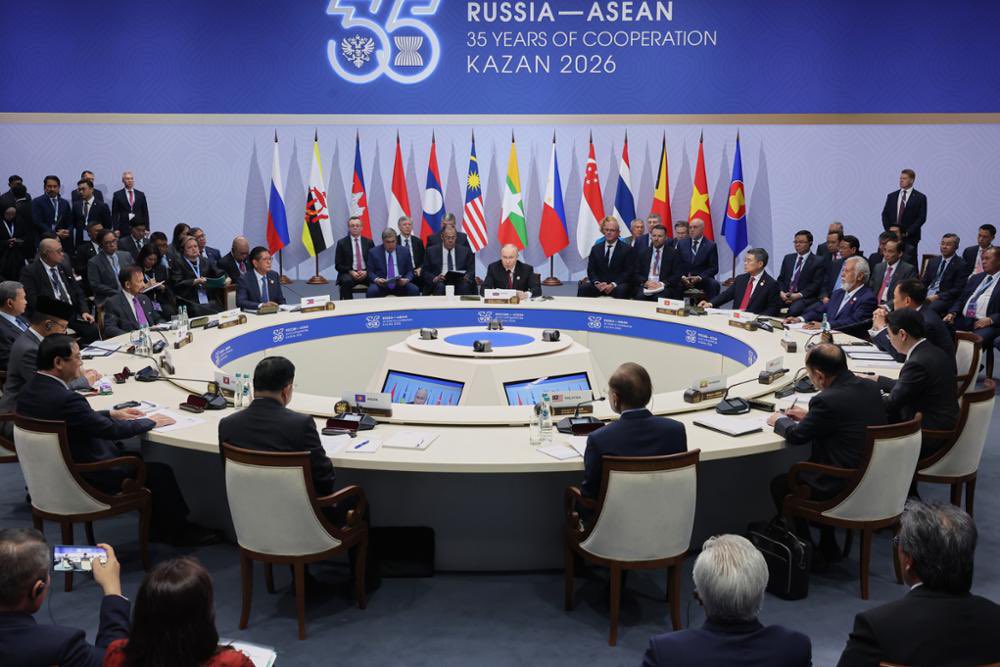
The roadmap was formalised on Thursday at the ASEAN-Russia Commemorative Summit in Kazan, where leaders adopted a series of agreements designed to strengthen ties as both sides mark 35 years of dialogue relations.
The summit approved four key documents, including the Kazan Declaration 2026 titled “ASEAN-Russian Federation: Unity in Diversity – 35 Years Together”, a new Plan of Action for 2026-2030, and joint statements on energy and cultural cooperation.
ASEAN described the agreements as a forward looking framework that would guide cooperation between the regional bloc and Russia in the years ahead.

“The adoption of these documents underscores ASEAN and Russia’s shared commitment to advancing the ASEAN-Russia Strategic Partnership and provides a forward-looking framework to guide their cooperation in the coming years,” ASEAN said in a statement posted on social media platform X.
The summit was co-chaired by Philippine President Ferdinand Marcos Jr., who serves as ASEAN Chair for 2026, and Russian President Vladimir Putin. The meeting brought together ASEAN leaders and representatives, along with ASEAN Secretary-General Kao Kim Hourn and senior officials from both sides.
A major focus of the discussions was expanding practical cooperation across sectors that both parties view as critical to future economic growth and resilience.

According to the declaration, Russia and ASEAN agreed to deepen collaboration in energy security, food security, agriculture, transport and logistics, tourism, innovation, science and technology, as well as emerging fields such as artificial intelligence and digital transformation.
The emphasis on these sectors reflects growing efforts by both sides to diversify partnerships and strengthen economic links amid shifting global trade and geopolitical dynamics.
Russian presidential aide Yuri Ushakov said the summit also highlighted a shared commitment to building what participants described as a more balanced international system.
“A commitment to the formation of a just and democratic multipolar world order based on the universally recognised principles of international law and the UN Charter was particularly emphasised,” Ushakov said following the meeting.
The leaders also discussed broader regional integration initiatives during a working lunch hosted by President Putin after the summit.
The discussions focused on integration processes across the Eurasian region and included participation from senior representatives of other regional organisations. Joining the meeting were the Secretary-General of the Shanghai Cooperation Organisation (SCO) and the Chairman of the Board of the Eurasian Economic Commission (EEC), reflecting efforts to explore greater coordination among regional institutions.
The newly adopted Plan of Action for 2026-2030 is expected to serve as the principal mechanism for implementing the strategic partnership over the next five years. It outlines priorities for cooperation and provides a framework for expanding political dialogue, economic engagement and people-to-people exchanges.

Energy cooperation emerged as another key pillar of the partnership, with both sides endorsing a separate joint statement dedicated to the sector. While details of specific projects were not disclosed, the agreement signals interest in strengthening collaboration in energy development, security and sustainability.
The adoption of a separate statement on cultural cooperation also highlighted efforts to broaden ties beyond economics and geopolitics. Officials said cultural exchanges, educational links and greater interaction between societies would remain important components of the partnership.
ASEAN, founded in 1967, has evolved into one of the world’s most influential regional organisations. The bloc currently comprises Brunei, Cambodia, Indonesia, Laos, Malaysia, Myanmar, the Philippines, Singapore, Thailand, Vietnam and Timor-Leste.
For Russia, deeper engagement with ASEAN represents an opportunity to expand its presence in one of the world’s fastest growing economic regions. For ASEAN, the partnership offers another avenue for diversification and cooperation with major global powers while maintaining its long standing policy of strategic balance.
The agreements adopted in Kazan are expected to provide fresh momentum to ASEAN-Russia relations as both sides seek to broaden cooperation across traditional and emerging sectors while navigating an increasingly complex international landscape.