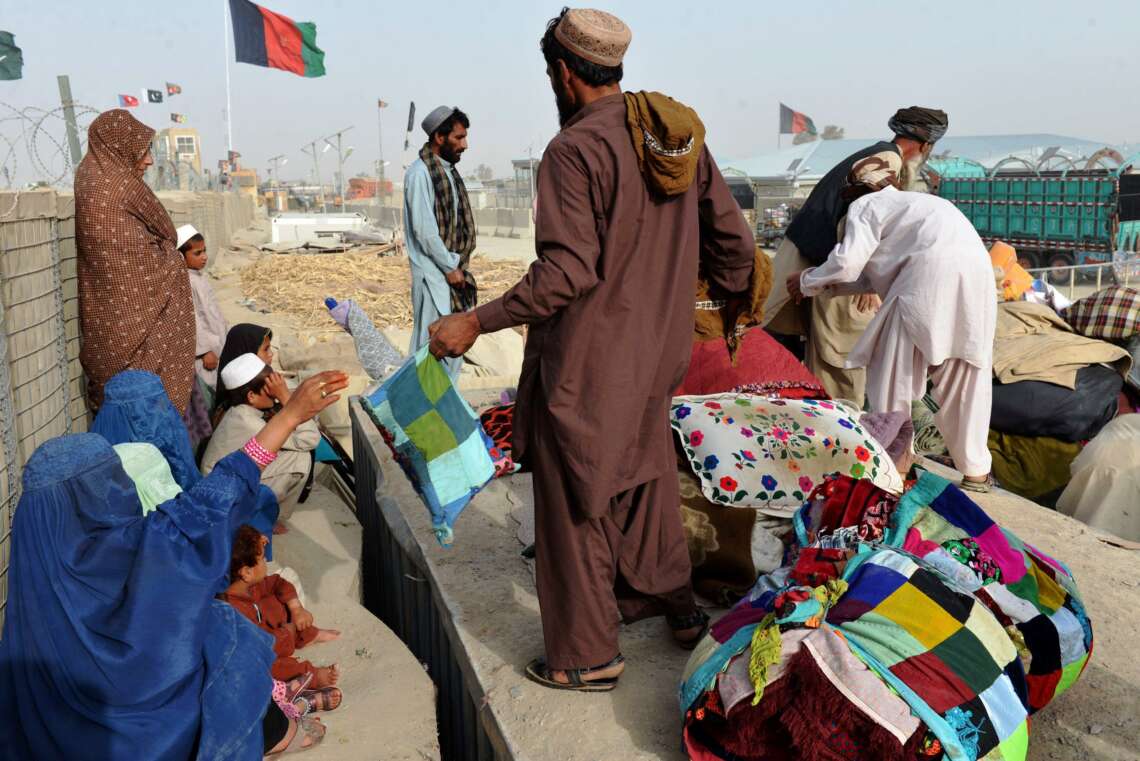
Thousands of civilians have reportedly been displaced as border violence damages schools, health facilities and critical infrastructure across eastern Afghanistan…reports Asian Lite News
Humanitarian conditions in eastern Afghanistan have worsened sharply following renewed border clashes with Pakistan, according to the United Nations Office for the Coordination of Humanitarian Affairs (OCHA).
The agency said ongoing cross border violence has intensified the humanitarian crisis in several Afghan provinces, causing civilian casualties, displacement and extensive damage to public infrastructure.
According to local media reports, at least seven people were killed and 79 others injured in airstrikes and shelling that struck Asadabad and parts of Kunar province on April 27.
OCHA said the attacks damaged key civilian facilities, including a fuel station, sections of a university dormitory, a religious affairs office and a drug rehabilitation centre. The destruction has further weakened already fragile public services in the region, Afghanistan based news agency Khaama Press reported.
The UN agency also warned that attacks on civilian infrastructure, particularly schools and healthcare facilities, have increased in recent weeks.
Since February, more than 10,000 people have reportedly been displaced from eastern and southeastern Afghanistan due to continuing clashes along the border. Large scale displacement has been recorded in provinces including Kunar, Nangarhar and Khost, with many families struggling to access shelter, food and medical assistance.
OCHA said at least 19 health facilities have either closed, suspended operations or are functioning at reduced capacity, affecting nearly 78,000 people. Damage to water supply systems in several villages has also raised fears of potential disease outbreaks.
The conflict has additionally disrupted education in the region, with more than 13,000 students in Kunar and Nangarhar affected after dozens of schools were reportedly damaged.
The UN agency warned that continued insecurity, destruction of infrastructure and limited humanitarian access were worsening the crisis and slowing recovery efforts for affected communities.
Humanitarian organisations have called for urgent emergency assistance as well as long term reconstruction efforts to restore damaged schools, health centres and water systems.
Tensions between Afghanistan and Pakistan have escalated in recent months, marked by repeated exchanges of fire and growing concerns over civilian casualties. Both countries have accused each other of fuelling instability along the border.
On Tuesday, Afghanistan’s Foreign Ministry summoned the Pakistani embassy’s Charge d’Affaires in Kabul to protest against recent attacks allegedly carried out by Pakistani forces on civilian targets in multiple Afghan provinces.
Afghan authorities also handed over a formal protest note accusing Pakistan of targeting public facilities near the Durand Line, including a university in Kunar province.
The ministry condemned what it described as violations of Afghan airspace and attacks on civilians, calling the actions a breach of Afghanistan’s territorial integrity and international norms.
In a statement, the Afghan government rejected allegations that the recent escalation had been initiated by Afghan forces and insisted that the root causes of the conflict should be investigated thoroughly.
Kabul also warned Pakistan against continuing such actions, stating that Afghanistan reserved the right to defend its territory and citizens against further attacks.