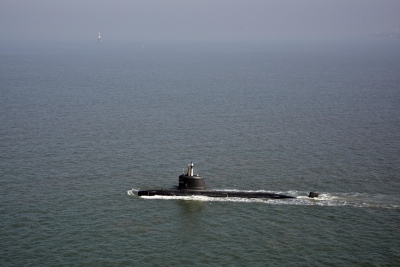
China surpasses US in nuclear submarine launches from 2021–25, signalling industrial momentum and intensifying strategic competition beneath Indo-Pacific waters….reports Asian Lite News
China has accelerated production of nuclear-powered submarines over the past five years, overtaking the United States in both the number of boats launched and total tonnage, according to a new assessment by the International Institute for Strategic Studies.
The report, titled Boomtime at Bohai, finds that between 2021 and 2025 China launched 10 nuclear-powered submarines compared with seven by the US. In terms of displacement, Chinese launches totalled around 79,000 tonnes, exceeding the US figure of 55,500 tonnes over the same period. The figures mark a sharp reversal from 2016 to 2020, when China added only three boats against seven American vessels.
Production pace reverses previous gap
Although Beijing does not publish official fleet numbers, the London-based think tank says the ramp-up reflects a sustained expansion of shipbuilding capacity, particularly at facilities in Bohai. The build-up includes both nuclear-powered ballistic-missile submarines (SSBNs) and nuclear-powered attack submarines (SSNs), strengthening what analysts describe as the maritime leg of China’s evolving nuclear triad.
Most notable has been the launch of the seventh and eighth Type-094 Jin-class SSBNs, designed to carry submarine-launched ballistic missiles. These vessels form the backbone of China’s sea-based nuclear deterrent. The report suggests that if satellite imagery assessments are accurate, China may have achieved a “1+2” production rhythm in 2024 and 2025 — delivering one ballistic-missile submarine and two attack submarines annually.
That output mirrors ambitions set out by the US Navy in its 2023 shipbuilding plan, which envisioned delivering one Columbia-class SSBN and two Virginia-class submarines per year by 2028. However, analysts caution against simple numerical comparisons. American submarines are typically larger, more technologically advanced and more complex to build than their Chinese counterparts, factors that can slow production timelines.
Quality questions remain
The report also underscores qualitative gaps. Earlier assessments by the US Office of Naval Intelligence indicated that China’s Type-093 and Type-094 submarines were noisier than late Cold War Soviet designs, making them easier to detect and track. While incremental improvements are likely, the retention of basic hull forms limits how much acoustic performance can be enhanced.
As a result, China’s ballistic-missile submarines are believed to operate primarily in the comparatively sheltered waters of the South China Sea, where they can be protected by other People’s Liberation Army Navy assets. Relative noise levels, rather than total inventory, may therefore constrain the tempo of deterrent patrols in the short term.
Missile upgrades extend deterrent reach
Missile modernisation may partly offset those operational limits. The replacement of the older JL-2 submarine-launched ballistic missile with the longer-range JL-3 significantly increases strike reach. With the JL-3, Type-094 submarines could theoretically target parts of the continental United States from patrol areas closer to Chinese shores, reducing the need for riskier deployments into the wider Pacific.
Looking ahead, attention is turning to the next-generation Type-096 SSBN, expected to begin production later this decade. If realised, it could incorporate quieter propulsion systems and enhanced missile capacity, narrowing the technological gap with Western designs. Entry into service is anticipated in the late 2020s or early 2030s.
Strategic ripple effects in Indo-Pacific
The broader context is intensifying naval competition in the Western Pacific. While the US Navy has long prioritised global power projection — equipping submarines with vertical launch systems capable of firing land-attack cruise missiles — China’s undersea force appears more focused on peer-level maritime combat and anti-ship capabilities in its near seas. New high-speed anti-ship missiles displayed during China’s 2025 Victory Day parade are expected to equip updated attack submarines.
For Western navies, the concern is not solely about technological parity but about scale. Even if individual Chinese boats remain less sophisticated, a larger fleet complicates surveillance, tracking and deterrence planning. At the same time, the IISS notes that China’s production inputs — including funding, workforce expansion and long-term programme objectives — remain opaque.
The expansion of submarine output does not automatically translate into operational dominance. Training cycles, maintenance demands, crew proficiency and integration with broader naval and aerospace assets all shape real-world effectiveness. Nonetheless, the shift in launch numbers signals a narrowing gap in industrial capacity that could reshape the maritime balance in the Indo-Pacific.