The expansion of BRICS could strengthen India’s diplomatic leverage and support its push for a more representative global order, according to an ISDP report…reports Asian Lite News Desk
The expansion of BRICS could give India greater diplomatic leverage and strengthen its engagement with countries across the Global South, while supporting its longstanding calls for reforms to global institutions, according to a report by the Sweden-based Institute for Security and Development Policy (ISDP).
The report said the enlarged grouping could give greater weight to India’s preferred principles of strategic autonomy, multipolarity, sovereign equality, reformed multilateralism and stronger representation for the developing world.
India, however, does not seek to replace the existing international order through BRICS, but to secure greater bargaining power within it, the report stated.
The enlargement of BRICS strengthens India’s push for reforms in the UN Security Council, IMF, World Bank and other global institutions that, according to the report, do not sufficiently represent current economic and demographic realities.
It also provides India with a platform to pursue priorities affecting the Global South, including development financing, climate justice, technology access, food and energy security, resilient supply chains and digital public infrastructure.
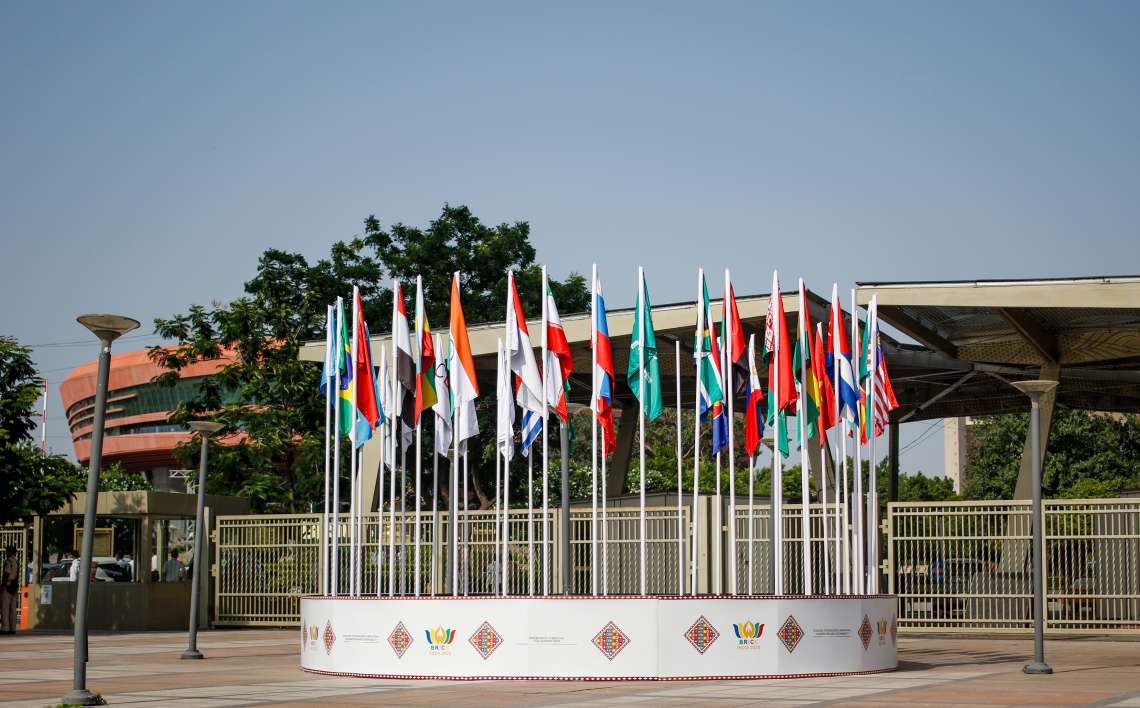
“New Delhi will host the BRICS Summit this week at a consequential moment for both the grouping and Indian foreign policy. BRICS is no longer the compact five-member forum that India helped build around the politics of emerging economies. Enlargement has given it a much broader geographic reach, greater demographic and economic weight, and an increasingly powerful claim to represent dissatisfaction with the existing international order,” the report mentioned.
The ISDP report said BRICS Plus should not be viewed only through the prism of China’s influence. Instead, the expanded grouping gives India an opportunity to build coalitions with its newer partners.
According to the report, BRICS Plus provides India with what the original grouping could not: a broader Global South constituency. However, the expansion also creates a more complex diplomatic environment in which New Delhi must manage competing interests and coalitions.
“India must manage China without making BRICS China-centric; preserve Russia without inheriting Moscow’s confrontation with the West; accommodate Iran’s interests without turning BRICS into an anti-Western platform; deepen relations with the UAE and other pragmatic middle powers; and engage newer members without allowing continuous expansion to hollow out the grouping,” the ISDP report mentioned.
The report said the New Delhi summit would therefore represent an important test for India’s foreign policy as it seeks to use the expanded grouping to support its broader multipolar approach.
“The New Delhi summit is therefore important less as a destination than as the beginning of a larger test for Indian foreign policy: how to make BRICS plus serve India’s multipolar strategy without allowing BRICS plus to define that strategy,” it noted.
The report also highlighted what it described as the diplomatic advantages of the expanded grouping. It said the original BRICS had provided India with an unusual diplomatic space, allowing New Delhi to engage simultaneously with China and Russia while strengthening its strategic ties with the United States, Europe and Japan.
The expansion, it said, considerably widens that diplomatic space by connecting India more systematically with countries across the Middle East, Africa, Asia and the wider Global South.
“An enlarged BRICS connects India more systematically with important states across the Middle East, Africa, Asia, and the wider Global South. Importantly, many of these do not see themselves as belonging permanently to either a Western or Chinese camp. That matters because India’s own foreign policy increasingly rests on precisely this rejection of binary alignment,” the report added.