Imran Khan’s sisters hold prayer sit-in outside Adiala Jail after being barred from meeting him, as PTI supporters decry selective restrictions and rising concerns over rights…reports Asian Lite News
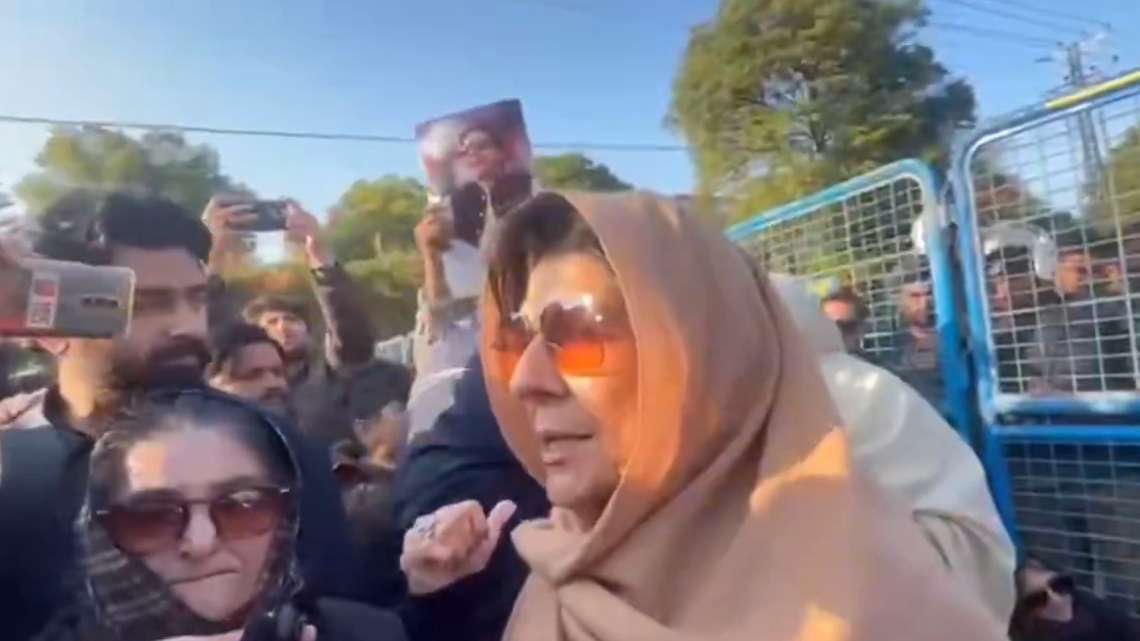
Family members of former Pakistan prime minister Imran Khan staged a peaceful prayer sit-in outside Adiala Jail after they were once again barred from meeting him, intensifying concerns among his supporters about access, legal rights and the broader political climate surrounding his prolonged incarceration.
Khan’s sisters, accompanied by senior leaders and workers of the Pakistan Tehreek-e-Insaf (PTI), arrived at the jail complex expecting to meet the former premier but were stopped by authorities, despite what party representatives said were standing court orders permitting family visits. The denial prompted the group to remain outside the prison premises, where they held collective prayers for Khan’s health, safety and release, while chanting slogans demanding that his rights be upheld.
PTI leaders present at the site said the gathering was not intended as a protest in the conventional sense but as a symbolic and peaceful assertion of a family’s right to see an incarcerated relative. They stressed that the sit-in centred on prayer and recitation of Quranic verses, underscoring its non-confrontational nature. Supporters who joined the gathering described it as an expression of solidarity with Khan’s family rather than a political demonstration.
According to those present, the family and party members have faced repeated obstacles in accessing Khan over the past two years. PTI representatives said they had approached courts multiple times to secure permission for meetings, only for those orders to be rendered ineffective at the jail gate. Each denial, they added, forced them back into a legal cycle of filing fresh petitions and contempt pleas, deepening frustration and eroding confidence in due process.
Party members accompanying the sisters described the situation as particularly distressing, noting that even immediate family members had been prevented from meeting Khan for extended periods. They argued that the restrictions went beyond routine prison protocol and amounted to selective enforcement, raising questions about equal treatment under the law.
During the sit-in, tensions briefly escalated when water was reportedly sprayed in the vicinity where women supporters were seated and reciting prayers. PTI leaders described the incident as unnecessary and insensitive, especially given the peaceful nature of the gathering. Despite the disruption, the group remained at the site for some time, reiterating that they would continue to seek meetings through legal and peaceful means.
Supporters also drew comparisons with past high-profile incarcerations in Pakistan, arguing that previous political leaders had not faced similar restrictions on visitation. PTI figures claimed that during the imprisonment of former prime minister Nawaz Sharif, visitors were allowed regular access without the need for repeated court intervention. They said the contrast had become a rallying point for Khan’s supporters, who view the current restrictions as politically motivated.
The sit-in comes amid a broader and increasingly tense political environment in Pakistan, where critics say dissenting voices have faced mounting pressure since the unrest of May 2023. That period followed Khan’s brief arrest in a corruption case, which triggered violent protests in several cities, including attacks on military installations and government property. The state’s response to those events has since reshaped Pakistan’s political and media landscape.
Earlier this month, an anti-terrorism court in Islamabad sentenced several journalists and social media commentators to life imprisonment after convicting them of inciting violence linked to the 2023 unrest. The verdict, delivered by Judge Tahir Abbas Sipra, was announced following trials conducted in absentia, as the accused were reported to be living abroad to avoid arrest. Those convicted included former military officers turned YouTubers, senior journalists and political analysts who had been vocal critics of the establishment.
Human rights organisations and press freedom groups have expressed alarm at the sweeping nature of the crackdown. The Committee to Protect Journalists described the investigations and prosecutions as retaliatory measures aimed at silencing critical reporting and commentary. Media advocates warned that the use of anti-terrorism laws against journalists risked creating a chilling effect on free expression and undermining democratic accountability.
Within this broader context, restrictions on access to Khan have become a focal point for PTI supporters, who argue that the treatment of the former prime minister symbolises a wider erosion of civil liberties. Party leaders have repeatedly raised concerns about Khan’s health, particularly during periods when family members were unable to see him or verify his condition.
Since November 2025, Khan’s relatives have publicly maintained that they were routinely denied permission to meet him, fuelling speculation and anxiety among supporters. When his sister Uzma Khanum was eventually allowed to visit him in December, she later indicated that his health appeared stable at the time. However, PTI leaders say sporadic access is insufficient and does little to address ongoing concerns about transparency and legal consistency.
Government officials have largely defended the prison administration’s actions, citing security protocols and legal procedures. However, they have not publicly responded in detail to claims that court orders permitting meetings were ignored. Legal experts note that repeated disputes over visitation rights point to deeper institutional frictions and highlight the politicisation of legal processes in high-profile cases.
As Pakistan continues to grapple with political polarisation, economic challenges and questions over the rule of law, the image of Khan’s sisters praying outside a high-security prison has resonated widely. For supporters, it represents resilience and moral protest; for critics, it underscores the unresolved tensions between state authority and individual rights.
With no immediate resolution in sight, PTI leaders have said they will persist with legal avenues and peaceful actions to secure regular access to Khan. The episode adds another layer to Pakistan’s protracted political crisis, where courtrooms, prisons and public spaces have become arenas for competing narratives about justice, power and democracy.