India has expressed disappointment that the United Nations has failed to give adequate attention to repression in Pakistan, particularly in Pakistan-occupied Jammu and Kashmir (PoJK)…reports Asian Lite News Desk
India has expressed disappointment that the United Nations has failed to give adequate attention to repression in Pakistan, particularly in Pakistan-occupied Jammu and Kashmir (PoJK), while condemning similar developments in other countries.
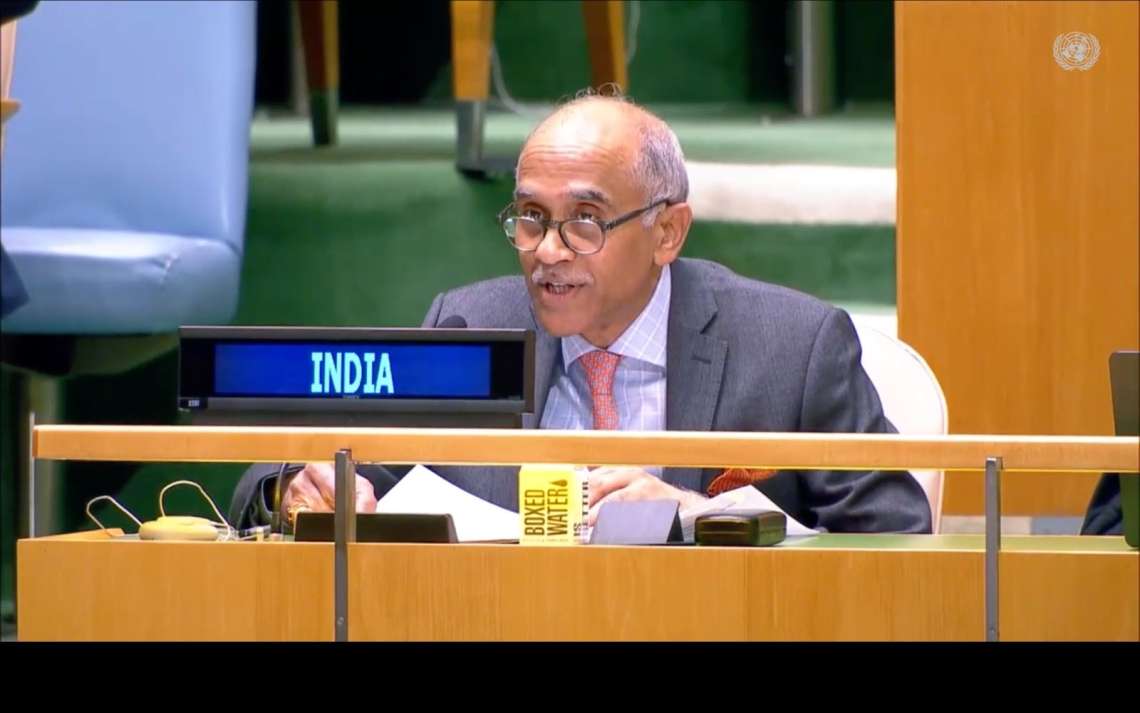
Speaking at the UN Security Council Open Debate on “Strengthening the Mechanisms for Peaceful Settlement of Disputes” on Thursday, India’s Permanent Representative to the UN, P. Harish, accused Pakistan of suppressing human rights and fundamental freedoms in the territory under its control and across the country.
Responding after Pakistan raised the Kashmir issue during the debate, Harish said, “While similar developments in other countries are excoriated by the United Nations, such repression and developments in Pakistan do not receive the attention they deserve.”
He added, “The ongoing developments in Pakistan occupied Jammu and Kashmir fully expose the true nature of the Pakistani state.”
Harish said the international community had witnessed the continued suppression of basic rights in the region.
“The world is witness to the continued suppression of basic rights, freedom of expression and association and stifling of fundamental freedoms of Kashmiris in Pakistan Occupied Kashmir,” he said.
“These are not isolated instances, but part of a larger design by the Pakistani establishment in Pakistan occupied Kashmir for close to eight decades,” he added.
Referring to recent unrest, Harish said Kashmiris in the Pakistan-occupied region protesting for their rights had been “ruthlessly put down” by Islamabad’s authorities.
He said at least 34 Kashmiris had been killed by Pakistani security forces since June. According to Harish, the latest incident took place in Tararkhal on July 14, when six Kashmiris were killed by security forces.
Expanding his criticism beyond Kashmir, Harish cited what he described as broader democratic backsliding in Pakistan.
Among the examples he listed were the imprisonment of political leaders, including a former prime minister, and the effective outlawing of the country’s main opposition party.
Former Prime Minister Imran Khan remains in prison following convictions handed down by Pakistani courts. Khan and his supporters have maintained that the cases against him were politically motivated and intended to prevent his participation in politics after his fallout with the country’s military establishment.
Harish also referred to Khan’s Pakistan Tehreek-e-Insaf (PTI), saying the party had effectively been prevented from contesting elections and faced the threat of a formal ban.
He further alleged that Pakistan’s military had strengthened its hold over the country’s political system through the 27th Constitutional Amendment.
According to Harish, the amendment expands the powers of the country’s top Army commander and grants lifelong immunity from criminal prosecution to senior military leaders.
Such “actions have decimated any semblance of democracy,” he said.
Harish urged Pakistan to focus on addressing its domestic challenges instead of raising Kashmir at international forums.
“Pakistan would do well to look inward and address the real issues in the country rather than resorting to fabricated narrative construction with religious imagery aimed at scoring domestic brownie points and misleading the wider UN membership,” he said.
Reiterating India’s long-standing position on Jammu and Kashmir, Harish said, “The Union Territory of Jammu and Kashmir has always been, is, and will remain an integral and inalienable part of India” regardless of Pakistan’s position.
He added, “The only outstanding issue with regard to Jammu and Kashmir is the naked aggression and illegal occupation of India’s sovereign territory by Pakistan.”