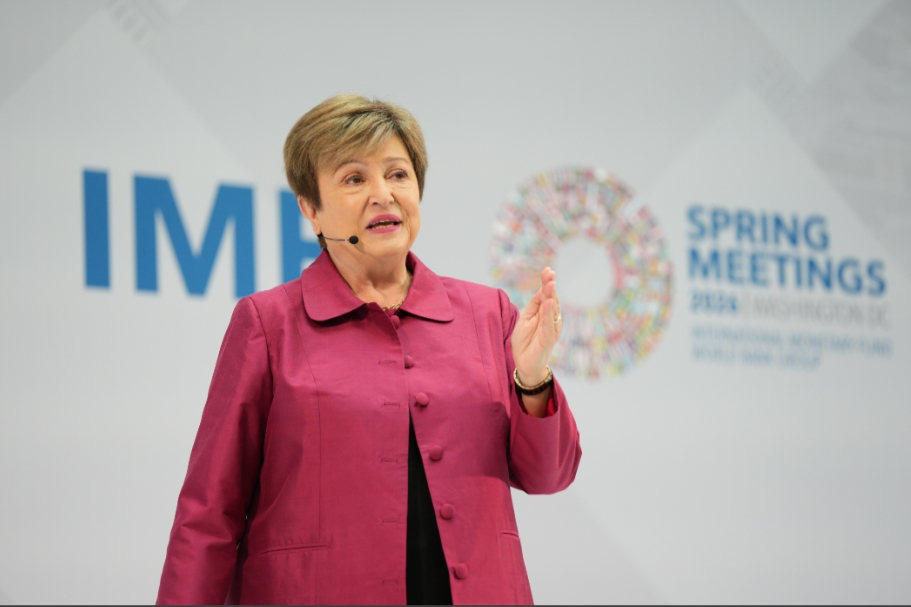
IMF Managing Director Kristalina Georgieva said the fallout was already being felt across continents…reports Asian Lite News
The head of the International Monetary Fund has sounded the alarm over what she described as a severe global economic shock stemming from the Iran war, warning that disruptions to energy supplies and rising prices could weigh on the world economy well into next year.
Speaking on CBS News’ Face the Nation, IMF Managing Director Kristalina Georgieva said the fallout was already being felt across continents, with the scale of damage hinging on how long the conflict continues and how fast production can recover.
The numbers she cited were stark. Roughly 13 percent of the world’s oil and a fifth of its gas have been cut off from global markets for more than five weeks, triggering a cascade of shortages across fuel, fertilisers, transport and international remittances. “People are hurting,” she said, describing supply shortfalls in multiple regions. “They’re hurting because of sheer lack of quantities.”

While the shock is global in scope, its impact is far from uniform. Countries heavily reliant on energy imports and those closest to the conflict zone are absorbing the worst of it, with poorer nations — whose limited financial reserves leave them little room to manoeuvre — facing the most acute strain. Asia is emerging as a particular pressure point, with energy rationing and supply disruptions hampering economic activity across the region. Rising fertiliser costs, Georgieva warned, could soon translate into higher food prices worldwide.
In the United States, the damage has so far been more contained, though Georgieva cautioned that persistently higher energy prices could act as a drag on efforts to bring inflation under control — functioning, in her words, like “a tax on income” that falls hardest on households with the least financial cushion.
Perhaps most sobering was her warning that a ceasefire alone would not quickly reverse the damage already done. “The impact is baked in,” she said, pointing to delayed shipments and infrastructure destruction that will continue to weigh on supply chains. Certain gas facilities critical to global energy production, she added, could take between three and five years to return to full operating capacity.
The war has forced the IMF to reconsider its outlook for global growth in 2026, which had previously been expected to improve. A downgrade now looks likely, though its magnitude will depend on the conflict’s duration and the pace of any recovery in energy output.
Georgieva urged governments to resist the temptation to respond with trade restrictions on fuel and instead called for targeted, temporary support for the most vulnerable communities. She acknowledged that over the longer term, the disruption could accelerate shifts toward greater energy diversification and efficiency — but was careful not to let that prospect soften the immediate message. “In the meanwhile,” she said, “people and businesses will be hurting.”