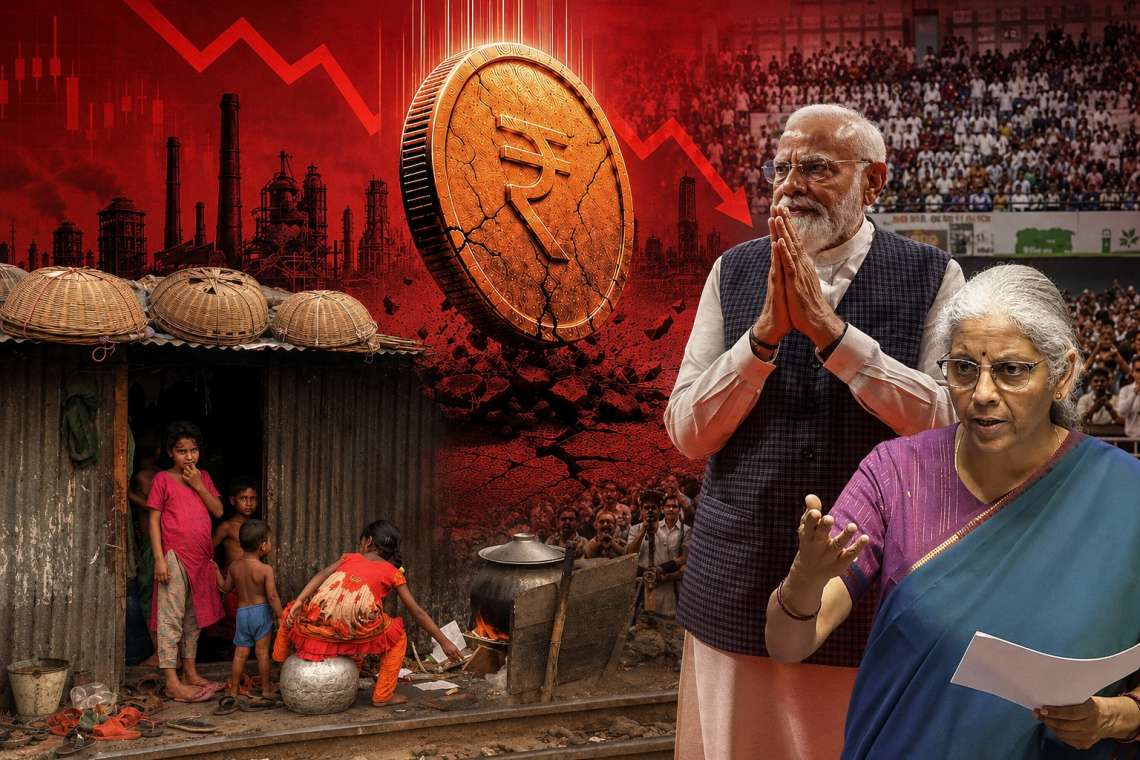
India’s rupee has fallen to historic lows against the US dollar, exposing not just the volatility of currency markets but the structural fault lines in an economy that has long deferred its most difficult questions, writes Manoj Menon
India’s rupee does not merely reflect economic conditions. It reveals them. The slide to historic lows against the US dollar has triggered the predictable round of political blame and emergency commentary. Opposition parties have cited mismanagement. Government supporters have pointed to a world reshaped by wars, trade disputes and shifting financial flows. Both arguments carry truth. Neither captures the whole picture.
The currency’s weakness is not simply a verdict on the present government, nor is it solely a casualty of rising oil prices. It is a signal about the structure of the Indian economy: one that successive governments have acknowledged, partially addressed and ultimately deferred.
India imports more than 88 per cent of its crude oil requirements and remains heavily reliant on foreign supplies of edible oils, fertilisers, industrial components and technology. Energy is not one sector among many. It is embedded in the cost of producing almost everything else: steel, cement, chemicals and food. When oil prices rise, as they have amid renewed instability in West Asia, the effect compounds. Transport becomes more expensive. Manufacturing margins narrow. Inflation climbs. The current account deficit widens. The rupee comes under more pressure.
India imports more than 88 per cent of its crude oil. When prices rise, the cost compounds through transport, manufacturing and food. The rupee absorbs the rest.
The political debate has treated this as a problem of the present. It is not. It is a structural characteristic that has persisted through multiple governments, oil shocks, and currency episodes. The question is not which administration failed to act quickly enough. The question is whether the country’s economic model contains a design flaw that has not yet been corrected.
Part of that design is the nature of India’s external accounts. The country runs a persistent current account deficit: it imports more than it exports, and the gap is financed by service revenue, remittances, and foreign capital inflows. Each of these contributions is real. None of them is reliable when global conditions deteriorate.
Foreign capital is the most volatile element. For years, India attracted substantial inflows because it offered rapid growth, a large domestic market and political stability. That combination was sufficient to offset structural weaknesses. Investors were prepared to finance the current account gap in exchange for access to a booming economy.
That equation is becoming less dependable. Global capital is growing more selective. Investors are increasingly focusing on countries with clear technological leadership: semiconductor manufacturers, advanced manufacturing hubs, and the infrastructure built around artificial intelligence. India remains one of the world’s fastest-growing major economies. But it has not yet convincingly positioned itself at the centre of the industries drawing global capital today. As investment flows become more conditional, the rupee loses a buffer it long relied on.
India pledged gold abroad in 1991 and could barely finance its import bill. Today’s situation is far less severe. The structural logic, however, is recognisably the same.
Manufacturing was supposed to resolve this. India has substantially expanded merchandise exports since liberalisation, and the ambition to build export-oriented industries remains central to economic strategy. Yet the quality of export growth matters as much as its scale. Much of India’s export industry depends on imported components, equipment and energy. Rising imports have frequently accompanied rising exports. The electronics sector makes the point plainly. India has become a significant exporter of consumer electronics, but the components are largely sourced from abroad. A growing export line has not translated into a narrowing trade deficit. Higher revenues and higher costs have tended to arrive together.
The result is a cycle that reinforces itself. A weaker rupee raises the cost of imported inputs. Higher costs compress margins and discourage investment. Slower investment limits productivity and industrial expansion. Weaker growth prospects make foreign investors more cautious, reducing the capital inflows that support the currency. The rupee comes under renewed pressure, and the cycle resumes.
This dynamic carries a historical echo. In 1991, India faced a balance-of-payments crisis so severe that it had to pledge gold abroad and could barely finance its import bill. The shock forced sweeping economic reforms. Today’s situation is far less acute: reserves are substantially larger, the financial system is more resilient, and India’s standing in global markets is incomparably stronger. But the structural logic is recognisably familiar. An economy that imports heavily, exports insufficient value and relies on foreign capital to bridge the gap remains exposed when global conditions shift.
The 1991 crisis produced a transformation under duress. What the present moment offers is rarer: the opportunity to act before constraint becomes acute. Reducing energy import dependence through sustained investment in domestic renewable capacity would directly address one of the rupee’s most persistent vulnerabilities. Deepening value chains in export industries, so that growth in exports translates more reliably into trade improvement, would address another. Neither path is quick. Both require sustained commitment rather than reactive management.
India’s electronics sector exports substantially more than it once did. It also imports almost every component it uses. More exports have not produced a narrowing trade deficit.
The currency cannot be defended indefinitely. Deploying reserves to support the exchange rate buys time. It does not improve the underlying position. A rupee maintained by intervention rather than by export strength remains exposed whenever global sentiment turns.
The deeper reckoning is this. India’s growth story over the past few decades has been real and significant. But growth that depends substantially on imported inputs, foreign capital and favourable external conditions carries embedded fragility. The rupee’s weakness is less about geopolitics than about the limits of a model that has yet to resolve its structural contradictions.
Strong countries tend to have strong currencies for a reason. They produce what the world wants to buy. Until India’s exports and domestic industrial capacity more convincingly close the current account gap, the rupee will remain a weather vane for global sentiment rather than a measure of underlying strength. Whether this moment becomes a catalyst for structural change or simply another episode to be managed and moved on from is the question that actually matters.