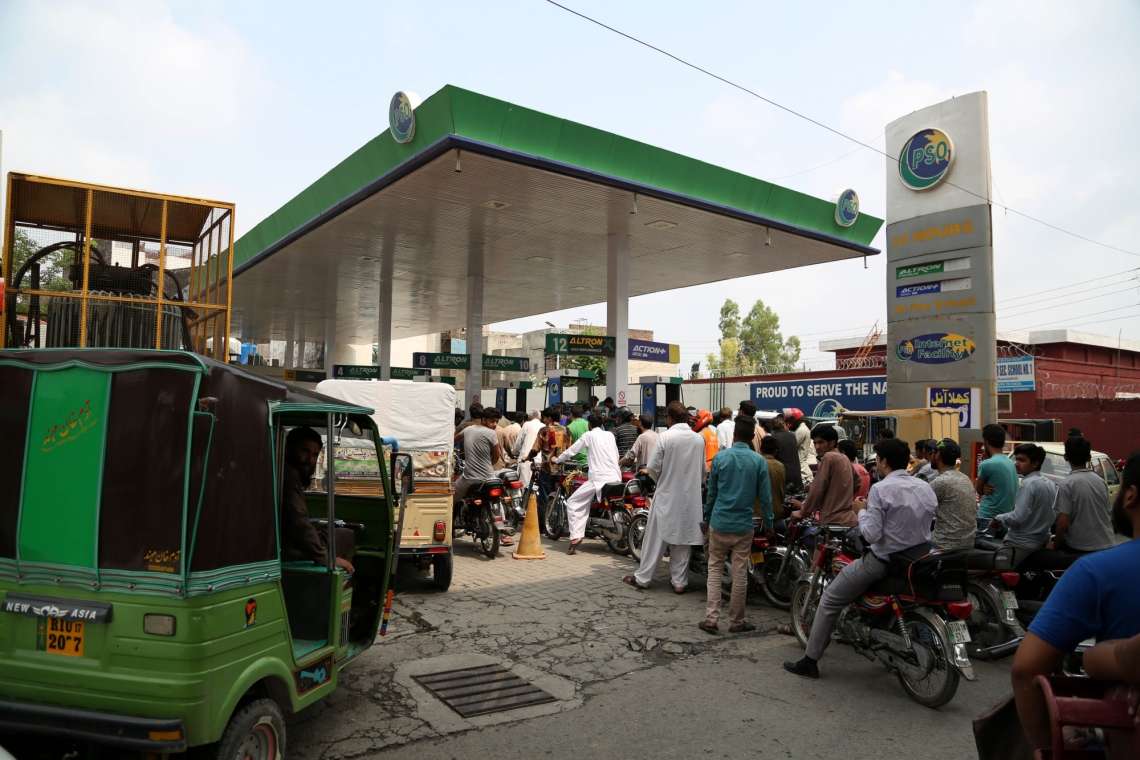
The country has no strategic petroleum reserve to buffer against external shocks. Legally mandated commercial stocks should cover 22 days, but in practice the effective range fluctuates between 10 and 28 days. This means that every dollar added to global crude prices shows up at Pakistani pumps within two weeks, and at grocery shelves a month later, as transport and logistics costs ripple through the economy, writes Dr Sakariya Kareem
The PKR 55 per litre increase announced at the outset of the Iran war landed like a jolt for ordinary Pakistanis, but in truth it was the predictable output of Pakistan’s pricing architecture, a system designed in such a way that global volatility flows almost unfiltered into domestic markets. Three structural features make this unavoidable.
First, Pakistan uses Import Parity Pricing, which pegs domestic fuel prices to international benchmarks every fortnight, leaving almost no cushion between global shocks and the retail pump. Second, the country imports more than 80 percent of its oil consumption and maintains almost no government‑managed strategic reserves. Third, it sources the overwhelming majority of its petroleum from Gulf producers whose shipments pass through a single maritime chokepoint: the Strait of Hormuz. When that corridor becomes unstable, Pakistan feels the tremors almost instantly.
This is precisely what is happening now. With tensions rising in the Gulf and traders pricing in the risk of supply disruption, Brent crude has surged. For Pakistan, which relies on the UAE for 50–56 percent of its petroleum imports and Saudi Arabia for another 30–35 percent, even a hint of instability in the region translates into higher freight insurance premiums, elevated spot prices, and a rapid pass‑through to domestic fuel costs. Analysts warn that a sustained closure of Hormuz could push Brent beyond its 2008 peak of USD 147 per barrel, with some projections reaching USD 200. In such a scenario, Pakistan’s vulnerability becomes acute.

The country has no strategic petroleum reserve to buffer against external shocks. Legally mandated commercial stocks should cover 22 days, but in practice the effective range fluctuates between 10 and 28 days. This means that every dollar added to global crude prices shows up at Pakistani pumps within two weeks, and at grocery shelves a month later, as transport and logistics costs ripple through the economy. The Rs55 hike is therefore not merely a price adjustment; it is the first visible wave of a broader inflationary tide.
The government, aware of the storm gathering offshore, has begun urging citizens to adopt austerity measures. Federal Minister for Information and Broadcasting Attaullah Tarar has appealed for reduced travel, greater carpooling, work‑from‑home arrangements, and expanded e‑learning in educational institutions. The state has attempted to lead by example, grounding 60 percent of government vehicles and mandating a 50 percent reduction in petrol usage across all departments. These steps reflect both urgency and constraint: Pakistan is under an IMF stabilization programme that sharply limits its ability to subsidize fuel or absorb price shocks. The last time the government attempted to shield consumers, through the 2022 fuel subsidy, the budget deficit ballooned to 9 percent of GDP, a mistake the Fund will not allow to be repeated.
The inflationary consequences are already unfolding. Transport fares have risen by up to 20 percent across goods carriers, intercity buses, railways and airlines. Higher freight costs inevitably push up the prices of food and other essentials, squeezing households whose purchasing power has been eroded by years of high inflation. Industries dependent on fuel for production and logistics face yet another blow to their competitiveness, compounding an already difficult business environment marked by high energy tariffs, currency volatility and weak demand. In Pakistan’s inflationary ecosystem, fuel is not just another commodity; it is the central node through which cost pressures propagate.
Yet Pakistan’s vulnerabilities are not confined to oil dependence alone. The fiscal position is deteriorating at a moment when resilience is most needed. The government is facing a revenue shortfall of over Rs657 billion. The IMF’s second review flagged a Rs157 billion gap in petroleum levy collections, while the Federal Board of Revenue has acknowledged a Rs430 billion shortfall in tax collections for July–February 2026. These gaps must be filled through contingency measures , most likely higher taxes on already strained sectors , further tightening the screws on economic activity.
Foreign exchange reserves, too, remain fragile. A three‑month closure of Hormuz would push Pakistan’s monthly oil import bill from USD 1.2–1.5 billion to USD 3.5–4.5 billion, rapidly draining reserves and forcing the government into emergency financing arrangements. Alternative routing through Saudi or UAE pipelines offers little relief, as freight and insurance costs rise by 150 to 200 percent. In such a scenario, Pakistan’s external account would come under severe pressure, potentially triggering currency depreciation that would amplify inflation even further.
There are, however, tools that could soften the blow. Oil hedging used widely by energy‑importing countries remains one of the few immediately actionable options. If Pakistan State Oil hedged just 20 percent of its import volume at a USD 90 per barrel cap, analysts estimate the inflationary pass‑through could be halved, saving roughly USD 800 million annually. But hedging requires institutional capacity, regulatory clarity and political consensus all areas where Pakistan has historically struggled.
Ultimately, the Rs55 increase is not an aberration; it is a symptom of a deeper structural fragility. Pakistan’s exposure to Gulf oil shocks is the product of policy choices made over decades, choices that left the country without strategic reserves, without diversified energy sources, without fiscal buffers, and without the institutional tools to manage volatility. Until these foundations are rebuilt, every tremor in the Gulf will continue to send shockwaves through Pakistan’s economy, tightening the squeeze on households, businesses and the state itself.