March 24, 2026
3 mins read

Bangladesh Fuel Shortage Deepens, Long Lines Hit Stations

The Petrol Pump Owners Association expressed serious concerns on the security and took a sharp dig at the government….reports Asian Lite News

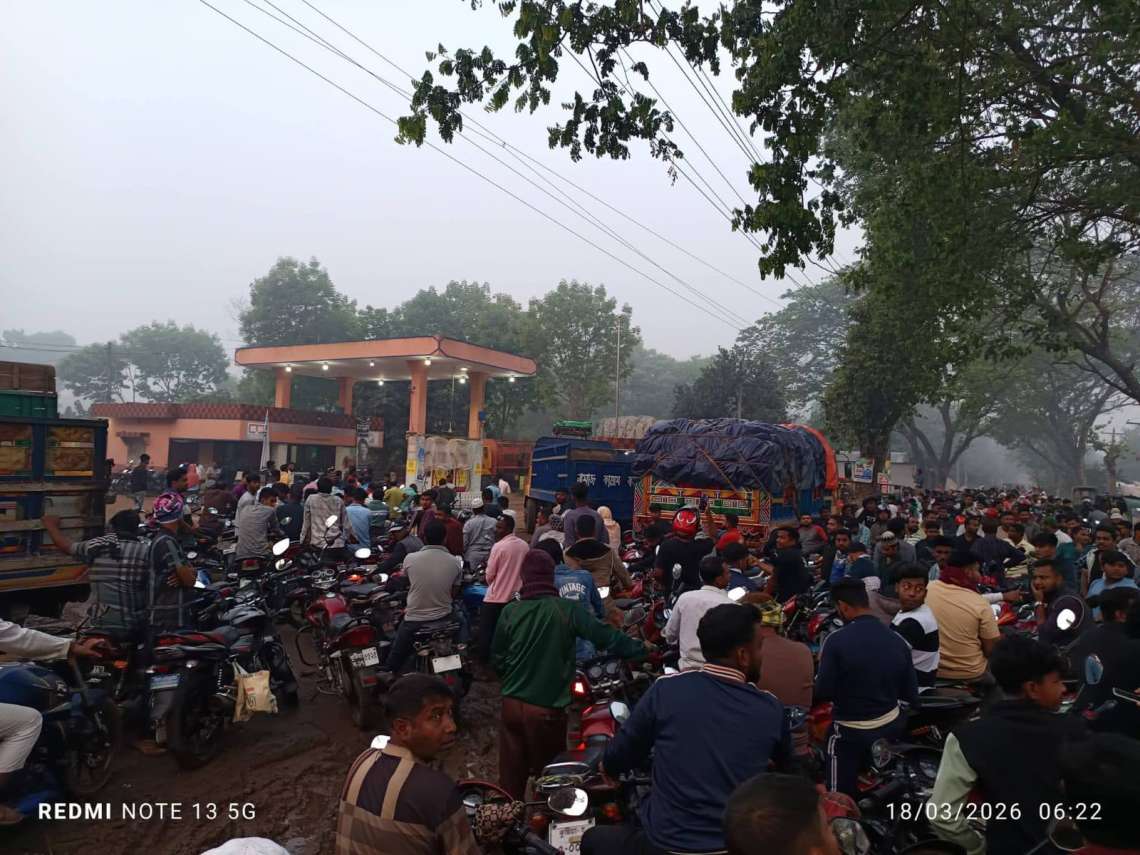
Amid the ongoing conflict in West Asia, Bangladesh is facing a worsening fuel crisis, with long queues and chaotic scenes reported at petrol stations as supplies fall short of demand, prompting growing concern among pump owners.

The owners have threatened to stop supplying fuel, urging security at petrol pumps and asked the government to take decisive action to control the situation.

“Under the state-owned fuel supplier Bangladesh Petroleum Corporation, (BPC) the oil companies are supplying an amount of fuel each day that is clearly insufficient compared to the existing demand”, Bangladesh Petrol Pump Owner’s Association said in a statement posted on its Facebook page.

Pic credits Facebook Petrol Pump Owners Association

The post highlighted the plight of the masses and the mounting pressure on pump workers.

“With millions of motorcycle riders and users across the country, customers are being forced to stand in long queues for hours to purchase fuel. As a result, many are becoming exhausted, frustrated, and increasingly bitter. At the same time, nozzle operators and pump workers are struggling to cope with continuous duty, mounting pressure, and frequent arguments with irritated customers. They are not accustomed to such relentless work conditions”, it added.

Noting that the situation has reached a “critical point”, the statement said, “Overall, the situation has reached a critical point. Due to security concerns and inadequate fuel supply, there is a real risk that petrol pumps across the country could be forced to shut down at any time”, the statement said.

The Petrol Pump Owners Association expressed serious concerns on the security and took a sharp dig at the government.

Pic credits Facebook Petrol Pump Owners Association

“The issue of security within the government’s fuel distribution system appears to have been completely overlooked by the authorities, including the district administration”, the Petrol Pump Owners Association said in a separate post on Facebook.

“At present, the government is playing virtually no effective role in ensuring safety in the retail marketing system of petrol pumps. Does the government believe that any loss incurred by petrol pumps is merely a private loss of the owners? If so, they are living in a fool’s paradise. The current situation reflects extreme levels of mismanagement and irresponsibility”, it said.

“On the day before Eid, one petrol pump in a district town had an opening stock of 10,500 liters of petrol and 10,500 liters of octane. Another pump owned by the same operator had 8,000 liters combined. They expected this supply would be enough to sell gradually over the day before Eid, Eid day, and part of the following day, alongside fresh incoming supply”, the statement said.

“Instead, what happened could hardly be described as normal sales — it resembled looting. There was no effective oversight. The administration remained indifferent, concerned only with collecting reports on how much stock was available and how much had been sold. Multiple agencies completed their paperwork from their offices and considered their duty fulfilled”, the statement added.

Pic credits Facebook Petrol Pump Owners Association

It further noted the threats received pumps and added, “Unregistered motorcycles, riders without licenses, and vehicles with various violations openly threatened to set pumps on fire. At around 3:00 a.m., mobs forced pumps to open and took fuel in large quantities. Without unofficial payments, even the police were reportedly absent”.

“In a recent incident in Thakurgaon, despite fuel being supplied, mobs armed with sticks vandalized and disrupted operations. No visible action from the administration was widely communicated afterward. If any action was taken, it was not publicly demonstrated”, the statement said.

“Such incidents are now threatening petrol pump owners nationwide. There is virtually no minimum security guarantee. Alongside the fuel shortage, the lack of state-provided security has made the crisis even more severe”, the statement said.

It also expressed concerns about fuel-tankers travelling large distances lest they be looted.

“We are also deeply concerned about whether fuel tankers can safely travel 100-150 kilometers from depots without being looted on the way. Who will guarantee that security? Surely, the answer should be the state. We want to clearly inform the authorities: without security, there will be no option but to shut down operations”, it said.
Previous Story

IEA Says Over 40 Energy Assets Destroyed in West Asia

Next Story

EC Withdraws Letter After BJP Seal Error Triggers Row in Kerala

Previous Story

IEA Says Over 40 Energy Assets Destroyed in West Asia

Next Story

EC Withdraws Letter After BJP Seal Error Triggers Row in Kerala

Latest from -Top News

Pakistan Risks Overstretching Itself in Yemen War

Pakistan’s expanding military role in Saudi Arabia amid the Yemen conflict could strain its defence resources and fragile finances…reports Asian Lite News Desk Pakistan’s military involvement in the war in Yemen may prove unsustainable because of mounting financial pressures and competing security demands, according to a new report. Islamabad’s growing military presence in Saudi Arabia risks stretching its defence resources while exposing the country to greater strategic and economic challenges. An article by Andrew Wilson in One World Outlook describes Pakistan’s involvement as a case of “fiscal and strategic overreach”, arguing that the country lacks the financial flexibility to sustain an expanded military commitment. Pakistan’s external finances depend heavily on an International Monetary Fund (IMF) programme, financial support from Gulf countries and remittances from Pakistani workers in the region. The report argues that deeper military involvement in the conflict could place additional pressure on these sources of financial stability. It also warns that deploying troops and military equipment abroad could weaken Pakistan’s capacity to address security challenges along its eastern border and deal with two domestic insurgencies. The move could also draw Islamabad into a conflict it has sought to approach cautiously. A Reuters report in May, citing Pakistani security and government sources, said Islamabad had deployed around 8,000 troops, a squadron of approximately 16 aircraft, mostly JF-17 fighter jets, two drone squadrons and a Chinese HQ-9 air-defence battery to Saudi Arabia. According to those sources, Riyadh was financing the deployment, with Pakistani personnel operating the equipment. The sources also said a confidential agreement contemplated the possibility of deploying up to 80,000 troops. Islamabad has not confirmed those figures, although it has acknowledged its military presence in Saudi Arabia, including the deployment of fighter jets at King Abdulaziz Air Base from April. The One World Outlook article argues that Saudi financial support can cover allowances and operating expenses but cannot easily replace military equipment needed elsewhere or resolve the political and strategic challenges of participating in the Yemen conflict. Pakistan’s defence budget is another concern. For the 2026-27 financial year, the federal government allocated PKR 3 trillion, or approximately $10.8 billion, to defence services. The allocation represents an 18 per cent increase from the original PKR 2.55 trillion provision and amounts to around 2.1 per cent of projected gross domestic product (GDP). Defence spending accounts for approximately 16 per cent of the federal government’s PKR 18.8 trillion expenditure. Military pensions are budgeted separately at PKR 822 billion, while debt servicing costs stand at approximately PKR 8 trillion, more than two-and-a-half times the defence allocation. The report argues that these competing financial obligations leave little room for additional military expenditure without placing further pressure on public finances. Pakistan’s reliance on IMF assistance also limits its fiscal flexibility. The country must meet the conditions attached to the programme, including a primary budget surplus target of 2 per cent of GDP and continued restraint on development spending. According to the article, these requirements make it difficult for Islamabad to finance an additional military commitment without compromising other budgetary priorities. Pakistan’s economic indicators offer limited reassurance. Economic growth for the 2025-26 financial year is estimated at between 3.6 and 3.7 per cent, while inflation reached approximately 10.3 per cent in September following an energy price shock. Foreign exchange reserves stood at around $21.5 billion at the end of September. Although this marks an improvement from the low levels recorded in 2023, the report notes that the reserves cover only a few months of imports. Financial assistance from Gulf partners remains central to Pakistan’s external stability. The article says Islamabad holds approximately $8 billion in Saudi deposits at its central bank. In July, the State Bank of Pakistan said Riyadh had extended the maturity of $5 billion in deposits to December 2028, easing the country’s immediate external financing requirements. A further $3 billion deposit was also extended in the spring. However, the article argues that these arrangements provide temporary relief rather than long-term financial independence, particularly as regional conflict threatens the stability of the Gulf economies on which Pakistan relies. The report concludes that Pakistan faces a difficult balance between supporting Saudi Arabia militarily and preserving the financial and military resources needed to address its domestic and regional challenges.

UK and Germany Ratify Kensington Treaty

Britain and Germany ratify the Kensington Treaty, agreeing new cooperation on AI, quantum research, defence and security while targeting investment, jobs and Russian hybrid threats…reports Asian Lite News Desk Britain and Germany

Economic tide is turning in Bangladesh

If there is one thing that can bring some comfort to the struggling Bangladeshi economy, it is good relations with India. Bangladesh should remember that Delhi’s backing, through easy supplies of essentials
Go toTop

Don't Miss

Violence rises in Bangladesh, women and children at risk

The critics accused both the former Muhammad Yunus-led interim government

B’desh HC postpones tax evasion hearing against pro-Pak leader

On December 30, 2019, Hossain appealed to the Joint Commissioner