Iranian President Masoud Pezeshkian rejects US terrorism accusations at the UN, displays photos of children killed in Minab and warns against wider regional escalation, reports Asian Lite News Desk
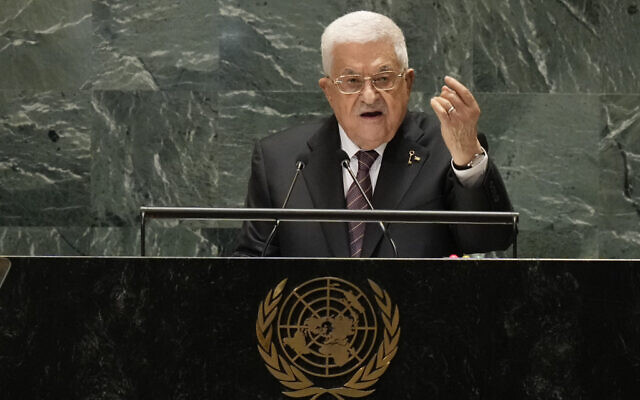
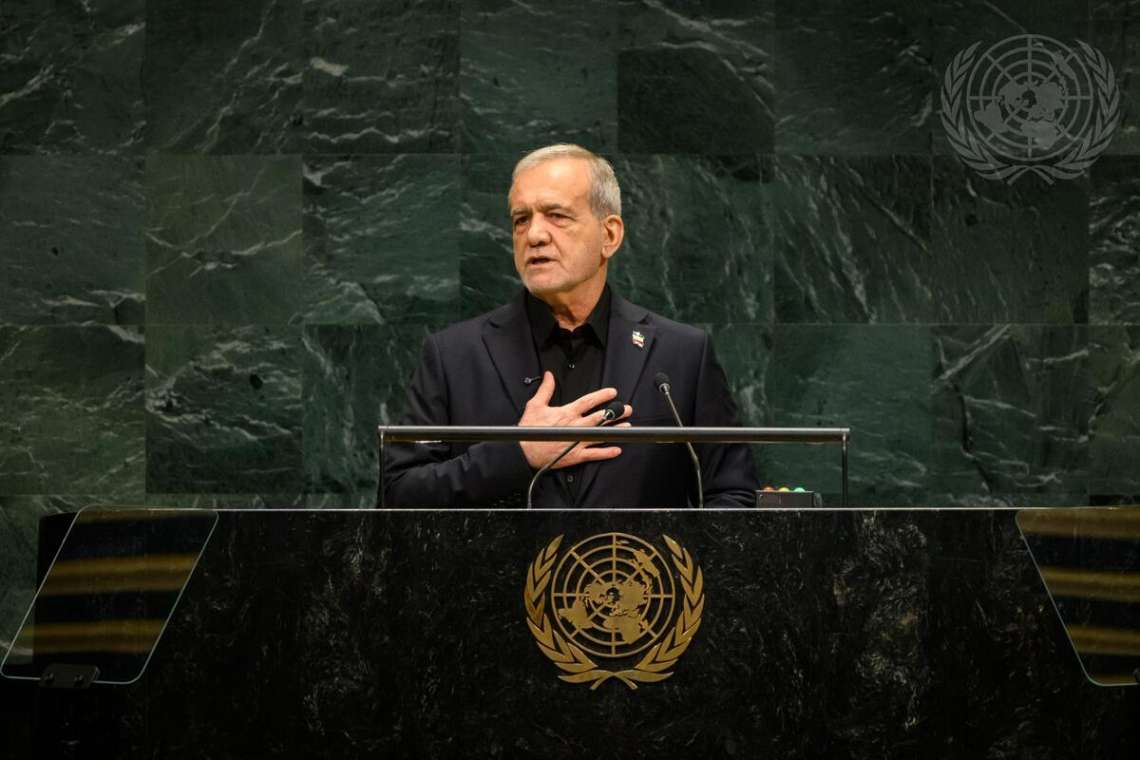
Iranian President Masoud Pezeshkian used his address to the 81st United Nations General Assembly in New York to reject US accusations against Tehran, accuse the United States and Israel of attacks on Iranian civilians and insist that Iran would not surrender its right to defend itself.
Speaking on Wednesday, a day after US President Donald Trump addressed the General Assembly, Pezeshkian presented Iran as a victim of aggression rather than a source of terrorism and directly challenged Trump’s description of Tehran. He also held up photographs of children killed in a strike on a school in Minab, as well as a picture of Iran’s late Supreme Leader Ayatollah Ali Khamenei, who Iran says was killed in a US-Israeli attack earlier this year.
The speech came as Washington and Tehran remain locked in a conflict that has raised fears of a wider regional escalation, while diplomatic efforts continue around a possible agreement and the reopening of the Strait of Hormuz.
Pezeshkian opened his address by responding to Trump’s criticism of Iran and his characterisation of the Islamic Republic as a source of terrorism and instability.

“The United States President described us as terrorists. Iran has not attacked anyone for 200 years, but now we’re being accused of being a source of instability in the region; we’re labelled terrorists,” he said.
“We have been the victims of terrorism,” he added, accusing the US and Israel of targeting Iranian territory and civilians.
Photos of children
One of the most striking moments of the speech came when Pezeshkian displayed photographs of children killed in the Minab school strike.
“You see these children? These children perished under bombs with weapons used by the United States and Israel. They were innocent, had committed no crimes,” he said.
Pezeshkian also referred to an attack on a sports facility in Lamerd, accusing the United States of using weapons that caused civilian casualties.
He said Iranian universities, healthcare centres, schools, hospitals and other infrastructure had been targeted during the conflict.

“The United States, by using weapons with multiple warheads, targeted that sports hall. They martyred, assassinated our scientists, our men, women, and children,” he said.
The claims form part of Tehran’s account of the conflict and have been strongly disputed by Washington. Reports on the Minab strike have since generated international scrutiny over the circumstances of the attack and whether sufficient precautions were taken to distinguish the school from a military target.
As Pezeshkian spoke about the civilian casualties, a US representative present in the General Assembly hall stood up, collected his briefcase and left the chamber. The departure was reported as the Iranian president continued his criticism of Washington. The Israeli delegation also did not attend the address.
‘We will never bow our head’
Pezeshkian also addressed the impact of US sanctions, saying the measures were hurting ordinary Iranians rather than simply putting pressure on the government.
“Those who are ill, innocent people, the poor, the least privileged in our society are the targets of these sanctions,” he said.
He argued that sanctions and military pressure would not force Tehran to surrender.
Referring directly to Trump, Pezeshkian said: “He must know that the resistance of the Iranian people will only increase in the face of sanctions, increased pressure, increased bullying.”
“We will never bow our head, or bend the knee,” he said.
At the same time, Pezeshkian left open the possibility of diplomacy, but said negotiations could not take place under threats or coercion.

“We invite the world to cooperate. We seek to think about a worthy future. If we want an order based on law, it must be based on peace,” he said, arguing that Trump’s remarks were contrary to the spirit of the United Nations.
He added that Iran was prepared to engage in dialogue but would not accept what he called “the language of force”.
Nuclear programme
Iran’s nuclear programme was another central issue in Pezeshkian’s address.
He insisted that Tehran’s nuclear ambitions were focused on peaceful applications, including energy, agriculture and industrial development, and rejected demands that Iran abandon civilian nuclear technology.
“No nuclear weapons and no limitations to peaceful nuclear technology,” Pezeshkian said.
He accused Western governments of applying a double standard by demanding inspections and restrictions on Iran while Israel possesses nuclear weapons.
“Nuclear weapons are in Israel, but the inspectors are in Iran. They kill, we are sanctioned, we are punished,” he said.
Pezeshkian maintained that Iran did not seek nuclear weapons but would not give up what he described as its inherent right to peaceful nuclear technology.
The issue remains at the centre of international efforts to reach a settlement with Tehran, with Washington insisting that Iran must not acquire a nuclear weapon.
Warning over Strait of Hormuz
The Iranian president also issued a warning over the Strait of Hormuz, the strategic waterway through which a significant share of global oil and gas shipments traditionally passes.
“We can’t let some have free access to Hormuz while imposing aggression on us. They close access to our own waterway,” he said.
“Expansion of war won’t lead to security.”
The comments came amid US efforts to ensure the movement of oil through the waterway and continuing concern among Gulf states about the economic and security consequences of prolonged disruption. Reuters reported that the strait had become a major focus of diplomatic efforts surrounding the conflict, given its importance to global energy markets.
Pezeshkian insisted that Iran did not want regional insecurity but said Tehran would maintain the military capability to deter attacks.
“We do not seek our security in the insecurity of others,” he said.
“Our defensive systems have been built so that no one can think that bombing Iranian cities will go unanswered.”
Pezeshkian also devoted significant attention to Gaza, describing the Palestinian territory as evidence of the failure of the international system to prevent civilian suffering.
“Palestine remains an open wound on the conscience of the international community, and Gaza remains a symbol of the failure of international mechanisms to prevent civilian suffering,” he said.
He argued that military action would not eliminate Palestinian demands for self-determination and said resistance would continue while occupation remained.
His remarks reflected Tehran’s long-standing position on the Israel-Palestinian conflict and came as Gaza remained a major issue during the General Assembly session.
Trump’s warning
Pezeshkian’s speech followed Trump’s address to the General Assembly on Tuesday, in which the US president made Iran one of his principal targets.
Trump said he faced a choice between reaching a deal with Tehran and taking much more severe military action.
“I have a big decision to make: Will a deal be made with Iran that lets them rebuild and create a far greater country than it ever was before … or do I annihilate the Islamic Republic, and do it quickly?” Trump said.
Trump also suggested that Tehran was waiting to see what happened in the US midterm elections before making a deal, although he said the elections were not influencing his policy.
His remarks came as diplomatic contacts continued. US special envoy Steve Witkoff and Jared Kushner had met mediators involved in efforts to negotiate an agreement with Iran, with Trump subsequently describing the discussions as a “very good meeting”.
“Iran extends its hands towards the world,” Pezeshkian said, arguing that cooperation should be based on equality rather than coercion.