September 6, 2021
3 mins read

Kisan mahapanchayat decides to go aggressive on farm laws

The farmers unanimously gave a call for complete Bharat Bandh on September 27 in protest against the three contentious farm laws….reports Asian Lite News

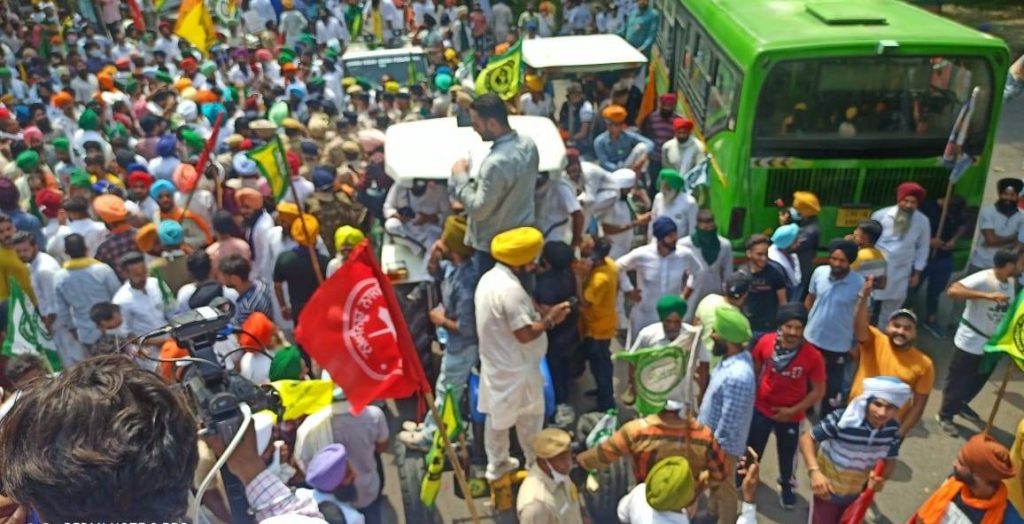
The Kisan Mahapanchayat in Muzaffarnagar on Sunday, turned out to be a massive show of strength of farmer unity as over 300 farmer unions from 15 states participated under the aegis of the Sanyukt Kisan Morcha (SKM) and reiterated their resolve to continue with the protest.

The farmers unanimously gave a call for complete Bharat Bandh on September 27 in protest against the three contentious farm laws.

“They (the Centre) said only a handful of farmers are protesting. Let them see what a handful this is today. Let us raise our voices so it reaches the ears of those sitting in Parliament,” the speakers said.

The farmer leaders said that the Mahapanchayat will also prove that the agitation has the support of ‘all castes, religions, states, classes, small traders and all sections of the society’.

The SKM said in a statement, “The Mahapanchayat today will make the Modi and Yogi governments realise the power of farmers, farm labourers, and supporters of the farm movement. The Muzaffarnagar Mahapanchayat will be the biggest ever in the last nine months.”

Farmer leaders made it amply clear that they would campaign against the ruling BJP in Uttar Pradesh and Uttarakhand Assembly elections in 2022 if the governments did not accept their demands. They even threatened to continue their agitation till 2024 when Lok Sabha elections are due.

They further said that efforts would now be made to strengthen the movement and ensure that farmers have their own government — one that caters to their interests.

Rakesh Tikait, BKU spokesperson, told reporters, “This is the strength of farmers and how long will the governments continue to deny us our rights. The farmers have come from several states on their own and they are not here for any political party.”

Tikait said that India was now being put up for sale and national assets were being sold out to the private sector.

He said that the next meeting would be held in Lucknow in support of the cane farmers.

The Rashtriya Lok Dal had a marked political presence at the Mahapanchayat.

The district administration had denied permission to the RLD to shower flower petals on the participants.

Rashtriya Lok Dal president Jayant Chaudhary, tweeted that the administration did not give permission to shower flower petals from a helicopter over the gathering.
“Wearing a lot of garlands. The people have given me a lot of love and respect. We wanted to salute and welcome the people by showering flowers on them. DM, ADG, City Magistrate, Principal Secretary. CM — everyone was informed, but they are not giving permission! What is the danger to the government with respect to farmers?” he tweeted.

Meanwhile, 32 farmer unions from Punjab demanded that the state government withdraw cases against protestors by September 8. If the cases are not withdrawn, the farmers will hold a bigger protest, the unions said.

The Mahapanchayat evoked a massive response from farmers and their supporters and the sprawling GIC ground was packed to capacity since morning and large crowds were seen on the roads leading to the venue.

What was significant in Sunday’s Mahapanchayat was the remarkably large presence of women, many of whom addressed for the gathering.

Thousands of farmers have been protesting at the borders of Delhi for the past nine months seeking the repeal of the three contentious farm laws which they apprehend will do away with the MSP system.

The Centre has so far held over 10 rounds of talks with the farmer unions to allay their concerns with no major breakthrough.

ALSO READ: India-US 2+2 dialogue to be held in November

Previous Story

Mandaviya participates in G-20 health ministers’ meeting

Next Story

Britain plans vaccine passport for nightclubs

Previous Story

Mandaviya participates in G-20 health ministers’ meeting

Next Story

Britain plans vaccine passport for nightclubs

Latest from -Top News

Pakistan Risks Overstretching Itself in Yemen War

Pakistan’s expanding military role in Saudi Arabia amid the Yemen conflict could strain its defence resources and fragile finances…reports Asian Lite News Desk Pakistan’s military involvement in the war in Yemen may prove unsustainable because of mounting financial pressures and competing security demands, according to a new report. Islamabad’s growing military presence in Saudi Arabia risks stretching its defence resources while exposing the country to greater strategic and economic challenges. An article by Andrew Wilson in One World Outlook describes Pakistan’s involvement as a case of “fiscal and strategic overreach”, arguing that the country lacks the financial flexibility to sustain an expanded military commitment. Pakistan’s external finances depend heavily on an International Monetary Fund (IMF) programme, financial support from Gulf countries and remittances from Pakistani workers in the region. The report argues that deeper military involvement in the conflict could place additional pressure on these sources of financial stability. It also warns that deploying troops and military equipment abroad could weaken Pakistan’s capacity to address security challenges along its eastern border and deal with two domestic insurgencies. The move could also draw Islamabad into a conflict it has sought to approach cautiously. A Reuters report in May, citing Pakistani security and government sources, said Islamabad had deployed around 8,000 troops, a squadron of approximately 16 aircraft, mostly JF-17 fighter jets, two drone squadrons and a Chinese HQ-9 air-defence battery to Saudi Arabia. According to those sources, Riyadh was financing the deployment, with Pakistani personnel operating the equipment. The sources also said a confidential agreement contemplated the possibility of deploying up to 80,000 troops. Islamabad has not confirmed those figures, although it has acknowledged its military presence in Saudi Arabia, including the deployment of fighter jets at King Abdulaziz Air Base from April. The One World Outlook article argues that Saudi financial support can cover allowances and operating expenses but cannot easily replace military equipment needed elsewhere or resolve the political and strategic challenges of participating in the Yemen conflict. Pakistan’s defence budget is another concern. For the 2026-27 financial year, the federal government allocated PKR 3 trillion, or approximately $10.8 billion, to defence services. The allocation represents an 18 per cent increase from the original PKR 2.55 trillion provision and amounts to around 2.1 per cent of projected gross domestic product (GDP). Defence spending accounts for approximately 16 per cent of the federal government’s PKR 18.8 trillion expenditure. Military pensions are budgeted separately at PKR 822 billion, while debt servicing costs stand at approximately PKR 8 trillion, more than two-and-a-half times the defence allocation. The report argues that these competing financial obligations leave little room for additional military expenditure without placing further pressure on public finances. Pakistan’s reliance on IMF assistance also limits its fiscal flexibility. The country must meet the conditions attached to the programme, including a primary budget surplus target of 2 per cent of GDP and continued restraint on development spending. According to the article, these requirements make it difficult for Islamabad to finance an additional military commitment without compromising other budgetary priorities. Pakistan’s economic indicators offer limited reassurance. Economic growth for the 2025-26 financial year is estimated at between 3.6 and 3.7 per cent, while inflation reached approximately 10.3 per cent in September following an energy price shock. Foreign exchange reserves stood at around $21.5 billion at the end of September. Although this marks an improvement from the low levels recorded in 2023, the report notes that the reserves cover only a few months of imports. Financial assistance from Gulf partners remains central to Pakistan’s external stability. The article says Islamabad holds approximately $8 billion in Saudi deposits at its central bank. In July, the State Bank of Pakistan said Riyadh had extended the maturity of $5 billion in deposits to December 2028, easing the country’s immediate external financing requirements. A further $3 billion deposit was also extended in the spring. However, the article argues that these arrangements provide temporary relief rather than long-term financial independence, particularly as regional conflict threatens the stability of the Gulf economies on which Pakistan relies. The report concludes that Pakistan faces a difficult balance between supporting Saudi Arabia militarily and preserving the financial and military resources needed to address its domestic and regional challenges.

UK and Germany Ratify Kensington Treaty

Britain and Germany ratify the Kensington Treaty, agreeing new cooperation on AI, quantum research, defence and security while targeting investment, jobs and Russian hybrid threats…reports Asian Lite News Desk Britain and Germany

Economic tide is turning in Bangladesh

If there is one thing that can bring some comfort to the struggling Bangladeshi economy, it is good relations with India. Bangladesh should remember that Delhi’s backing, through easy supplies of essentials

DP World Lands 15-Year Bangladesh Port Deal

The agreement between the Chittagong Port Authority (CPA) and DP World covers the New Mooring Container Terminal…reports Asian Lite News Desk Bangladesh has signed a 15-year concession agreement with global ports operator
Go toTop

Don't Miss

Unpacking the coal outcome of Glasgow pact for India

Experts believe India’s domestic target of 500GW of renewable energy

Jaishankar, UAE envoy discuss deepening ties

Jaishankar emphasized that continuing conversations between the two counties on