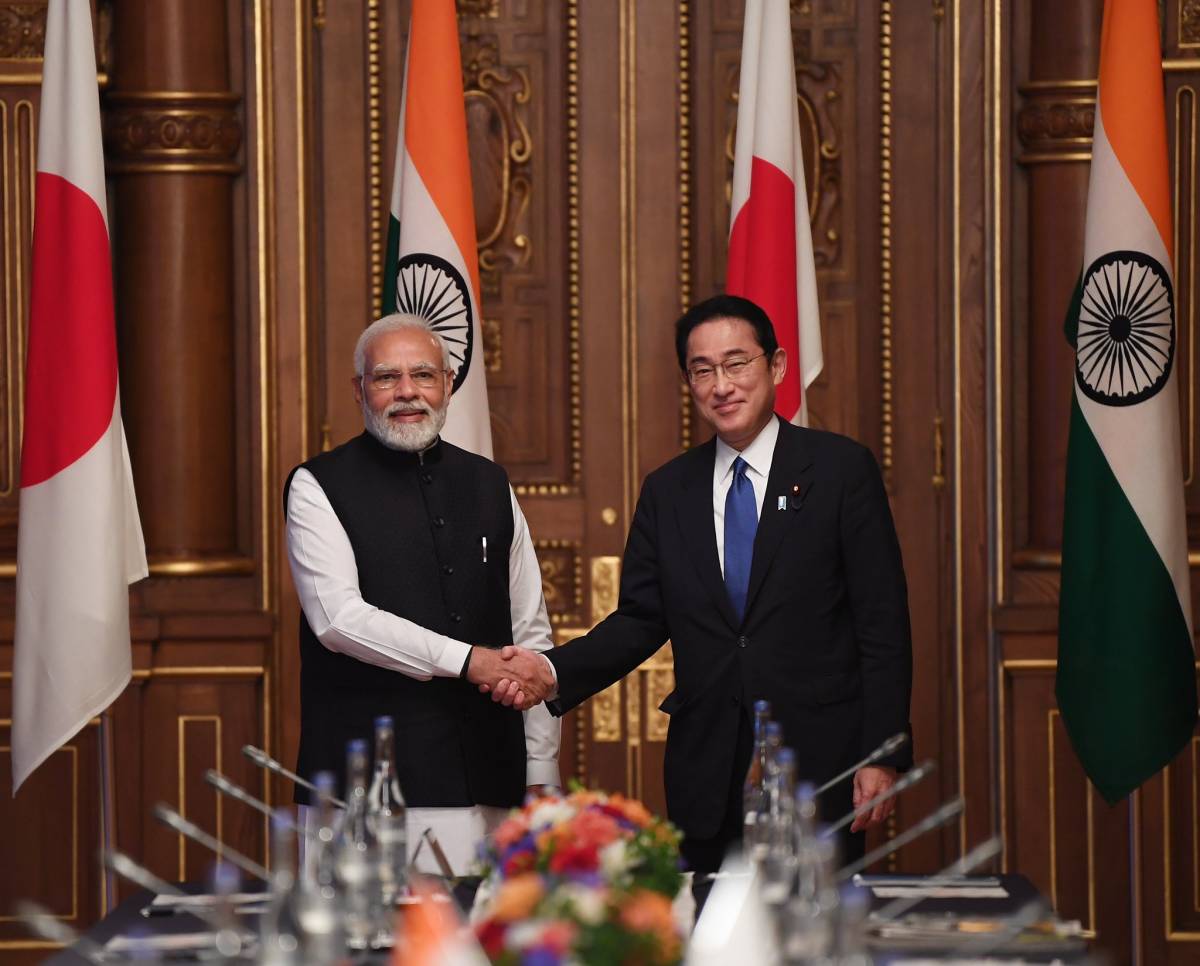
During the meeting, Modi highlighted the steps taken by the Government of India to improve ease of doing business, logistics through the Gati Shakti initiative …reports Asian Lite News
India and Japan have agreed to further enhance bilateral security and defence cooperation, including in defence manufacturing.
During a bilateral meeting held in Tokyo on Tuesday, Prime Minister Narendra Modi and his Japanese counterpart Fumio Kishida concurred that the next 2+2 Foreign and Defence Ministerial Meeting may be held in Japan at the earliest.
Both leaders had a productive exchange of views on enhancing bilateral relations in various spheres as well as on some regional and global issues. They also appreciated the growing economic ties between the two countries.
“They agreed that both sides should work jointly towards implementing their decision to have 5 trillion yen in public and private investment and financing from Japan to India in the next five years,” India’s Ministry of External Affairs said in a statement on Tuesday.
During the meeting, Modi highlighted the steps taken by the Government of India to improve ease of doing business, logistics through the Gati Shakti initiative and urged Kishida to support greater investments by Japanese companies in India.
Appreciating that Japanese companies were increasing their investments in India and that 24 Japanese companies had successfully applied under the various PLI schemes, Modi discussed the progress in implementation of the Mumbai-Ahmedabad High Speed Rail project with Kishida and welcomed the signing of the exchange of notes of the 3rd tranche loan for this project.
The two leaders also discussed possibilities of collaboration in critical and emerging technologies such as 5G, Beyond 5G and semiconductors. They agreed to deepen cooperation in the area of Clean Energy including green hydrogen and, in this regard, encouraged more business to business collaboration, the MEA said.
Modi raised the issue of further easing of travel restrictions in order to facilitate quarantine free entry into Japan for travellers from India carrying Covaxin and Covishield vaccination certificates. The two leaders concurred that the India-Japan Act East Forum was useful in prioritising the development of India’s northeast region, and looked forward to early implementation of various projects which were identified by the two sides during the Annual Summit.
Modi and Kishida also exchanged views on recent global and regional developments. They noted the convergences in their respective approaches to the Indo-Pacific and reaffirmed their commitment towards a free, open and inclusive Indo-Pacific region. In this context, they welcomed the progress in the Quad’s contemporary and constructive agenda such as vaccines, scholarships, critical technologies and infrastructure.
PM Modi thanked Prime Minister Kishida for the warmth and hospitality extended to him and members of his delegation during the visit.
The Japanese premier invited Modi to visit Japan for the next Annual Bilateral Summit, which he accepted.