February 28, 2023
4 mins read

Sunak declares new Brexit pact

The Prime Minister now faces the uphill task of getting Northern Ireland’s Democratic Unionist Party on board with the new Windsor Framework…reports Asian Lite News

Prime Minister Rishi Sunak on Monday unveiled a “decisive breakthrough” in achieving a new deal with the European Union (EU) to resolve the post-Brexit trade dispute related to Northern Ireland.

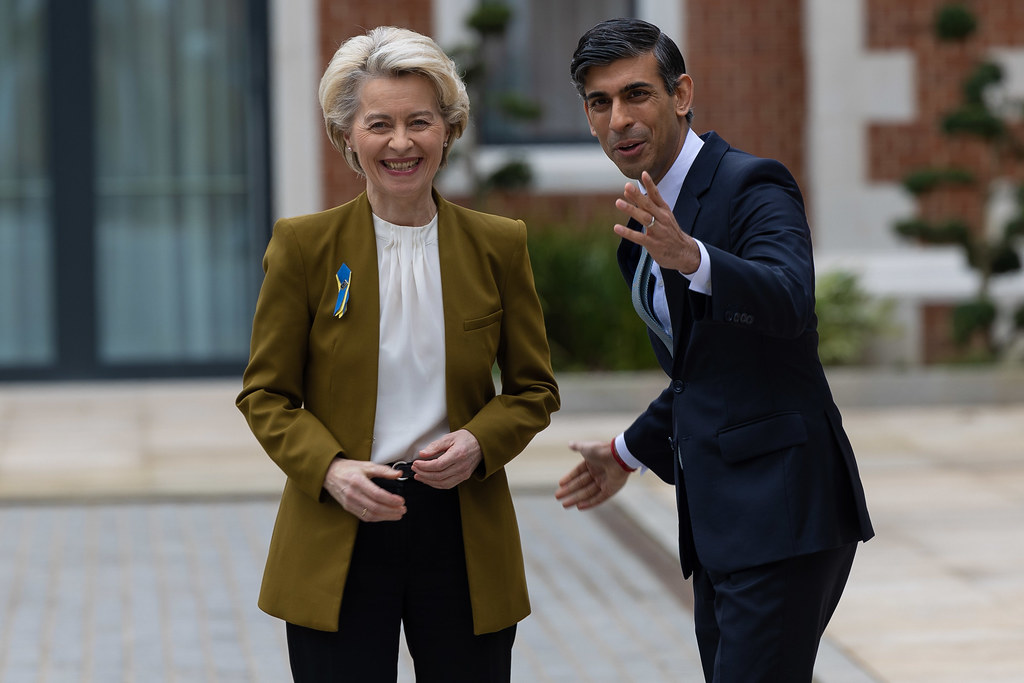
After weeks of intensive negotiations, Sunak was joined by European Commission President Ursula von der Leyen for a final set of in-person talks in Windsor, south east England, after which the duo addressed the media to confirm a new “Windsor Framework”.

It replaces the previous Northern Ireland Protocol, agreed by Sunak’s former boss Boris Johnson to prevent a hard border between UK territory Northern Ireland and EU member-state Ireland but eventually proving unworkable and causing much tension between the UK and EU.

“I’m pleased to report that we have now made a decisive breakthrough. Together we have changed the original protocol and are today announcing the new Windsor framework,” Sunak told reporters.

“Today’s agreement delivers smooth-flowing trade within the whole United Kingdom, protects Northern Ireland’s place in our union and safeguards sovereignty for the people of Northern Ireland… and [removes] any sense of a border in the Irish Sea,” he said.

Von der Leyen echoed Sunak’s optimism to say that the UK and EU can now open a new chapter in their post-Brexit relationship.

They detailed ‘big steps forward’ to deliver trade flow with goods destined for Northern Ireland travelling through a new ‘green lane’ with a separate ‘red lane’ reserved for items expected to move on to the EU.

‘We will end the situation where food made to UK rules could not be sent to and sold in Northern Ireland. This means that if food is available on supermarket shelves in Great Britain, then it will be available on supermarket in Northern Ireland,’ said Sunak.

The legal text of the Northern Ireland Protocol has been amended to ensure critical VAT and excise changes for the whole of the UK can be made and the devolved Northern Irish parliament in Stormont would have a say on the changes. “These negotiations have not always been easy, but I’d like to pay an enormous personal tribute to Ursula for her vision in recognising the possibility of a new way forward… Today’s agreement is about preserving that delicate balance and charting a new way forward for the people of Northern Ireland,’ added Sunak.

The leader now faces the uphill task of getting Northern Ireland’s Democratic Unionist Party (DUP) on board with the new Windsor Framework.

The DUP had been strongly opposed to the earlier protocol, which meant goods arriving from England, Scotland and Wales within the United Kingdom were checked when they arrived at Northern Irish ports. This was seen as undermining the region’s position within the rest of the UK, besides severely impacting trade.

The other group likely to make things difficult for Sunak in the House of Commons include the hard Brexiteers within the Conservative Party, including backbencher Johnson, who had warned against backing down over Northern Ireland Protocol Bill – which would have given the UK Parliament a chance to unilaterally change parts of the protocol.

However, Sunak had indicated that a fresh negotiated agreement with the EU was preferable over the controversial Bill that would have put the UK on a legal collision course with its European neighbours.

The Windsor Agreement will now need to be backed by lawmakers on both sides of the Channel.

Asked if he’s worried that the Euroskeptic wing of the ruling Conservative party or Northern Ireland’s Democratic Unionist Party (DUP) can scupper the deal, Sunak said that the agreement “addresses” their concerns.

“I believe that what we have achieved today is a real breakthrough and it’s now for the parties to consider that and decide themselves how to take it forward and build a better future for people in Northern Ireland,” he added.

The region has been without an executive since the DUP pulled out of the power-sharing agreement over the Protocol in February 2022 arguing the treaty undermines its place in the UK.

The DUP has issued a list of “tests” it says must be fulfilled for it to support any deal. These include “no checks on goods going from Northern Ireland to Great Britain or from Great Britain to Northern Ireland” and “no new regulatory barriers develop between Northern Ireland and the rest of the United Kingdom.”

DUP leader Jeffrey Donaldson said on Twitter that they “take our time to consider the detail and measure a deal against our seven tests.”

Michelle O’Neill, Vice President of the republican Sinn Fein party, meanwhile described the deal as a “breakthrough”.

“We are at a critical turning point. The economic possibilities this opens up must now be seized. The onus is on the DUP to end its boycott & now join the rest of us to make politics work,” she said.
ALSO READ-Sunak to meet EU chief over post-Brexit deals

Previous Story

CPN-UML quits Nepal’s fragile ruling coalition

Next Story

Saudi to upgrade India ties to ‘highest level’

Previous Story

CPN-UML quits Nepal’s fragile ruling coalition

Next Story

Saudi to upgrade India ties to ‘highest level’

Latest from -Top News

Pakistan Risks Overstretching Itself in Yemen War

Pakistan’s expanding military role in Saudi Arabia amid the Yemen conflict could strain its defence resources and fragile finances…reports Asian Lite News Desk Pakistan’s military involvement in the war in Yemen may prove unsustainable because of mounting financial pressures and competing security demands, according to a new report. Islamabad’s growing military presence in Saudi Arabia risks stretching its defence resources while exposing the country to greater strategic and economic challenges. An article by Andrew Wilson in One World Outlook describes Pakistan’s involvement as a case of “fiscal and strategic overreach”, arguing that the country lacks the financial flexibility to sustain an expanded military commitment. Pakistan’s external finances depend heavily on an International Monetary Fund (IMF) programme, financial support from Gulf countries and remittances from Pakistani workers in the region. The report argues that deeper military involvement in the conflict could place additional pressure on these sources of financial stability. It also warns that deploying troops and military equipment abroad could weaken Pakistan’s capacity to address security challenges along its eastern border and deal with two domestic insurgencies. The move could also draw Islamabad into a conflict it has sought to approach cautiously. A Reuters report in May, citing Pakistani security and government sources, said Islamabad had deployed around 8,000 troops, a squadron of approximately 16 aircraft, mostly JF-17 fighter jets, two drone squadrons and a Chinese HQ-9 air-defence battery to Saudi Arabia. According to those sources, Riyadh was financing the deployment, with Pakistani personnel operating the equipment. The sources also said a confidential agreement contemplated the possibility of deploying up to 80,000 troops. Islamabad has not confirmed those figures, although it has acknowledged its military presence in Saudi Arabia, including the deployment of fighter jets at King Abdulaziz Air Base from April. The One World Outlook article argues that Saudi financial support can cover allowances and operating expenses but cannot easily replace military equipment needed elsewhere or resolve the political and strategic challenges of participating in the Yemen conflict. Pakistan’s defence budget is another concern. For the 2026-27 financial year, the federal government allocated PKR 3 trillion, or approximately $10.8 billion, to defence services. The allocation represents an 18 per cent increase from the original PKR 2.55 trillion provision and amounts to around 2.1 per cent of projected gross domestic product (GDP). Defence spending accounts for approximately 16 per cent of the federal government’s PKR 18.8 trillion expenditure. Military pensions are budgeted separately at PKR 822 billion, while debt servicing costs stand at approximately PKR 8 trillion, more than two-and-a-half times the defence allocation. The report argues that these competing financial obligations leave little room for additional military expenditure without placing further pressure on public finances. Pakistan’s reliance on IMF assistance also limits its fiscal flexibility. The country must meet the conditions attached to the programme, including a primary budget surplus target of 2 per cent of GDP and continued restraint on development spending. According to the article, these requirements make it difficult for Islamabad to finance an additional military commitment without compromising other budgetary priorities. Pakistan’s economic indicators offer limited reassurance. Economic growth for the 2025-26 financial year is estimated at between 3.6 and 3.7 per cent, while inflation reached approximately 10.3 per cent in September following an energy price shock. Foreign exchange reserves stood at around $21.5 billion at the end of September. Although this marks an improvement from the low levels recorded in 2023, the report notes that the reserves cover only a few months of imports. Financial assistance from Gulf partners remains central to Pakistan’s external stability. The article says Islamabad holds approximately $8 billion in Saudi deposits at its central bank. In July, the State Bank of Pakistan said Riyadh had extended the maturity of $5 billion in deposits to December 2028, easing the country’s immediate external financing requirements. A further $3 billion deposit was also extended in the spring. However, the article argues that these arrangements provide temporary relief rather than long-term financial independence, particularly as regional conflict threatens the stability of the Gulf economies on which Pakistan relies. The report concludes that Pakistan faces a difficult balance between supporting Saudi Arabia militarily and preserving the financial and military resources needed to address its domestic and regional challenges.

UK and Germany Ratify Kensington Treaty

Britain and Germany ratify the Kensington Treaty, agreeing new cooperation on AI, quantum research, defence and security while targeting investment, jobs and Russian hybrid threats…reports Asian Lite News Desk Britain and Germany

Economic tide is turning in Bangladesh

If there is one thing that can bring some comfort to the struggling Bangladeshi economy, it is good relations with India. Bangladesh should remember that Delhi’s backing, through easy supplies of essentials

DP World Lands 15-Year Bangladesh Port Deal

The agreement between the Chittagong Port Authority (CPA) and DP World covers the New Mooring Container Terminal…reports Asian Lite News Desk Bangladesh has signed a 15-year concession agreement with global ports operator
Go toTop

Don't Miss

Sunak demands oil and gas companies increase investments

He repeated his view that no options were off the

Economy is on the right track, claims Sunak

With Chancellor Jeremy Hunt to deliver his pre-election Budget on