Dubai’s Mohammed bin Rashid Al Maktoum Solar Park reaches record capacity in 2025, accelerating clean energy targets and reinforcing the UAE’s leadership in renewable power….reports Asian Lite News
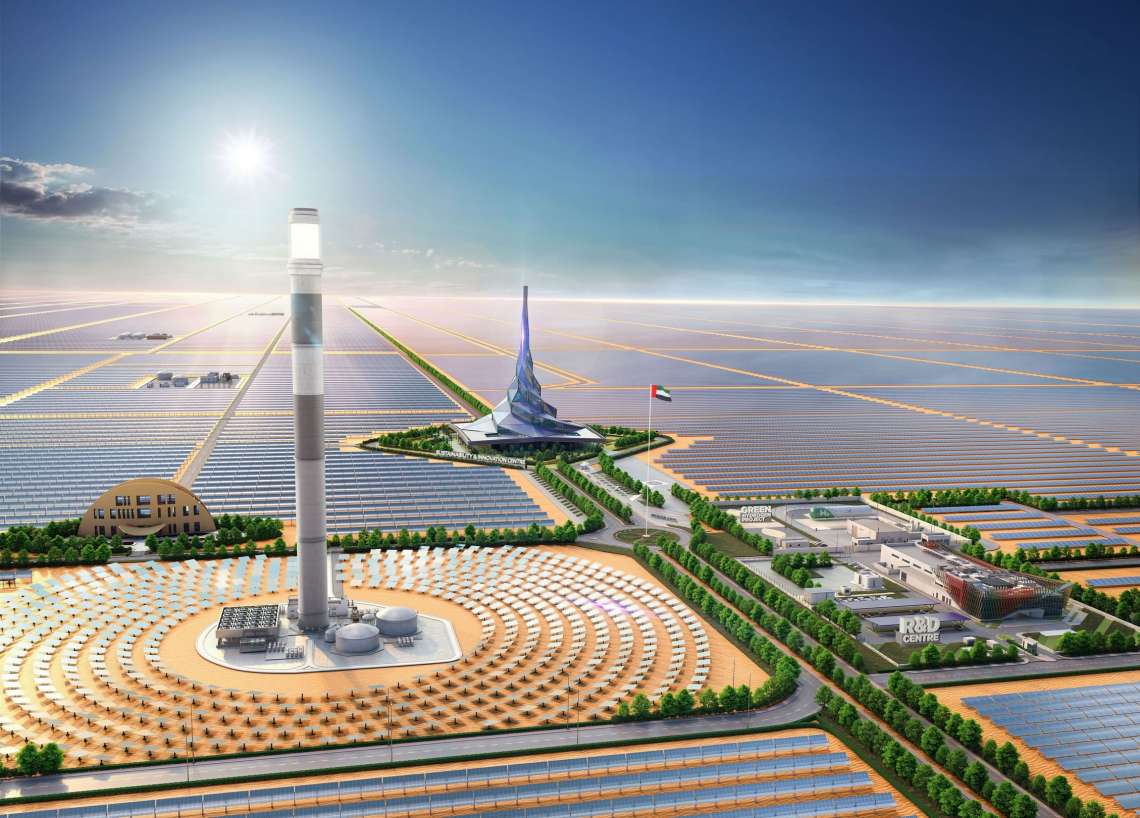
The Mohammed bin Rashid Al Maktoum Solar Park strengthened its position as a flagship of the UAE’s clean energy transition in 2025, reaching a new record in installed capacity and accelerating expansion plans that underline Dubai’s long-term commitment to sustainability and carbon neutrality.
Throughout the year, the world’s largest single-site solar energy project continued to scale up production in line with the Dubai Clean Energy Strategy 2050 and the Carbon Neutrality Strategy 2050. By the end of 2025, the Solar Park’s total installed capacity had climbed to 3,860 megawatts (MW) of clean energy, following the addition of 800 MW generated through a combination of photovoltaic panels and concentrated solar power (CSP) technologies.
This milestone has significantly increased the contribution of renewable energy to Dubai’s power mix. The Solar Park now accounts for approximately 21.5 per cent of the total electricity generation capacity of the Dubai Electricity and Water Authority (DEWA), marking a decisive shift away from conventional energy sources and reinforcing solar power as a cornerstone of the emirate’s energy strategy.
The Solar Park now accounts for approximately 21.5 per cent of the total electricity generation capacity of the Dubai Electricity and Water Authority (DEWA), marking a decisive shift away from conventional energy sources.
The latest capacity increase forms part of the project’s sixth phase, which has been delivered at an accelerated pace. Officials say the strong progress has allowed Dubai to revise its long-term ambitions upward. Projections now indicate that the Solar Park’s total capacity will exceed 7,260 MW by 2030, well above the earlier target of 5,000 MW. As a result, clean energy is expected to contribute around 34 per cent of Dubai’s total power generation capacity within the next five years.
Momentum continued in 2025 with the launch of the tender for the project’s seventh phase. This next stage is expected to add around 2,000 MW of solar power, integrated with advanced energy storage systems capable of storing 1,400 megawatt-hours. Once completed, the phase will enable the production of up to 8,400 megawatt-hours of stored clean energy, positioning the Solar Park among the largest solar-plus-storage projects in the world.
The Solar Park’s global profile was further enhanced during the year when it achieved a new Guinness World Record for the highest capacity produced by a concentrated solar power plant operated by a single entity. The CSP capacity of the fourth phase reached 700 MW, demonstrating the UAE’s ability to deploy complex, next-generation clean energy technologies at scale and setting new international benchmarks.
Beyond capacity and technology, the project continues to deliver substantial environmental benefits. When the revised 2030 target is reached, the Solar Park is expected to reduce carbon emissions by more than 8.5 million tonnes annually. This contribution plays a critical role in the UAE’s broader climate action efforts, supporting national commitments to reduce emissions while meeting growing energy demand sustainably.
The project has also emerged as a powerful driver of investment and economic activity. Throughout 2025, the Solar Park attracted strong interest from both local and international developers, with dozens of companies signalling preliminary commitments to participate in upcoming phases. The project’s implementation under the Independent Power Producer (IPP) model has proven particularly attractive, enabling private sector participation while delivering competitive tariffs and long-term value.
Today, the Mohammed bin Rashid Al Maktoum Solar Park stands as one of the most prominent renewable energy projects in the Middle East and a key symbol of the UAE’s clean energy ambitions. With further expansion phases already in motion, the project is set to play an even greater role in positioning Dubai and the UAE at the forefront of the global energy transition.