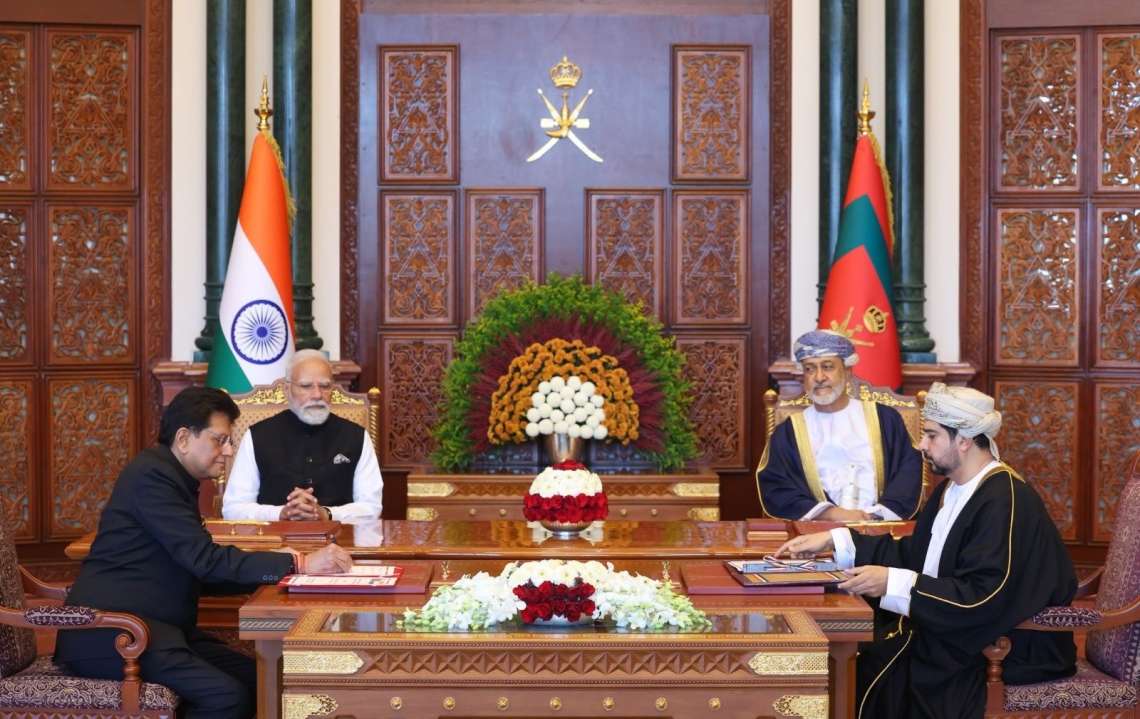
Oman and India elevate ties with a landmark CEPA and sectoral pacts, unlocking trade, investment, maritime cooperation and deeper people-to-people engagement….reports Asian Lite News
Oman and India have taken a decisive step towards deepening their long-standing partnership with the signing of a Comprehensive Economic Partnership Agreement (CEPA) and a raft of memoranda of understanding spanning trade, agriculture, education, culture and maritime cooperation. The agreements were concluded at the end of Prime Minister Narendra Modi’s two-day visit to Muscat, underscoring the growing ambition of India–Oman relations as the two countries mark 70 years of diplomatic ties.
The visit reflected the steady evolution of bilateral engagement into a comprehensive strategic partnership, built on centuries-old maritime links and reinforced by modern economic and geopolitical convergence. Both sides described the outcomes as forward-looking and mutually beneficial, with a clear emphasis on expanding trade, investment and people-to-people ties.
CEPA delivers sweeping market access
At the heart of the visit was the Oman-India CEPA, described by both leaders as a milestone in bilateral economic relations. The agreement provides zero-duty access on 98.08 per cent of Oman’s tariff lines, covering 99.38 per cent of India’s exports by value. This includes full tariff elimination for major labour-intensive sectors such as textiles, gems and jewellery, leather, footwear, engineering goods, pharmaceuticals, medical devices and automobiles, with immediate tariff elimination on nearly all covered products.
India has offered tariff liberalisation on 77.79 per cent of its tariff lines, covering almost 95 per cent of imports from Oman by value. Sensitive sectors have been excluded, particularly select agricultural products, precious metals and certain labour-intensive goods, reflecting India’s calibrated approach to trade liberalisation.
The agreement also opens new opportunities for India’s services sector. Oman’s global services imports exceed $12 billion, while India’s share remains just over 5 per cent, highlighting substantial untapped potential. CEPA allows 100 per cent foreign direct investment by Indian companies in major services sectors in Oman through commercial presence, strengthening prospects in IT services, logistics, hospitality, healthcare and professional services.
Bilateral trade between the two countries already exceeds $10 billion annually, supported by a strong Indian business presence in Oman, where more than 6,000 Indian establishments operate. Nearly 700,000 Indian nationals live and work in Oman, and annual remittances of around $2 billion underline the depth of economic and social links.
Maritime, agriculture and education
Beyond trade, the two sides adopted a Joint Vision Document on Maritime Cooperation, signalling a shared commitment to regional maritime security, the blue economy and sustainable use of ocean resources. Given Oman’s strategic location along vital sea lanes and India’s expanding maritime role, the document reflects growing alignment on regional stability and maritime governance.
Agricultural cooperation received a fresh boost with the signing of an MoU covering agriculture and allied sectors, including agricultural science, animal husbandry and aquaculture. An executive programme on millet cultivation and agri-food innovation was also adopted, promoting training, scientific exchanges and sustainable farming practices, in line with India’s global push for millets.
Education and research emerged as another key area of collaboration. An MoU on higher education is expected to facilitate faculty and student exchanges, institutional partnerships and joint research, supported by the forthcoming India–Oman Knowledge Dialogue. Health cooperation was also discussed, with proposals to strengthen collaboration in traditional medicine, including plans for an Ayush chair and an information cell in Oman.
Cultural ties were reinforced through an MoU on maritime heritage and museums, enabling joint exhibitions and research initiatives. The leaders welcomed the joint exhibition on the legacy of Indo-Oman relations and noted progress on culture digitisation projects.
Modi’s 29th global honour
The visit carried strong diplomatic symbolism. Sultan Haitham bin Tarik conferred the First Class of the Order of Oman on Prime Minister Modi, one of the country’s highest civilian honours, marking Modi’s 29th international award. The leaders held detailed consultations at Al Baraka Palace, reviewing cooperation across defence, security, energy, technology and regional issues.
Addressing the Indian community and business leaders in Muscat, Modi highlighted the vast potential for deeper economic engagement and invited Omani businesses to invest and innovate in India. India Inc has welcomed the CEPA, describing it as a strategic boost for exports, investment-led growth and long-term economic cooperation with the Gulf.