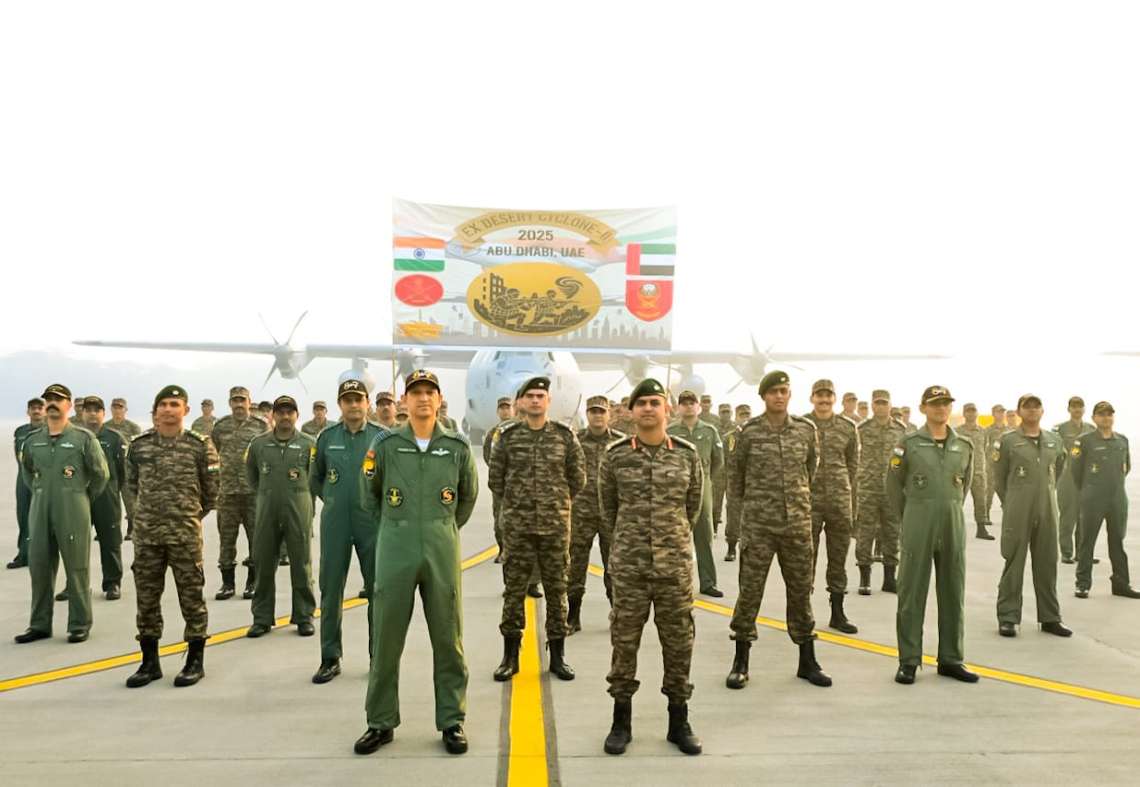
India and the UAE reinforce their strategic partnership as Exercise Desert Cyclone-II brings troops together in Abu Dhabi for intensive urban warfare and counter-terrorism training.
India and the United Arab Emirates have taken another significant step in strengthening their strategic and military partnership with the launch of the second edition of the joint military exercise, Desert Cyclone-II, in Abu Dhabi. The exercise, running from December 18 to 30, reflects the growing depth of defence cooperation between the two nations and their shared commitment to regional stability and security.
An Indian Army contingent has travelled to the UAE to participate in the exercise, marking a continuation of the close defence engagement that has gathered momentum in recent years. The Indian contingent comprises 45 personnel, primarily drawn from a battalion of the Mechanised Infantry Regiment. On the Emirati side, the UAE Land Forces are represented by a unit of similar strength from the 53 Mechanised Infantry Battalion, ensuring balanced participation and joint operational learning.
According to the Ministry of Defence, the core objective of Desert Cyclone-II is to enhance interoperability between the Indian Army and the UAE Land Forces through realistic joint training in an urban environment. The exercise places particular emphasis on sub-conventional operations conducted under a United Nations mandate, preparing both forces to operate together in peacekeeping, counter-terrorism and stability missions.
Over the course of nearly two weeks, troops from both countries will engage in an intensive programme of tactical drills designed to reflect the complex challenges of modern warfare. Training will focus on fighting in built-up areas, coordinated heliborne operations and detailed mission planning. These activities are aimed at sharpening combat readiness while also promoting seamless coordination between the two forces.
A key feature of the exercise is the integration of unmanned aerial systems and counter-UAS techniques, reflecting the evolving nature of urban conflict and the increasing role of technology on the battlefield. By jointly practising the use of these systems, both sides aim to develop shared operational procedures that can be applied in real-world scenarios.
Desert Cyclone-II builds on the strong foundation laid by recent high-level defence engagements between the two countries. The exercise follows the successful visit of the UAE Land Forces’ Commander, Major General Yousef Maayouf Saeed Al Hallami, to India in late October, as well as the visit of the Commander of the UAE Presidential Guard earlier this month. These engagements have helped deepen trust, enhance dialogue and identify new areas of collaboration.
During his visit, Major General Al Hallami held extensive discussions with India’s Army Chief, General Upendra Dwivedi, reinforcing the shared vision for closer military cooperation and regular joint training. Officials on both sides have highlighted the importance of such interactions in building long-term professional relationships and fostering mutual understanding at all levels of command.
The conduct of Desert Cyclone-II underlines the broader strategic partnership between India and the UAE, which spans defence, security, trade and technology. As two influential regional players, both nations have emphasised their shared interest in promoting peace, security and stability across the wider region.
By strengthening professional bonds, aligning tactics and procedures, and developing interoperable capabilities, Desert Cyclone-II is expected to further cement the growing military diplomacy between India and the UAE. The exercise stands as a clear signal of the trust, confidence and forward-looking cooperation that now characterise defence ties between the two countries.