New agreement aims to speed up deportations and deepen cooperation as Starmer faces pressure over rising arrivals …reports Asian Lite News
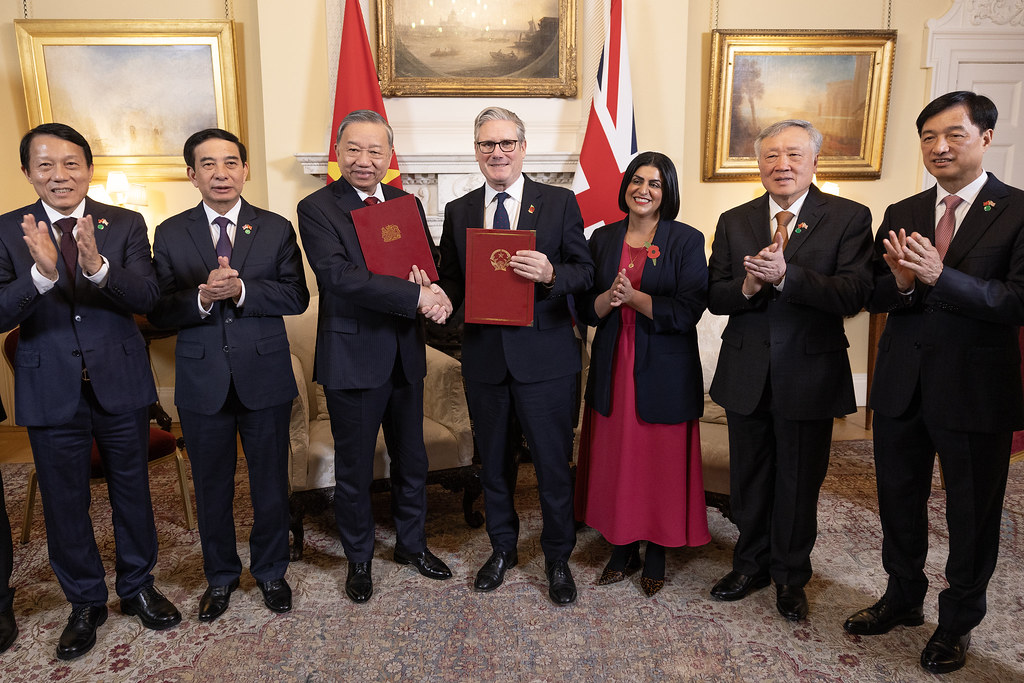
Britain and Vietnam have signed a new agreement designed to tackle illegal migration, with Prime Minister Keir Starmer hailing it as the “strongest” deal Hanoi has ever reached with another country on this issue.
The accord was announced on Wednesday following a meeting between Starmer and Vietnamese Communist Party chief To Lam in London. It comes as the Labour government faces mounting political pressure to bring down the number of undocumented migrants entering the UK, particularly through small boat crossings across the English Channel.
According to official data, Vietnamese nationals accounted for the largest proportion of foreign small-boat migrants arriving in Britain during the first half of 2024 — representing 17 per cent of all such arrivals between January and June. Overall, small-boat crossings made up 43,000 of the total 48,000 irregular arrivals in the year ending June 2025, highlighting the scale of the challenge confronting the government.
The new agreement is intended to accelerate the return of Vietnamese nationals who have no legal right to remain in the UK. Downing Street said the deal would “cut red tape” and make deportations “faster and more efficient,” signalling a shift toward stronger bilateral enforcement cooperation between the two countries.
“The number of illegal arrivals from Vietnam has already been cut by half, but more can be done,” Starmer said in a statement released after the meeting. “Today’s agreement shows that through international cooperation – not shouting from the sidelines – we can deliver for the UK and for working people.”
The government described the accord as a key step in its wider strategy to tighten control over irregular migration routes while maintaining diplomatic goodwill with countries of origin. Officials noted that the deal goes further than any previous agreement signed by Vietnam with another partner nation, setting new benchmarks for information sharing, documentation, and repatriation processes.
The talks also reflected Hanoi’s shifting approach under To Lam, who became Communist Party General Secretary last year and has since assumed a leading role in shaping Vietnam’s foreign policy. Traditionally, this function was shared among the president and prime minister, but Lam’s consolidation of power has allowed for a more assertive diplomatic posture.
For Starmer, the deal marks an important moment in his effort to reassert control over migration policy amid declining public approval ratings. Since taking office last year, the Labour government has seen support erode in opinion polls, with many voters citing concerns over immigration alongside the cost of living crisis. The surge in support for the right-wing Reform UK party — which has made border control a central issue — has further increased the pressure on Starmer to show tangible progress.
Polling consistently places immigration among the top concerns for British voters, ranking just below inflation and housing. While Labour’s focus has been on pragmatic solutions such as strengthening international partnerships and improving enforcement, critics have accused the government of moving too slowly and failing to deter Channel crossings.
Wednesday’s joint declaration went beyond migration, outlining a broader commitment to deepen ties between the two countries. London and Hanoi agreed to enhance cooperation in sectors including trade, science and technology, energy, and education. The statement said both sides aimed to “strengthen political trust and promote mutual prosperity” while addressing shared challenges such as climate change and sustainable development.
The agreement also fits into a wider pattern of post-Brexit diplomacy, as the UK seeks to strengthen relations with key partners in Asia. Vietnam has become an increasingly important player in regional supply chains and global manufacturing, offering opportunities for expanded economic engagement alongside tighter security cooperation.
For Hanoi, the partnership with London provides a means to balance ties with both Western powers and regional neighbours. The deal is also seen as a response to growing concerns about human trafficking and the exploitation of Vietnamese migrants abroad — issues that have drawn international scrutiny in recent years.
Earlier this year, Britain reached a similar understanding with France to manage cross-Channel migration. Under that arrangement, London agreed to take in a set number of legitimate asylum seekers with family connections in the UK, while Paris pledged to accept the return of undocumented migrants intercepted after crossing the Channel. The Vietnam accord is viewed as part of this evolving network of bilateral arrangements intended to manage migration flows through cooperation rather than confrontation.
While the details of implementation remain to be seen, officials from both governments expressed confidence that the new measures would yield practical results in the coming months. The British Home Office is expected to work closely with Vietnamese authorities on identification and repatriation processes, while also supporting public awareness campaigns aimed at discouraging dangerous journeys.
The success of the agreement will likely depend on how swiftly the two sides can operationalise its provisions — particularly those related to documentation and safe return. Analysts note that similar deals in the past have faltered due to bureaucratic delays and legal challenges.
For now, however, the accord offers the Labour government an opportunity to demonstrate progress on one of its most politically sensitive fronts. Whether it will be enough to reverse its slide in the polls remains uncertain, but the deal with Hanoi underscores Starmer’s preference for diplomacy over rhetoric — and his determination to show that international cooperation, rather than confrontation, can deliver tangible results.