If the carrier is truly dead, the world’s most serious navies are conducting a very expensive funeral in reverse, writes Cdr Rahul Verma (Retd)

There is a strange comfort in declaring the aircraft carrier obsolete. It sounds bold, modern and intellectually fashionable. It travels well in seminar rooms and think-tank papers, dressed in missile-age language: anti-ship ballistic missiles, hypersonics, long-range kill chains and the rising cost of floating airfields.
But from the flight deck, the argument looks different.
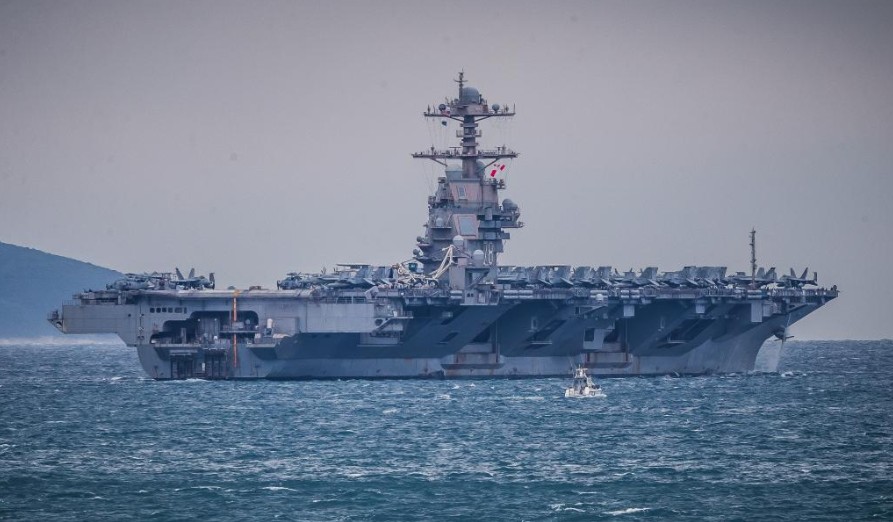
The countries most loudly cited as evidence that carriers are obsolete are the very countries building more of them. The U.S. Navy continues to operate eleven carriers and is moving ahead with the Gerald R. Ford class. China already sails three and is projected to field at least four to six by the mid-2030s, with some assessments going higher. If the carrier is truly dead, the world’s most serious navies are conducting a very expensive funeral in reverse.
This matters for India because the carrier debate is not academic. It sits at the heart of whether India remains a continental power with a navy, or becomes a true maritime power with strategic reach.
The case against carriers usually rests on two claims: that anti-ship ballistic missiles such as China’s DF-21D and DF-26 can hold them at risk from beyond the reach of carrier aviation, and that the cost of a carrier battle group can no longer be justified. Both contain real concerns. No aviator, ship’s captain or fleet commander should dismiss the missile threat lightly.
A carrier is not invincible. It never was. But vulnerability is not obsolescence. If it were, tanks, airbases, destroyers, submarines and command headquarters would all have been retired long ago.
On the cost question, the honest answer is that carriers are expensive and the opportunity cost is real. But the comparison is not carrier-versus-nothing; it is carrier-versus-equivalent-capability. Replicating the persistent, mobile, sovereign air power a carrier provides through land bases, basing agreements and forward deployments is neither cheaper nor strategically equivalent for a country with India’s geography.

The DF-21D and DF-26 are designed primarily to complicate American carrier operations within the First Island Chain. That is a real problem for the U.S. Navy. But the Indian Ocean is not the First Island Chain. The geography is different. The surveillance problem is different.
The adversary set is different. The operating spaces between Hormuz, Gwadar, Diego Garcia, the Maldives, Sri Lanka, the Andaman and Nicobar Islands and the Malacca Strait cannot be reduced to a South China Sea template.
The United States has not responded to the missile threat by sending carriers to museums. It has invested in electronic warfare, longer-range carrier aviation, layered fleet air defence, unmanned teaming and distributed maritime operations. China’s behaviour is even more instructive. Beijing has built its anti-carrier missile narrative around keeping American carriers at distance — and is simultaneously building its own carrier fleet. That is not contradiction. That is doctrine. Missiles can deny space. Carriers can influence events across it. There lies the real difference.
A shore-based missile can threaten. A submarine can ambush. A destroyer can defend and strike. A maritime patrol aircraft can search and classify. But an aircraft carrier carries sovereign air power to sea. It creates political presence without asking for basing rights. It sustains air operations where land bases are unavailable, vulnerable or politically constrained. It gives a nation options before the first shot is fired and flexibility after it.
I say this not as someone looking at a carrier from a satellite image, but as someone who has lived the environment. Four years onboard INS Viraat, and operations from carriers, destroyers and frigates, teach you that a carrier is not just a ship. It is a moving airfield, a command node, a political signal and a national instrument of will. It is also unforgiving. It demands seamanship, aviation discipline, engineering stamina and battle-group integration of the highest order.
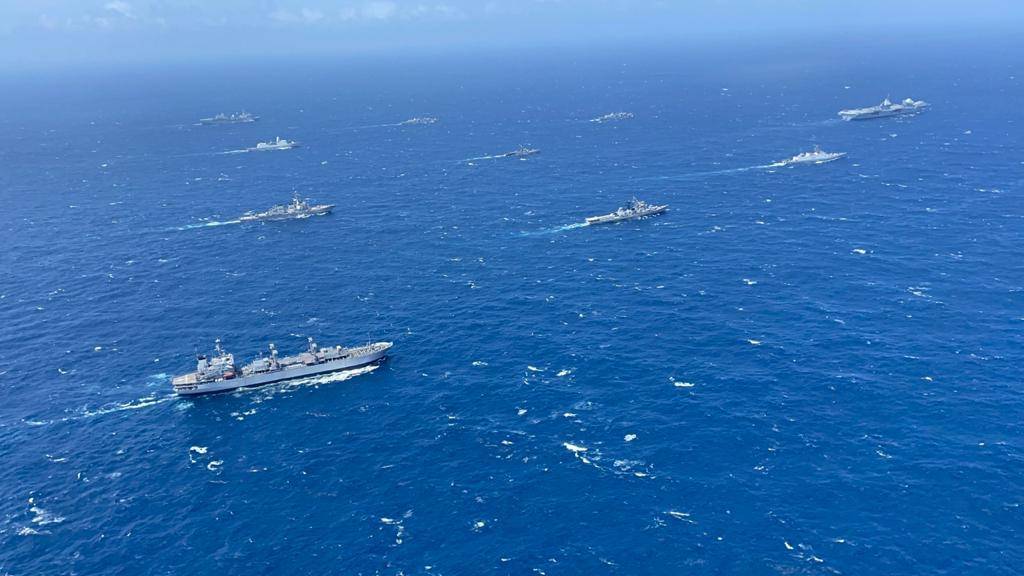
That is why the carrier cannot be judged in isolation. INS Vikrant is not meant to steam alone into a missile engagement zone like a target on a range. It operates as part of a layered system: P-8I Poseidons providing long-range surveillance and ASW reach, Kalvari-class submarines screening forward, Kolkata and Visakhapatnam-class destroyers bringing area air defence, plus frigates, tankers, helicopters, UAVs and satellites. The carrier is the anchor around which that battle group coheres.
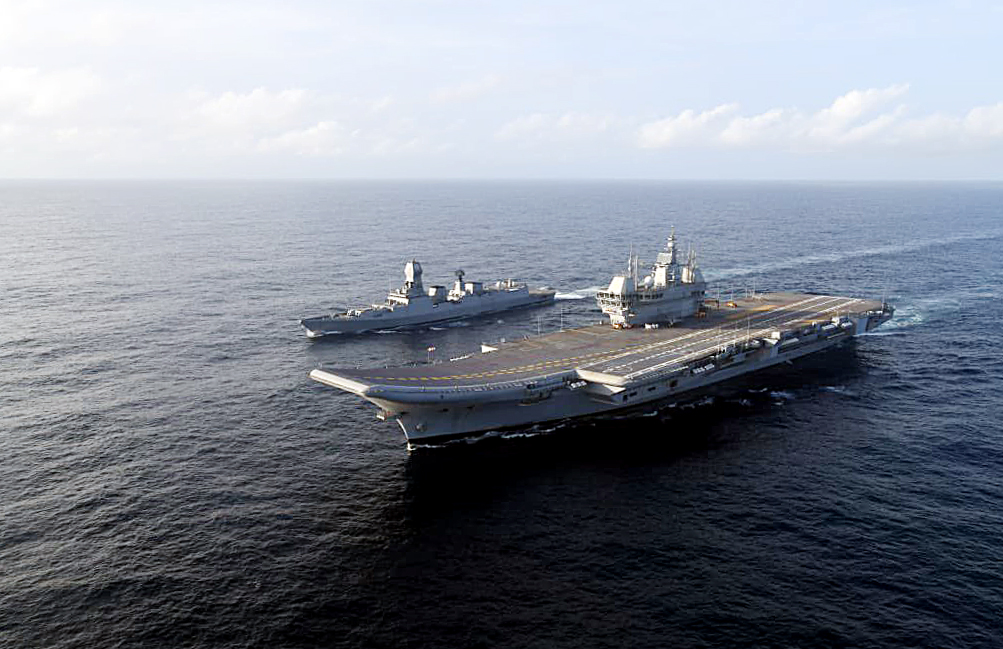
Remove it, and the Navy still has capable platforms — but they become individually capable rather than collectively decisive.
Pakistan’s coastal anti-ship capability does not by itself threaten an Indian carrier operating in the central or southern Arabian Sea under layered battle-group protection. Iran’s anti-ship inventory is more mature, but much of it is optimised for the confined waters of the Persian Gulf and the Strait of Hormuz. These are serious tactical threats in specific geographies. They are not universal arguments against carrier aviation.
India’s maritime challenge is not merely to defend its coastline. It is to secure sea lines of communication, dominate the Bay of Bengal, watch the eastern and western approaches, support island territories, respond to crises, reassure partners and deter adversaries. No shore-based aircraft can cover all of this with the persistence, mobility and political independence a carrier battle group provides.
And much of the carrier’s value sits below the threshold of war. In peacetime, it is diplomacy with a flight deck. In crisis, deterrence with options. In war, manoeuvre with air power.
The mistake is to look at a carrier only through the question, “Can it be hit?” Of course it can. Everything in war can be hit. The better question is what operational and strategic choices it creates — and what India would lose without it.
Without carriers, India’s maritime posture becomes more dependent on land bases, more predictable in reach, and more constrained by geography. The Navy becomes better at sea denial than sea control. It can contest, but not always influence. For a country with India’s trade dependence, island territories and great-power ambitions, that is a strategic narrowing we should not accept lightly.
Serious navies do not abandon difficult capabilities merely because they are expensive. They adapt them. That is what the U.S. Navy is doing. That is what China is doing. That is what India must do.
India does not need to copy the American supercarrier model. It does not need to match China hull for hull. But it does need a credible, survivable and continuously available carrier aviation capability suited to the Indian Ocean Region. That is the real significance of the IAC-2 decision.
Vikrant cannot be treated as a ceremonial symbol; it must be the foundation of a larger maritime aviation architecture — integrated with P-8I, MH-60R, indigenous fighters, UAVs, space-based surveillance, electronic warfare and future unmanned carrier-capable systems.
The future carrier battle group will not look like the past. It will be more networked, more distributed, more unmanned, more dependent on data fusion and more exposed to electronic and missile threats. But the requirement for mobile sea-based air power has not disappeared. If anything, it has become more important.
The Indian debate must move beyond lazy binaries: carrier versus missile, platform versus platform, cost versus vulnerability. The real question is whether India can afford to give up sea-based air power while China expands it and the United States continues to rely on it. That answer should be obvious.
The countries calling aircraft carriers obsolete are the ones building more of them. India should ignore the slogan, study the behaviour, and draw the correct lesson. From the flight deck, the carrier is not dead. It is being forced to evolve. And for a nation that seeks to shape the Indian Ocean rather than merely watch it, that evolution is not optional.
(Rahul Verma (Retd) is a former Indian Naval aviator, helicopter pilot and unmanned systems SME. He has served for over two decades in Naval Aviation, including more than four years onboard INS Viraat, and has flown and operated from aircraft carriers, destroyers and frigates. He writes on Unmanned Systems, Maritime Air Power, Helicopters, Autonomous Warfare and Defence Innovation. The author can be reached at: [email protected])