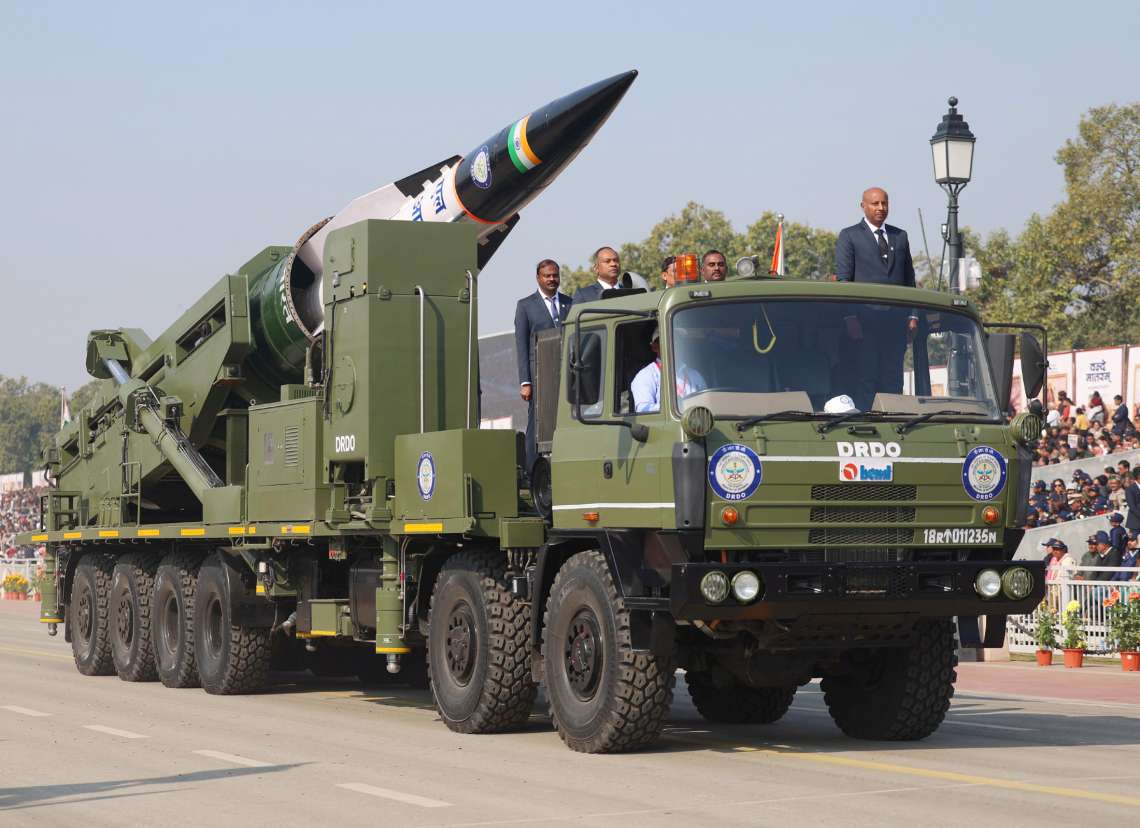
DRDO unveils India’s Long Range Anti-Ship Hypersonic Missile and advanced submarine systems at Republic Day, highlighting growing self-reliance and major strides in defence technology….reports Asian Lite News
India’s Defence Research and Development Organisation (DRDO) used the 77th Republic Day parade at Kartavya Path to showcase a range of cutting-edge, indigenously developed defence technologies, underscoring the country’s growing self-reliance and technological maturity in the military domain. The display highlighted major advances in missile systems, naval warfare and underwater combat capabilities, reinforcing India’s strategic focus on strengthening deterrence and maritime security.
The centrepiece of DRDO’s presentation was the unveiling of the Long Range Anti-Ship Hypersonic Missile (LR-AShM), a weapon system that represents a major milestone in India’s hypersonic weapons programme. Displayed with its launcher during the parade, the missile has been designed to meet the coastal battery requirements of the Indian Navy and significantly enhance its ability to strike high-value maritime targets at long ranges.
The LR-AShM is a hypersonic glide missile capable of engaging both static and moving targets. According to DRDO, the system can carry multiple types of payloads and is among the first of its kind to feature fully indigenous avionics and high-accuracy sensor packages. Its design reflects years of research into advanced guidance, propulsion and materials technologies, all developed domestically.
Technically, the missile follows a quasi-ballistic trajectory and is capable of achieving hypersonic speeds beginning at Mach 10, while maintaining an average velocity of around Mach 5 during multiple “skip” phases of flight. This unique flight profile allows the missile to travel at extreme speeds while retaining manoeuvrability, making interception extremely difficult.
One of the LR-AShM’s most critical features is its ability to engage moving targets in the terminal phase of flight. Indigenously developed sensors guide the missile with high precision, while its low-altitude trajectory, combined with speed and manoeuvring capability, limits the ability of enemy ground-based and ship-borne radar systems to detect and track it. This combination makes the weapon both highly survivable and lethal in contested maritime environments.
The missile is powered by a two-stage solid propulsion rocket motor system. After the first stage accelerates the missile to hypersonic speed and separates, the second stage provides additional propulsion before burnout. The vehicle then transitions into an unpowered glide phase, executing atmospheric manoeuvres before striking its target with precision.
Alongside the hypersonic missile, DRDO’s tableau at Bharat Parv 2026 was themed ‘Naval Technologies for Combat Submarines’ and displayed several indigenous systems designed to act as force multipliers for the Indian Navy’s conventional submarine fleet. These included the Integrated Combat Suite (ICS), the Wire Guided Heavy Weight Torpedo (WGHWT) and the Air Independent Propulsion (AIP) system, each aimed at ensuring superiority in underwater combat.
The Integrated Combat Suite is a next-generation submarine-based defence system that functions as a “system of systems”. It generates a comprehensive tactical picture by integrating data from multiple sensors, enabling commanders to make informed decisions on weapon selection, launch and guidance during underwater and anti-submarine warfare operations. The Ministry of Defence noted that the ICS was developed through collaboration among eight DRDO laboratories, with participation from nearly 150 major industry partners and micro, small and medium enterprises across the country.
The Wire Guided Heavy Weight Torpedo was showcased as the primary armament of submarines, designed to counter modern surface and underwater threats in open-ocean environments. According to the Defence Ministry, the torpedo provides a high level of lethality in anti-submarine warfare scenarios, addressing the Navy’s need for reliable, long-endurance weapons as it expands its underwater fleet to secure dominance in blue-water operations.
Another highlight was the Air Independent Propulsion system, a technology that dramatically enhances a submarine’s underwater endurance and stealth. The AIP system is powered by an indigenously developed phosphoric acid fuel cell coupled with a novel onboard hydrogen generator. By feeding hydrogen and oxygen into the fuel cell, the system produces electricity that is conditioned and fed directly into the submarine’s power line, allowing it to operate silently underwater for extended periods without surfacing. The modular nature of the AIP technology also allows it to be adapted for future submarine platforms.
Beyond naval technologies, DRDO’s contributions were visible across several Armed Forces contingents in the parade. Systems on display included the Arjun Main Battle Tank, the Nag Missile System (NAMIS-II), the Advanced Towed Artillery Gun System, the BrahMos supersonic cruise missile, the Akash air defence system, the Battlefield Surveillance Radar and Anti-Tank Guided Missile platforms.
In a statement, DRDO reiterated its role as the Armed Forces’ primary design and development agency, emphasising its commitment to the vision of Aatmanirbhar Bharat. By partnering with industry, academia and the services, the organisation said it continues to deliver advanced, mission-critical systems tailored to India’s security needs.
The indigenous development of these technologies, DRDO added, marks a significant step forward in India’s journey towards defence self-reliance and strengthens the country’s ability to safeguard its strategic interests across land, sea and air.