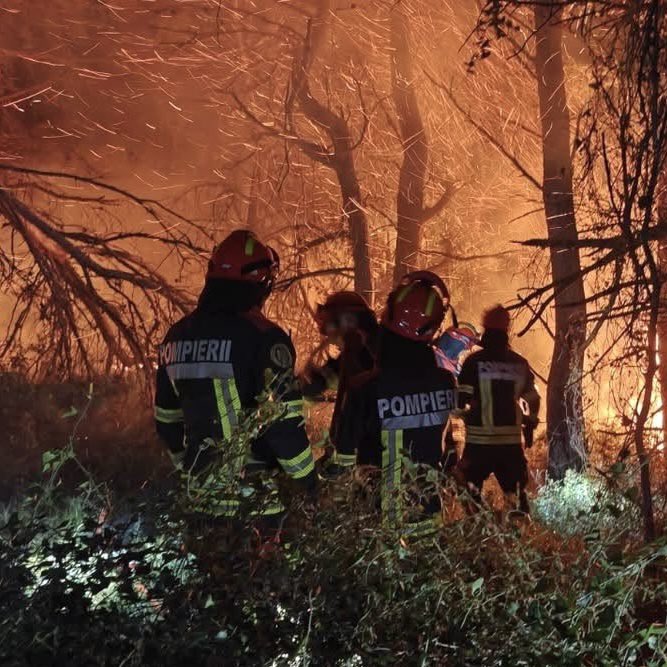
Uncontrolled wildfires are advancing towards the outskirts of Bordeaux as France and Spain battle some of the worst blazes in recent years…reports Asian Lite News Desk
Uncontrolled wildfires advanced towards the outskirts of Bordeaux on Sunday, threatening the heart of France’s renowned wine-producing region as emergency crews in France and Spain battled multiple blazes that have forced nearly 300,000 people to evacuate or remain under shelter orders.
Authorities said about 220,000 people had been evacuated across France, while more than 75,000 residents in neighbouring Spain had fled their homes. A further 30,000 people were instructed to shelter in place as fires continued to spread.
French firefighters were working to stop the flames from reaching Bordeaux after wildfires swept across the Cap Ferret peninsula, a popular Atlantic coast tourist destination, before advancing through surrounding countryside towards the regional capital.
Bordeaux Mayor Thomas Cazenave said the main firefront had reached within 15 kilometres of the city’s main entry points. While there were no immediate plans to evacuate Bordeaux, whose wider metropolitan area has a population of around 850,000, officials acknowledged the rapidly changing situation.
French Interior Minister Laurent Nunez described the crisis as unprecedented.

“We have a fire that is not under control and which is moving in the direction of the city area,” Nunez said.
“The overall situation is very unfavourable, we are in a situation that is unprecedented,” he added, stressing that authorities would continue to closely assess developments.
As the fire moved closer to populated areas, French authorities released footage showing police officers carrying out overnight door-to-door evacuations in the municipalities of Marcheprime and Cestas. Officers knocked on residents’ doors in the dark, urging families to leave their homes immediately as a precaution.
The wildfire emergency has also intensified across the border in Spain, where Prime Minister Pedro Sanchez visited fire-ravaged communities in the central province of Avila, one of three provinces, alongside Madrid and Toledo, battling major blazes.
Spanish Environment Minister Sara Aagesen said more than 50,000 hectares of land had been destroyed in Avila alone, making it the country’s largest wildfire in recent history.
Another major blaze continued to burn out of control in the eastern province of Castellon, where more than 4,300 hectares have been destroyed. The fire has spread into the Sierra de Espadan Natural Park, threatening extensive pine and cork oak forests.
“The fire is out of control, it’s very difficult to extinguish from a technical standpoint, especially because of the adverse weather conditions that will continue throughout the day,” Valencian regional leader Juanfran Perez told reporters near the scene.
European countries have stepped up assistance under the European Union’s Civil Protection Mechanism as the scale of the disaster grows.
Greece and Italy have each deployed two Canadair firefighting aircraft to Spain, while Portugal has sent more than 100 military personnel together with specialised firefighting equipment. Spain’s Interior Ministry also announced on social media platform X that two additional firefighting aircraft from Turkey are expected to arrive as soon as possible.
Prime Minister Sanchez said his government would officially declare a civil protection emergency on Tuesday for the worst-affected central provinces, unlocking recovery funds to support affected communities.
He also revealed that more than 150,000 hectares have been destroyed across Spain since January, six times the area burned during the same period last year, highlighting the scale of this year’s wildfire season.
Emergency services in both France and Spain remain on high alert as firefighters continue efforts to contain the fast-moving blazes amid unfavourable weather conditions, with authorities warning that strong winds, high temperatures and dry conditions could further complicate firefighting operations and increase the risk of additional evacuations.