More than 1,300 years after the tragedy of Karbala, thousands of mourners bring the memory of Imam Husayn, and his message of sacrifice, justice and resistance to oppression, into the heart of modern London … A special report by Mohammad Reza Amirinia
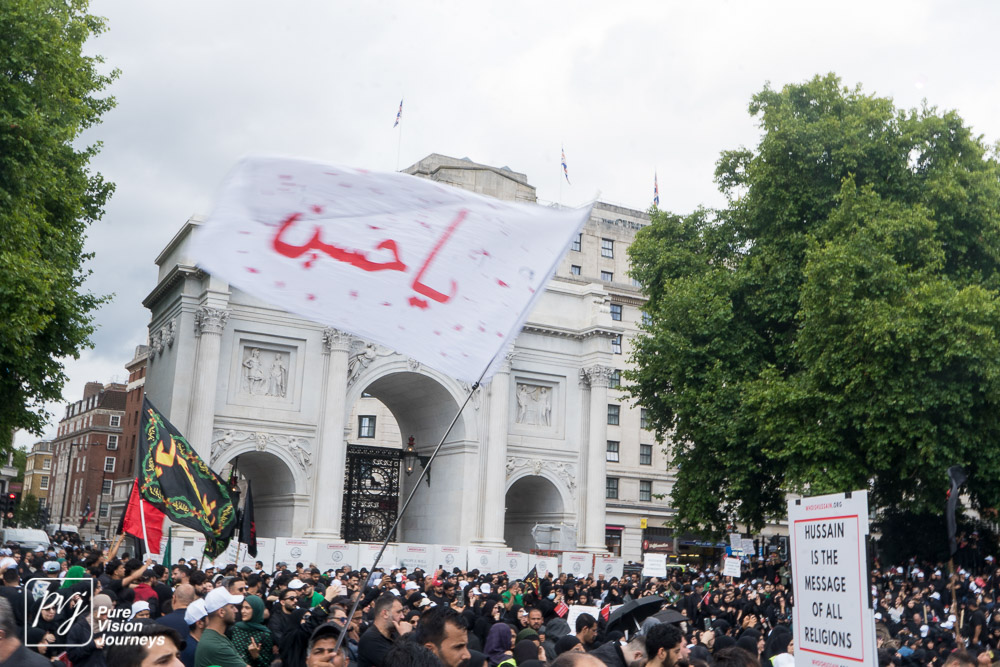
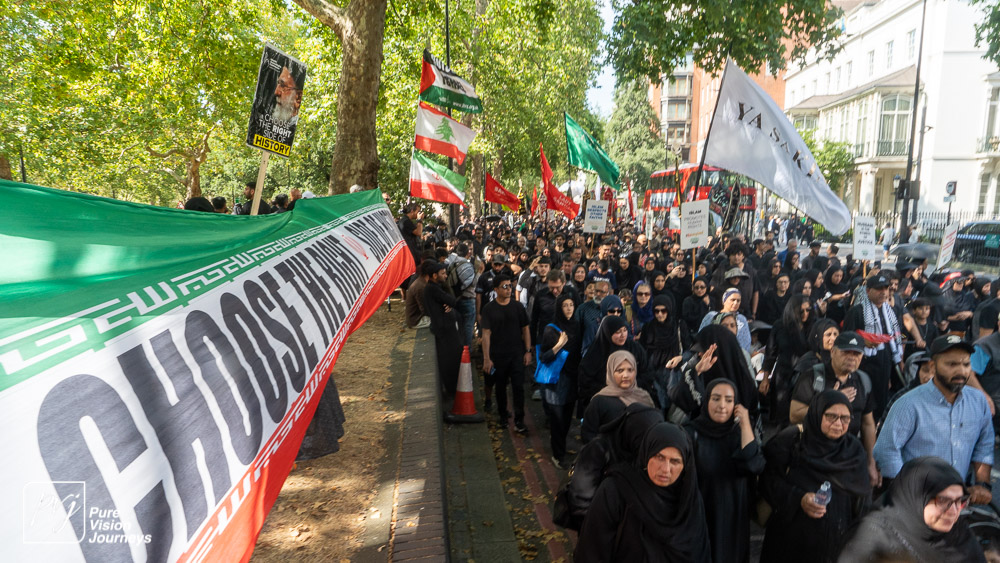
It is a bright summer day in central London. The sun is intense, yet people continue to arrive in small and large groups through the great archway of Marble Arch and gather around Hyde Park. Almost everyone is dressed in black. At first glance, it looks like a funeral. But this is something far more profound: an Ashura procession, a public expression of grief and remembrance by Shia Muslims commemorating the death of Imam Husayn, the grandson of the Prophet Muhammad, at Karbala in present-day Iraq in 680 CE.
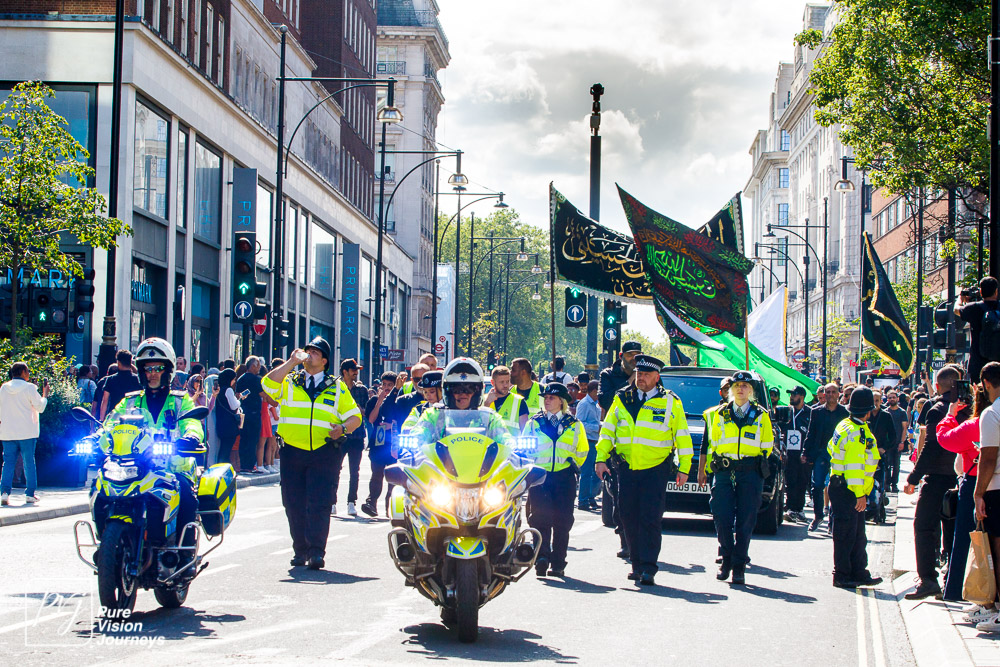
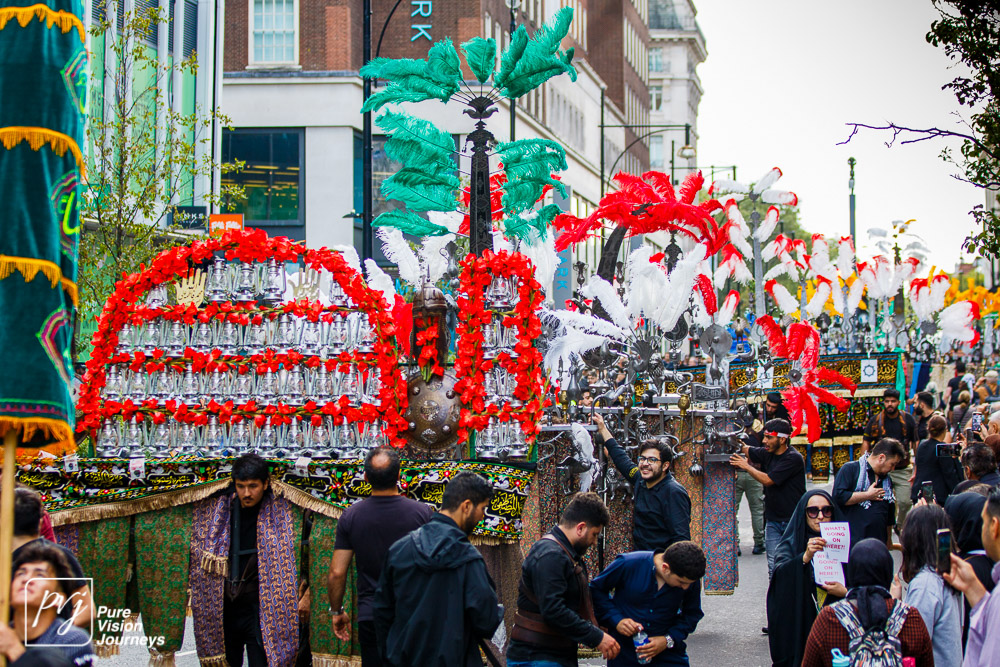
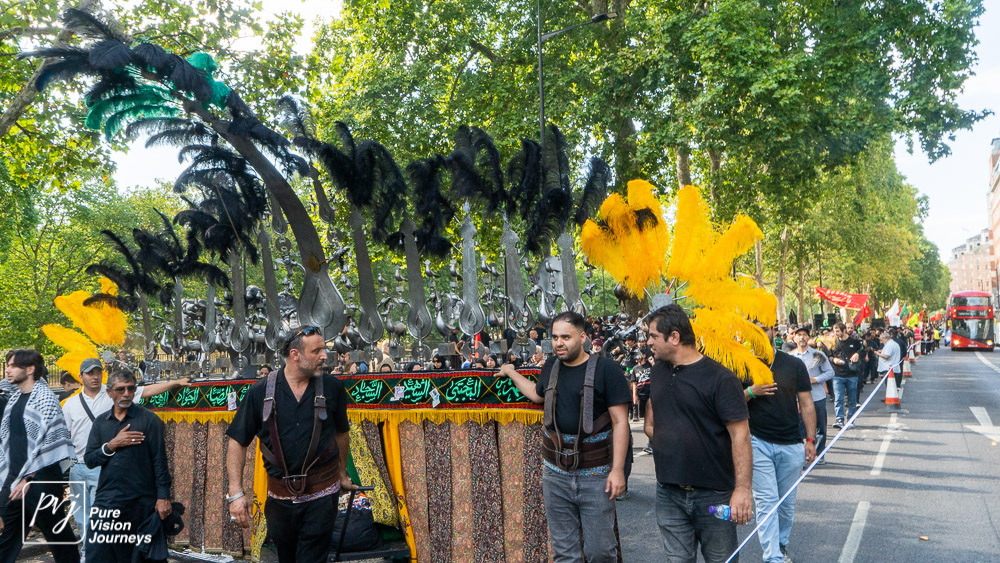
Preparations are under way. Drums and percussion instruments are being tested. Flags and banners are positioned. Above the growing crowd rise ornate alams – ceremonial standards associated with Ashura and Arbaeen.
The alams are closely associated with Abbas ibn Ali, the half-brother of Imam Husayn and standard-bearer of Husayn’s camp at Karbala. For Shia Muslims, they symbolise loyalty, courage, sacrifice and devotion. Often heavy and intricately decorated with metalwork, calligraphy and religious symbols, they are carried by participants who take turns bearing their weight. Soon, the green surroundings of Hyde Park are transformed into a sea of black.
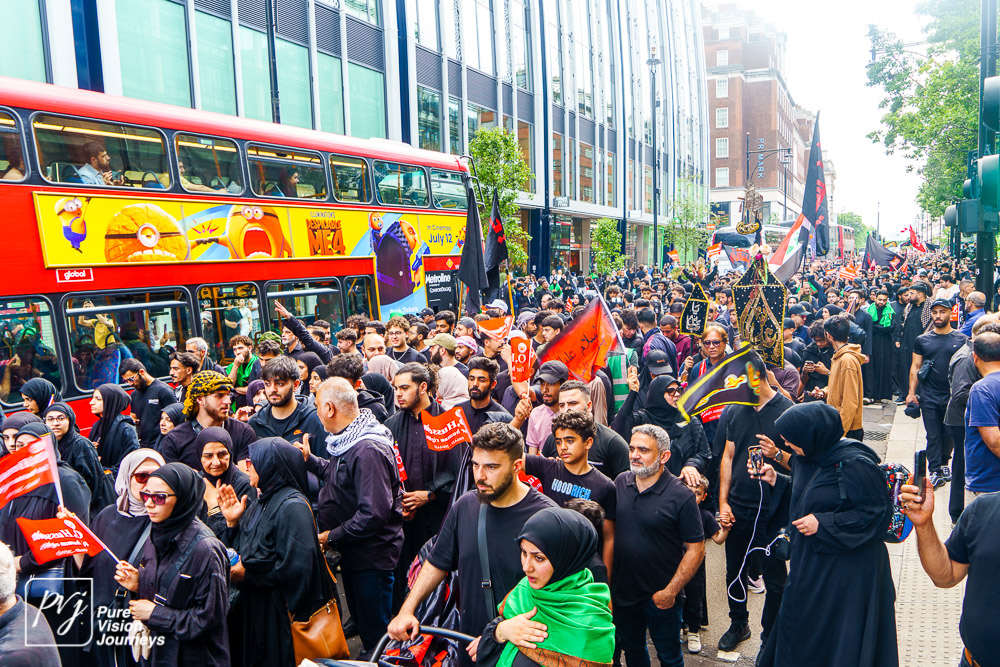
Men and women, young and old, children and babies in pushchairs are among the mourners. Green and red flags rise above the crowd, while the alams catch the sunlight.
A profound sense of grief fills the air. I have witnessed Ashura and Arbaeen processions in London over the years. Their routes and circumstances have varied, sometimes taking participants towards Notting Hill, Oxford Street, Piccadilly Circus, Trafalgar Square, Parliament Square and Downing Street, while Arbaeen processions have also travelled along Edgware Road and Park Lane.
Yet the purpose remains consistent: to remember Imam Husayn and the tragedy of Karbala, and to express values associated with his legacy – sacrifice, justice, dignity and resistance to oppression.
The sound of drums and cymbals begins to move through the assembly. A trumpet joins the rhythm. Then the lead reciter begins, his voice carrying across the crowd as he recites Qur’anic verses and mournful elegies remembering Husayn.
For an unfamiliar observer, it is an extraordinary sight. Why would a tragedy more than thirteen centuries old bring people onto the streets of London?
The answer lies in Karbala.
Husayn refused to give allegiance to Yazid ibn Mu’awiya. With members of his family and a relatively small group of supporters, he became surrounded by a much larger force. On the tenth day of Muharram, known as Ashura, Husayn and many of his companions were killed.
For generations of Shia Muslims, Karbala has come to represent much more than a historical battle. Husayn’s stand has become a symbol of sacrifice, justice, dignity and resistance to oppression. Ashura commemorates his death. Arbaeen marks the 40th day afterwards. Both remain major occasions of remembrance.
And now that remembrance has a London address.
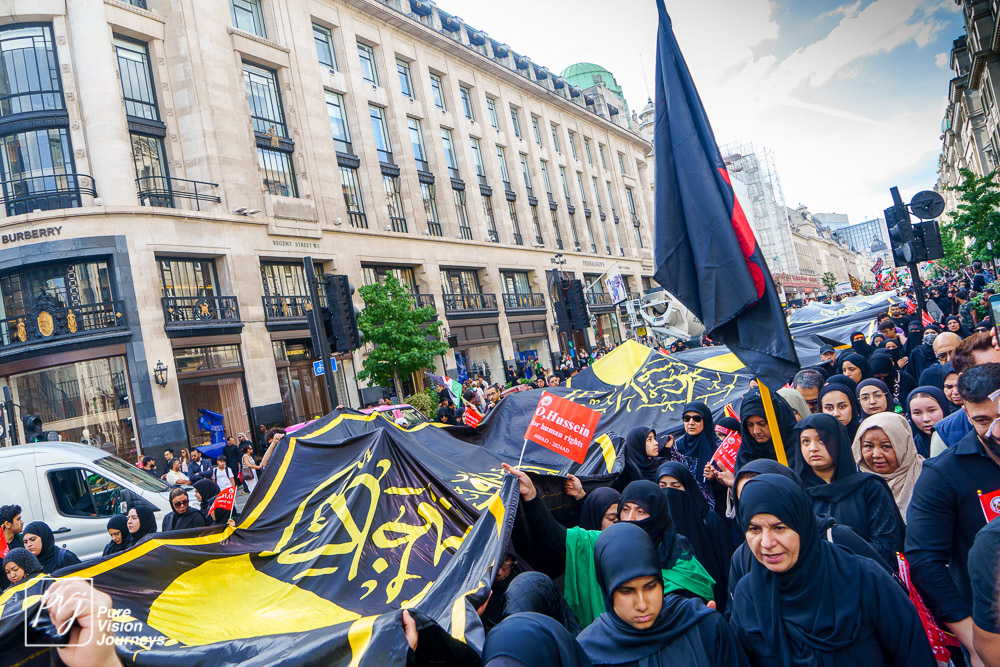
The procession moves through the streets like a black river. Participants come from Middle Eastern, South Asian, African and European backgrounds. Some have roots in Iran, Iraq, Pakistan, India and Lebanon. Others were born in Britain, while some are converts to Islam.
They are united not by nationality, but by the memory of Husayn. I see people crying. Some make no attempt to hide their tears. Others listen quietly, visibly moved by the recitations.
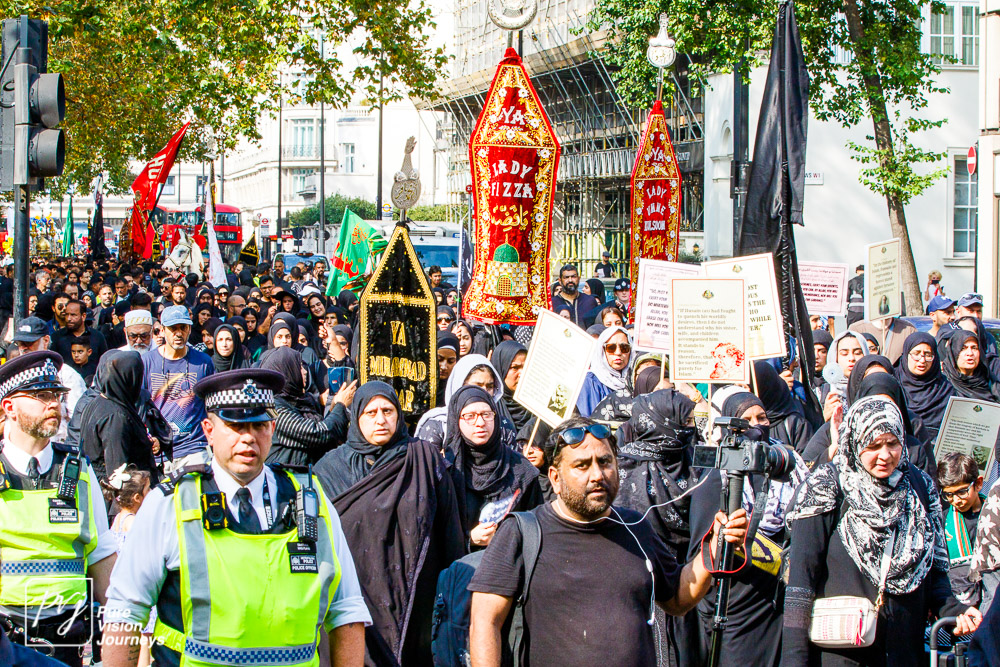
There are elderly people walking with sticks, people with disabilities, young families, teenagers and babies. Three generations of some families appear to be taking part together.
For them, this is not simply an event. It is faith, identity and collective memory.
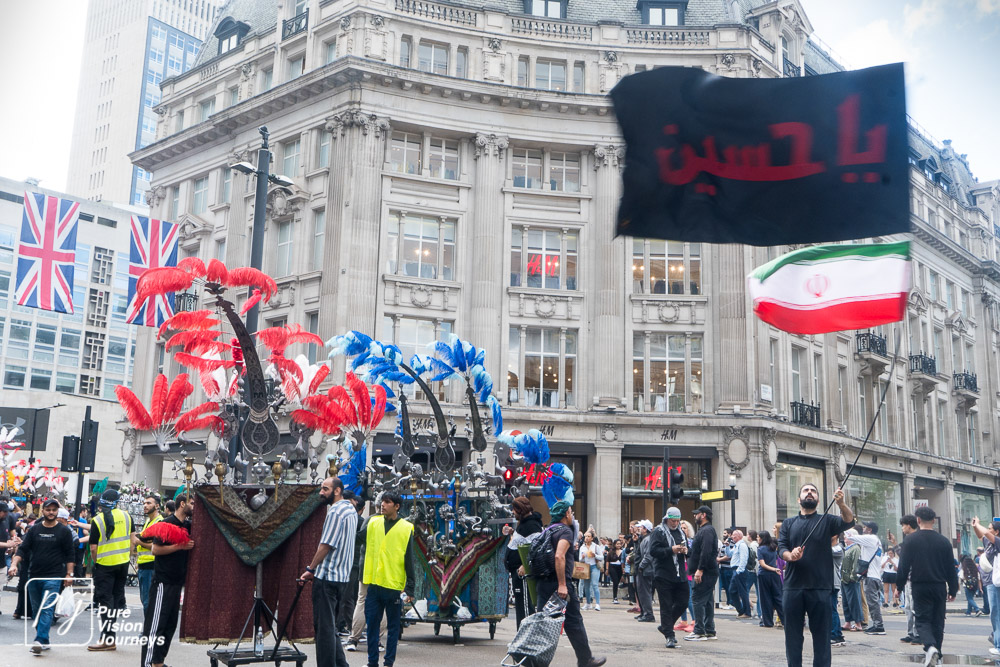
One striking feature of the procession is the mixture of traditional religious symbolism and contemporary messages. Arabic calligraphy covers many banners, while English-language signs explain the values associated with Husayn. Iraqi, Palestinian and Iranian flags are also visible. A large Iranian flag carries the English message: “Choose the right side of history.”
Another remarkable sight is a vast black Husayni mourning banner decorated with elaborate gold Arabic calligraphy, carried by dozens of participants through the streets.
Near the end of the procession, two alams are brought together. Their bearers carefully bend the standards forward, almost as if they are greeting one another. The standards are then swung and gently twisted before being raised again, their intricate metalwork glittering in the sunlight.
For many participants, the message of Karbala remains universal: standing against injustice.
From the pavement, however, the procession looks different to different people. Some spectators stop to take photographs and videos. Others ask questions or read leaflets. Some are fascinated.
Not everyone is impressed. Traffic is disrupted, and some motorists and passengers appear frustrated by the delays.
That tension is part of life in a multicultural city. A public religious gathering can be deeply meaningful to those participating while appearing unfamiliar or inconvenient to those encountering it unexpectedly. But perhaps that is also what makes London distinctive.
The capital accommodates different religions, cultures, nationalities and traditions. Ashura and Arbaeen bring a story from seventh-century Iraq into the heart of twenty-first-century London.
More than a thousand years after Karbala, the English historian Edward Gibbon wrote that the tragic death of Husayn would awaken sympathy even in a distant age and climate. Standing in modern London, his observation feels remarkably relevant.
The procession eventually disappears. The drums fall silent. Traffic resumes. Buses move again and the streets return to their familiar rhythm. But for those who marched, the remembrance does not end.
Karbala is thousands of miles away. Yet its memory is here – in London.
And the name of Husayn continues to echo through the capital.
(Mohammad Reza Amirinia is a London-based freelance journalist. For more images, please visit – https://amirinia.com/uk)