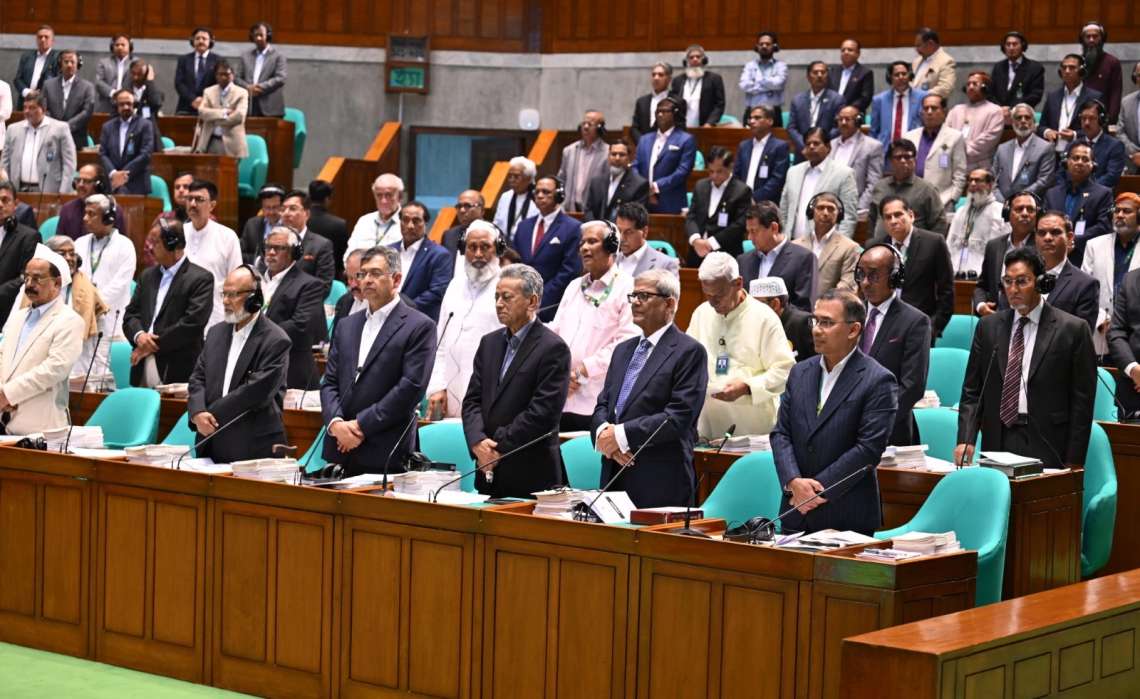
In the charged atmosphere of Bangladesh’s Parliament, a decision framed as an administrative necessity has reopened an old debate—one that touches the very foundations of accountability and civil liberties, writes Husna Beegum
Bangladesh’s Parliament has moved decisively to restore the National Human Rights Commission Act of 2009, repealing the more expansive 2025 amendment ordinance introduced by the interim administration led by Muhammad Yunus.
The passage of the National Human Rights Commission (Repeal and Re-enactment) Bill, 2026, through a voice vote marks a significant legislative reversal, one that has drawn sharp objections from opposition lawmakers and reignited concerns about the direction of human rights oversight in the country.
The decision, taken during the first parliamentary session under the current dispensation, effectively dismantles provisions that had briefly broadened the scope and authority of the commission.
The move has been described by critics within Parliament as a step backward, reviving a framework that, in their view, had previously been used to shield authority rather than scrutinise it.
2009 framework returns
The restored 2009 Act re-establishes the earlier structure of the National Human Rights Commission, a body that has long been criticised for limited autonomy and restricted jurisdiction.
The repealed 2025 ordinance had introduced several notable changes, including expanded authority to investigate complaints against the military and other disciplined forces, a departure from earlier constraints.
It had also removed the “superior orders” defence, a legal provision that allowed individuals to avoid liability by citing compliance with orders from higher authorities.

Furthermore, the ordinance had empowered the commission to initiate legal proceedings independently, intervene in court cases, and actively pursue remedies for victims.
With the repeal of these provisions, the commission’s mandate reverts to a narrower scope.
The legislative shift has therefore altered not only the institutional framework but also the balance of accountability mechanisms within Bangladesh’s governance structure.
Opposition voices and parliamentary friction
The parliamentary debate surrounding the bill revealed deep divisions. Opposition lawmaker Hasnat Abdullah voiced strong objections, arguing that the restored law had historically been used to justify actions against political opponents.
He cited past instances where the commission’s leadership appeared to endorse controversial measures taken against opposition activists.
Abdullah characterised the move as a regression, warning that the reinstatement of the 2009 framework could undermine efforts to strengthen institutional accountability.
His remarks reflected broader concerns among opposition parties, including the Bangladesh Nationalist Party, which have long accused state institutions of being leveraged against dissent.
Despite these objections, the bill was passed without a formal vote count, underscoring the limited capacity of opposition voices to influence legislative outcomes in the current parliamentary configuration.
Government’s justification
Bangladesh’s Minister for Law, Justice and Parliamentary Affairs, Md Asaduzzaman, defended the decision, presenting it as a temporary administrative measure rather than a substantive policy shift.
He argued that restoring the 2009 law was necessary to ensure the continuity of the National Human Rights Commission, particularly in the absence of a fully operational alternative framework.
According to the minister, repealing the 2025 ordinance without reinstating the earlier law would have created the impression that Bangladesh lacked a functioning human rights body.
He emphasised that the restoration was intended to remain in place pending broader consultations and a comprehensive review involving relevant stakeholders.
This explanation, however, has not fully addressed concerns about the immediate implications of the rollback, particularly given the scope of powers that have been withdrawn.
Interim ordinance: A brief expansion
The 2025 ordinance, introduced during the interim administration, had been part of a broader legislative agenda that saw the promulgation of over 130 ordinances between August 2024 and February 2026.
Among these, the amendments to the human rights framework stood out for their attempt to expand oversight and enhance accountability.
By extending the commission’s jurisdiction to include the military and other disciplined forces, the ordinance had signalled a shift towards greater institutional scrutiny.
The removal of the “superior orders” defence was also seen as aligning domestic law with international human rights principles, which generally reject such defences in cases involving serious violations.
The ordinance’s provisions allowing the commission to initiate cases and intervene in judicial proceedings further strengthened its potential role as an active watchdog rather than a passive advisory body.
The repeal of these measures has therefore reversed a set of changes that had briefly altered the landscape of human rights governance in Bangladesh.
Historical context and institutional criticism
The National Human Rights Commission, established under the 2009 Act, has faced sustained criticism over its effectiveness and independence.
Observers have pointed to its limited enforcement powers and its perceived reluctance to challenge state actions, particularly in politically sensitive cases.
Concerns have also been raised about statements made by past officeholders, which critics argue reflected a willingness to justify controversial actions in the name of maintaining order.
These perceptions have contributed to scepticism about the commission’s ability to function as an impartial arbiter of rights violations.
The decision to restore the 2009 framework has therefore revived longstanding debates about the role and credibility of the institution.
International perception and scrutiny
Bangladesh’s human rights record has been subject to periodic scrutiny by international organisations and foreign governments. The structure and functioning of oversight bodies such as the National Human Rights Commission play a significant role in shaping these assessments.
The government’s assertion that maintaining a functioning commission is essential for international perception highlights the importance of institutional continuity.
However, the nature of the framework underpinning that institution remains a critical factor in determining its credibility.
The rollback of provisions that expanded investigative authority and accountability mechanisms may influence how Bangladesh’s human rights architecture is viewed externally, particularly in the context of ongoing global discussions on governance and rule of law.
A legislative turn with wider implications
The passage of the 2026 bill represents more than a procedural adjustment. It marks a clear legislative choice to revert to an earlier model of human rights oversight, one that had been widely debated and criticised in the past.
The speed and manner of the bill’s passage, coupled with the limited scope for opposition engagement, have further underscored concerns about the legislative process itself.
The reliance on a voice vote, despite significant objections, has drawn attention to the dynamics of parliamentary decision-making in Bangladesh.
At a broader level, the episode reflects the ongoing tension between competing visions of governance—one emphasising administrative continuity and control, the other advocating expanded oversight and accountability.
An unsettled trajectory
As Bangladesh moves forward, the restoration of the 2009 human rights law stands as a defining moment in its recent legislative history. The decision has reintroduced a framework that carries both institutional familiarity and historical controversy.
The implications of this shift will likely continue to unfold, shaping debates within Parliament, influencing perceptions among observers, and affecting the operational landscape of human rights oversight in the country.
For now, the reinstated law signals a return to an earlier approach—one that places renewed focus on the balance between authority and accountability in Bangladesh’s evolving political environment.