Macron invites Modi to 2026 Évian G7 Summit as France and India seek bridge between G7 and BRICS during dual presidencies and deepen strategic ties….reports Asian Lite News
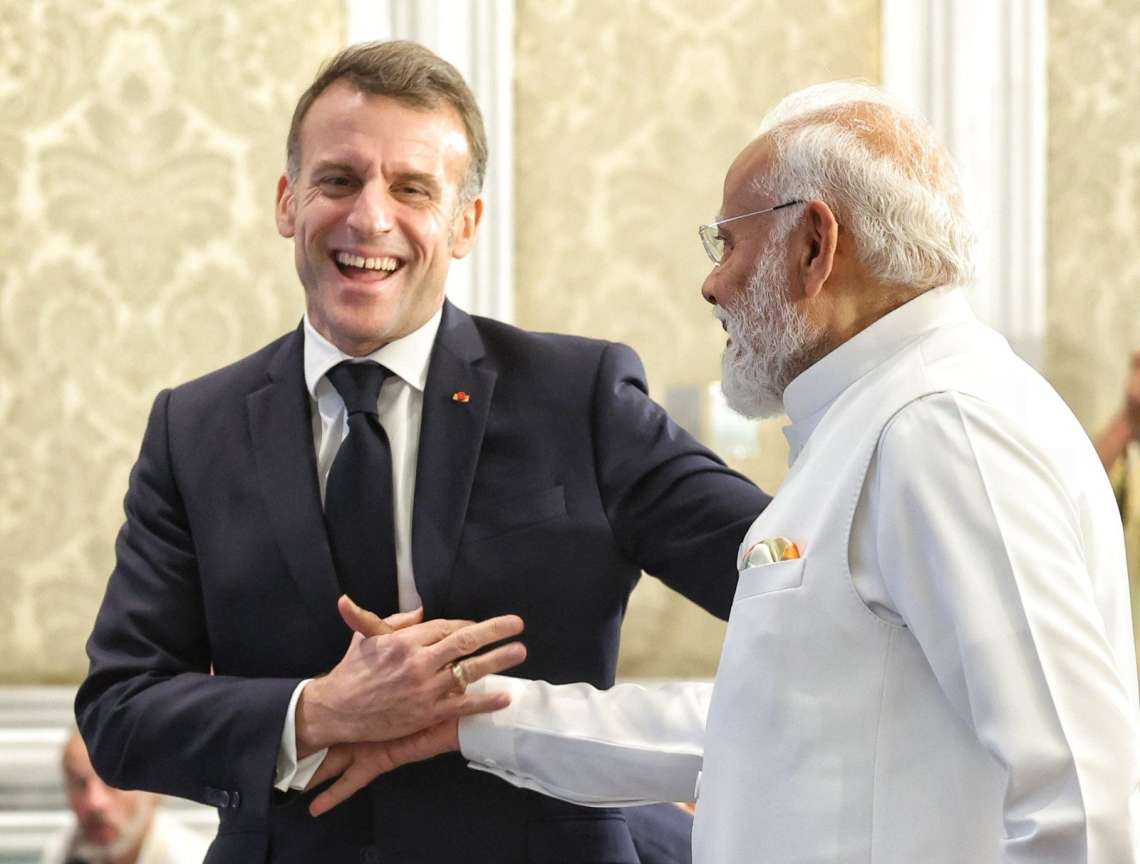
French President Emmanuel Macron has formally invited Prime Minister Narendra Modi to attend the 52nd G7 Summit, which France will host in 2026 in the lakeside town of Évian.
The invitation, announced during Macron’s visit to Mumbai, signals a renewed push to align India and France more closely on global economic governance, climate action, innovation and strategic stability at a time of shifting geopolitical currents.
Macron described 2026 as a year of “acceleration” for the India-France partnership, noting that it will coincide with India’s chairmanship of BRICS and France’s presidency of the G7. He said this dual leadership moment presents a rare opportunity to build bridges between two influential multilateral platforms that increasingly shape global debates.

In that spirit, the French President proposed holding an ad hoc bilateral meeting in the weeks leading up to the Évian summit to establish areas of concrete agreement on the international agenda. The aim, he suggested, would be to narrow differences and address major global imbalances before leaders gather at the G7 table.
The Group of Seven comprises the United States, the United Kingdom, France, Germany, Japan, Italy and Canada, along with the European Union. While India is not a member, it has been invited as a special guest on multiple occasions in recent years, reflecting its growing weight in global economic and strategic affairs.
In a joint statement, India welcomed the invitation, underlining its longstanding engagement with the G7 and commitment to constructive participation in discussions on global economic stability, development finance, resilient supply chains, climate action and international security. Both sides expressed confidence that India’s presence in Évian would strengthen collective efforts to address shared challenges and promote a more inclusive international order.
Macron also emphasised innovation and youth engagement as pillars of the next phase of cooperation. He said that during Modi’s visit, a dedicated bilateral segment would bring together young innovators from leading Indian universities and research centres with counterparts from France, Europe and G7 countries. The initiative is intended to foster collaboration in artificial intelligence, clean energy, connectivity infrastructure and other emerging sectors.
The French President stressed that the partnership between New Delhi and Paris is “stable and predictable”, built on trust and shared democratic values. Over recent years, cooperation has deepened across defence, civil nuclear energy, space, maritime security and renewable energy. France has been a key partner in India’s solar initiatives and in advancing strategic projects in the Indo-Pacific.
Trade and education were also highlighted as areas for further expansion. Macron called for stronger collaboration in research, student exchanges and commercial ties, arguing that the bilateral relationship should become even more effective in delivering tangible outcomes for both societies.
Beyond the G7, Macron recalled a separate invitation extended jointly with Kenyan President William Ruto for Modi to participate in the “Africa Forward: Partnerships between Africa and France for Innovation and Growth” summit in Nairobi. That gathering is expected to focus on energy transition, health, agriculture, artificial intelligence and the blue economy — areas where India has steadily increased its engagement across the African continent.
For India, the convergence of its BRICS chairmanship and France’s G7 presidency next year offers a platform to shape discussions across both advanced and emerging economies. BRICS — now expanded to include 11 countries such as Brazil, China, Russia, South Africa, Saudi Arabia and the United Arab Emirates — has positioned itself as a voice of the Global South, advocating reforms in global financial and governance structures.
Diplomats see Macron’s invitation as part of a broader French effort to ensure dialogue between the G7 and major emerging powers, particularly on macroeconomic coordination, climate finance and digital governance. With global supply chains under strain and geopolitical tensions persisting, closer coordination between advanced and emerging economies is viewed as increasingly vital.