At Davos 2026, the UAE showcases its growing leadership in shaping open, technology-driven global trade, positioning itself as a trusted bridge between economies in a fragmented world….reports Asian Lite News
The United Arab Emirates has used its presence at the World Economic Forum (WEF) 2026 in Davos to reinforce its growing role as a central player in shaping the future of global trade, highlighting a model built on openness, technology and strategic partnerships at a time of profound geopolitical and economic change.
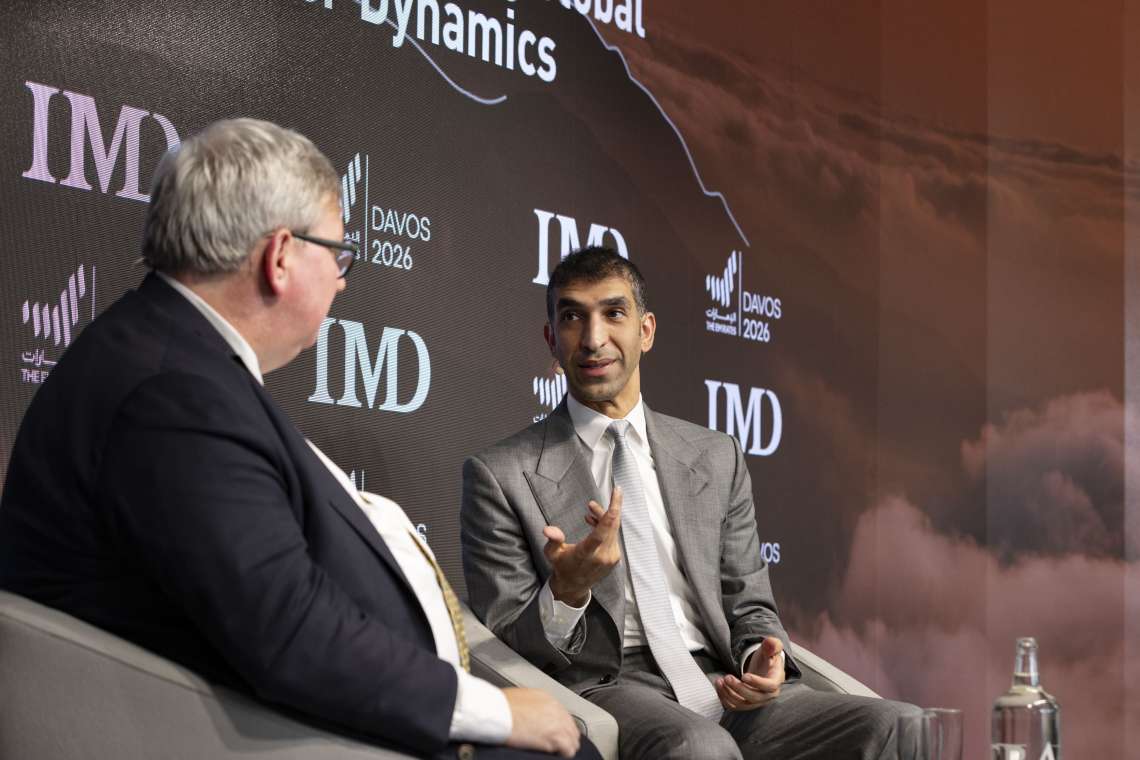
During a high-level dialogue held as part of the WEF’s official programme, the UAE set out its vision for sustaining open and rules-based trade amid rising fragmentation, supply chain realignment and shifting centres of economic power. The session brought together Dr Thani bin Ahmed Al Zeyoudi, UAE Minister of Foreign Trade, and Simon Evenett, Professor of Geopolitics and Strategy at IMD, who explored how global trade leadership is evolving beyond traditional power blocs.
Dr Al Zeyoudi said the global economy is entering a phase in which leadership in trade will increasingly be defined by credibility, adaptability and cooperation rather than sheer economic size. He argued that as some traditional trade leaders become more inward-looking, the need for agile and reliable partners capable of sustaining open markets has never been greater.
“The UAE’s approach is grounded in building bridges between economies,” Al Zeyoudi said, outlining a strategy that prioritises partnership, flexibility and the modernisation of trade rules to reflect new realities such as digital commerce, supply chain resilience and sustainable growth.
He pointed to the UAE’s expanding network of Comprehensive Economic Partnership Agreements (CEPAs) as evidence of this approach in action. These agreements, now spanning key markets across Asia, Africa, the Middle East and Europe, have strengthened the country’s role as a trusted hub linking East and West, while providing businesses with greater market access and predictability.
A central theme of the discussion was the UAE’s Future of Investment and Trade Partnership, which Dr Al Zeyoudi described as a next-generation model for global economic cooperation. The initiative aims to facilitate investment flows, modernise trade frameworks and respond to emerging challenges such as technological disruption and geopolitical uncertainty. He said the partnership demonstrates how collaborative leadership can help preserve openness while adapting to a rapidly changing global environment.
Simon Evenett placed the UAE’s strategy in a broader geopolitical context, noting that the diffusion of economic power is creating opportunities for smaller and mid-sized economies to play a stabilising role in global trade. He said countries with open policies, strong institutions and diversified partnerships are increasingly well positioned to support continuity in international commerce.
Evenett cited the UAE as an example of how proactive trade diplomacy can help maintain momentum in global trade, even as uncertainty rises. He argued that leadership is no longer concentrated in a single capital, but shared among nations that demonstrate consistency and a long-term commitment to cooperation.
The Davos dialogue coincided with the launch of the third annual TradeTech Report, a flagship publication of the TradeTech Global Initiative, a partnership between the UAE, the World Economic Forum and the Abu Dhabi Department of Economic Development. Announced during Dr Al Zeyoudi’s keynote address to the “Recoding Trade” session, the report offers a detailed assessment of how advanced technology is reshaping global supply chains.
Titled “The TradeTech Paradox: Connectivity and Fragmentation”, the report introduces the concept of the TradeTech Stack, a framework that maps how technology connects different layers of the global trading system. These include international institutions that set foundational rules, national governments that regulate trade, logistics providers that enable movement, and businesses that produce and export goods and services.
The report highlights how technologies such as artificial intelligence and blockchain are already improving customs processes, logistics coordination and cross-border payments, making trade faster, safer and more predictable. At the same time, it warns that uneven adoption and regulatory fragmentation remain major obstacles, calling for closer collaboration between governments and the private sector.
Ahmed Jasim Al Zaabi, Chairman of the Abu Dhabi Department of Economic Development, said the TradeTech Initiative has played a key role in modernising global trade since its launch in 2023, describing trade as the lifeblood of economies and communities. He said Abu Dhabi’s position as a global supply chain node places it at the forefront of efforts to make trade more efficient and resilient.
WEF President and CEO Borge Brende said technology is becoming the connective infrastructure of modern trade, helping economies maintain continuity through greater coordination and confidence in cross-border processes.
Through its engagements in Davos, the UAE has positioned itself as a forward-looking partner committed to strengthening global trade governance at a time when the system faces mounting stress. By combining diplomacy, innovation and openness, the country is seeking not only to protect global commerce but to help reshape it for the demands of the 21st century.