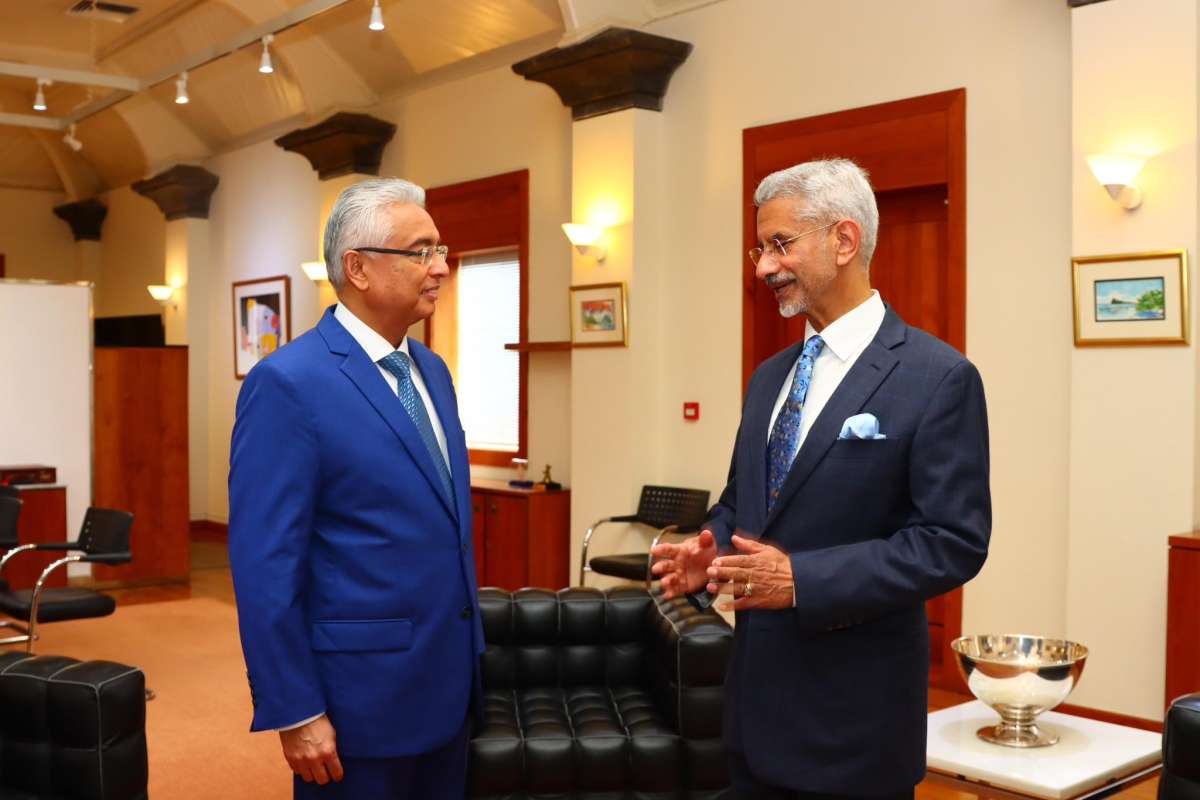
Dr S. Jaishankar recalled that he had the privilege of calling on Mauritius PM Jugnauth and conveying the greetings of PM Modi…reports Asian Lite News
External Affairs Minister S Jaishankar reaffirmed India’s consistent and continued support for Mauritius in its quest for progress, and expressed pride in being a partner of Mauritius in its journey towards modernity.
EAM Jaishankar is on a two-day official visit to Mauritius. He made the remarks at the inauguration of projects and the exchange of a Memorandum of Understanding (MoU) between India and Mauritius in Port Louis, in the presence of Mauritius Prime Minister Pravind Jugnauth.
This marks his first bilateral visit to Port Louis after being re-appointed in the third term of Prime Minister Narendra Modi’s government.
“India is truly proud to be a partner of Mauritius in your journey towards modernity and progress,” Jaishankar said in his remarks.
“Mauritius is one of the first countries that I am visiting in my current term as External Affairs Minister. It underscores the strength and depth of our bilateral ties. It is also an opportunity to underline India’s unwavering commitment to its special and enduring partnership with Mauritius,” he added.
Jaishankar further recalled that he had the privilege of calling on Mauritius PM Jugnauth and conveying the greetings of PM Modi. “I also told the Prime Minister that the people of India appreciated very deeply his presence as the Modi government was sworn in for the third time, last month,” he said.
Jaishankar reiterated that during his meeting with the Mauritius PM, they discussed various aspects of bilateral ties, including the Development Partnership, Defence and Maritime Corporation, economic and trade ties, and people-to-people linkages.
“I reiterated India’s consistent and continued support for Mauritius in its quest for progress and prosperity. After all, our ties with Mauritius benefit from four Indian priority foreign policy approaches,” the EAM said.
Jaishankar added that Mauritius is part of India’s Neighbourhood First Policy, of our Vision SAGAR, of our Africa Forward Initiative, as well as of our commitment to the Global South. “In addition, we share the closest of bonds from history and kinship,” he said.
Highlighting the deep-rooted ties, Jaishankar recalled President Draupadi Murmu’s visit to Mauritius this year as the chief guest of Mauritius National Day celebrations
“As announced then, I was honoured today to hand over the first Overseas Citizen of India cards to two very fine specimens of seventh-generation Indian origin Mauritians. This special carve-out for Mauritius further demonstrates our special and enduring ties,” he said.
Emphasising that India-Mauritius relations have actually blossomed into a robust and multifaceted partnership, Jaishankar said that it serves as a role model for India’s successful development collaboration abroad.
“…I am privileged to join him tomorrow, in inaugurating the Mediclinic in Grand Bois, built with Indian grant assistance, adding to a list of signature projects here. I will also visit another Indian assisted project, the Civil Service College in Moka, which will be ready for inauguration soon,” he noted.
Highlighting the community development projects, Jaishankar underscored that they have virtually inaugurated 12 of them today, and with this, 37 out of 96 such community projects have become operational in the span of just one year.
“Eight more, I understand, will be inaugurated in the next two months in Rodrigues and Agalega,” he added.
On space cooperation, he said that it has been translated into a concrete project with the exchange of Project Plan Document between India’s ISRO and Mauritius MRIC.
“We look forward to its early implementation so as to launch a satellite for Mauritius,” EAM said.
Jaishankar expressed pleasure in handing over the royalty payment cheque of 1.3 million Mauritian rupees towards revenues earned from the sale of Mauritian nautical charts produced by our joint hydrography service.
“This maritime collaboration is now nearly two decades old and has added value to our multifaceted cooperation,” he stressed.
He said that both nations will support the Mahatma Gandhi Institute in digitising the documented records of indentured workers, as well as provide training to MGI staff through the National Archives of India.
They also agreed to renew the term of the ICCR Chair in Sanskrit and Indian Philosophy at the MGI for another five years, Jaishankar said.
Highlighting the issue of Chagos, Jaishankar reaffirmed India’s support for Mauritius.
“India will continue its consistent support to Mauritius in line with its principal stand on decolonization and support for sovereignty and territorial integrity of nations,” he said.
Jaishankar’s visit to Port Louis comes around a month after PM Jugnauth visited India for the swearing-in ceremony of Prime Minister Narendra Modi along with his new cabinet and Council of Ministers. (ANI)
Jugnauth lauds scope of India-Mauritius space cooperation
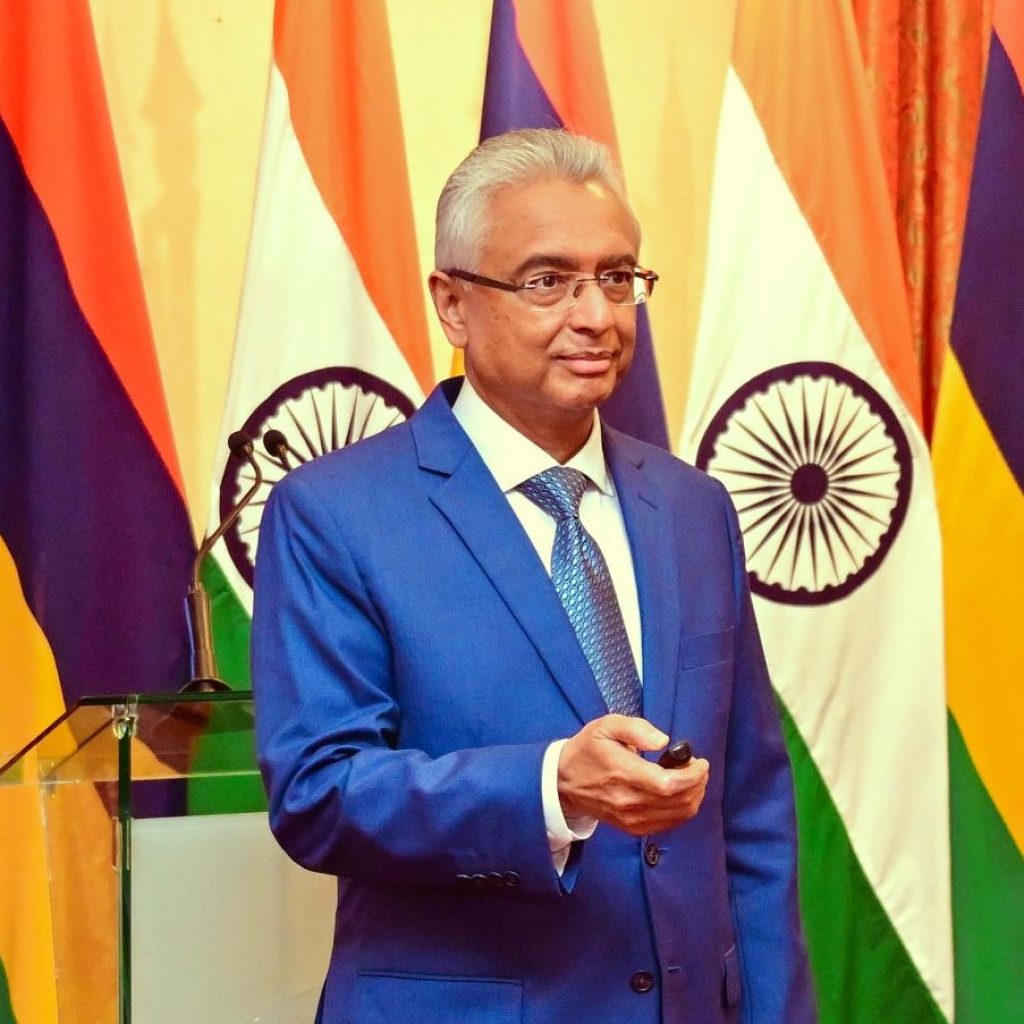
Mauritius Prime Minister Pravind Jugnauth said that the overall scope of space cooperation between India and Mauritius will foster a new era, that would allow the flow of data relating to the territory.
He made the remarks at the inauguration of projects and the exchange of a Memorandum of Understanding (MoU) between India and Mauritius in Port Louis. External Affairs Minister S Jaishankar was present on the occasion. Pravind Jugnauth spoke about his meeting with External Affairs Minister S Jaishankar.
He said, “This morning, I had a bilateral meeting with His Excellency, Dr Jaishankar. During this, we had truthful discussions on the future contours of a strategic partnership between Mauritius and India. A moment ago, we proceeded with an e-inauguration of 12 high-impact community development projects which will benefit the entire population.”
Speaking about the exchange of project plan document for India-Mauritius joint satellite between ISRO and MRIC, Jugnauth said, “Following the launching ceremony, we had exchange of instruments, cooperation which relate to development of National institute for curriculum research, Mauritius for the Mauritius Institute of Education, the digitisation of the Indian immigration archives at the Mahatma Gandhi Institute, the Indian Council for Cultural Relations, and the Chair for Sanskrit and Indian philosophy at the Mahatma Gandhi Institute, the exchange of the project plan document for India-Mauritius joint satellite between the Indian Space Research Organisation and Mauritius Research and Innovation Council.”
He stressed that Mauritius remains committed to maximise the use of renewable energy as mentioned in the renewable energy roadmap 2030.
Stressing that space cooperation will foster a new era, Jugnauth said, “The overall scope of the India-Mauritius space cooperation will foster a new era, which will allow the flow of data pertaining to our territory, the establishment of India-Mauritius space portal providing value-added services and will unlock new avenues for the utilisation of space technologies. Mauritius remains committed to maximise the use of renewable energy as laid out in the renewable energy roadmap 2030. I know we can count on India’s support in achieving these objectives.”
He recalled his participation at the G20 Summit held under India’s Presidency in Delhi in September last year.
Jugnauth said, “Invitation extended by Indian Prime Minister Narendra Modi which allowed me to represent Mauritius at 2023 G20 summit, held in New Delhi provided our republic with a high-level platform to voice our concerns and ambitions regarding the various challenges posed by climate change.”
He announced that the Mauritius government has setup a committee to devise a set of guidelines and a master plan to revive the Ganga Talao spiritual sanctuary compound into a religious and cultural hub.
Mauritius PM said, “You will recall that during the recent of President Droupadi Murmu, it was announced that the government of India will support Mauritius in redevelopment of the sacred Ganga Talao spiritual sanctuary compound into religious and cultural hub. In that regard, I am pleased to announce that the government of Mauritius has setup a committee to devise a set of guidelines and masterplan to revive the sacred place. The government of India will help us in implementing the project.”
ALSO READ-Fight against terrorism SCO’s priority: Jaishankar