December 3, 2025
2 mins read

Deadly IED Blast Rocks Khyber Pakhtunkhwa

Pakistan has witnessed an increase in militant activities in the past year, particularly in Khyber Pakhtunkhwa and Balochistan…reports Asian Lite News

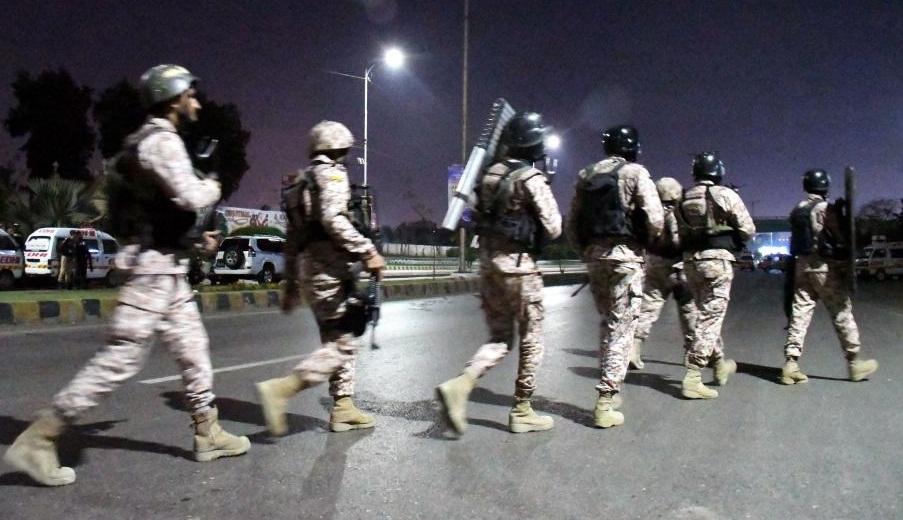
Three police officers including an assistant sub-inspector (ASI) were killed in a blast targeting a police vehicle in Dera Ismail Khan, Khyber Pakhtunkhwa, Pakistan on Wednesday.  Local media reported this, citing district police spokesperson Yaqoob Zulqarnain.

Zulqarnain stated that an improvised explosive device was used to carry out the blast in the Paniyala area, Pakistan’s leading daily Dawn reported.

The police spokesperson stated that ASI Gul Alam, Constable Rafiq and the driver of the mobile van, Sakhi Jan, were killed in the attack while another constable accompanying them remained unhurt.

He said that the security personnel had cordoned off the site of the incident, and a search operation had been launched. He said, “Police are searching for the attackers, and the matter is being investigated from all angles.”

Four people, including the senior government official and three others, were injured after a convoy of North Waziristan Assistant Commissioner Shah Wali Khan was targeted in Khyber Pakhtunkhwa, Pakistan-based Samaa TV reported.

Shah Wali Khan was travelling with his security squad on the Bannu–Miranshah Road when attackers targeted his convoy near Masoomabad Mamandkhel. He died on the spot, while two security police personnel and a passerby were also killed in the attack.

Three people, including two members of Shah Wali Khan’s security staff and the convoy’s driver, were injured in the incident. All injured people were taken to the hospital for treatment.

Pakistan has witnessed an increase in militant activities in the past year, particularly in Khyber Pakhtunkhwa and Balochistan, after Tehreek-i-Taliban Pakistan (TTP) ended its ceasefire with the government in November 2022.

On Monday, a police personnel was killed, and three others were injured in a suicide blast targeting a security vehicle in Lakki Marwat district of Khyber Pakhtunkhwa. Lakki Marwat District Police Officers’ spokesperson Asif Hassan stated that a Tajori police mobile was targeted in a suicide blast and identified the deceased as head constable Alauddin. He stated that the bomber’s accomplice fled from the spot.

Meanwhile, Islamabad-based Centre for Research and Security Studies (CRSS) in its latest security report has revealed that Pakistan has witnessed an over 46 per cent rise in overall violence in its security landscape for the third quarter of 2025.

As per the report, Pakistan reported at least 901 fatalities and 599 injuries — among civilians, security personnel, and outlaws – resulting from 329 incidents of violence, including “terror” attacks and counter-terror operations.

Pakistan recorded 1,527 fatalities between January and September 2024 (Q1-Q3). The 2414 fatalities during the same period showcase a surge of 58 per cent in violence. However, the source of fatalities has shifted. As many as 505 deaths were reported due to security operations in 2024, while 1022 people died due to “terror” attacks.

Previous Story

Priesner Takes Charge at UN India

Next Story

Kerala’s Changing Food Culture

Previous Story

Priesner Takes Charge at UN India

Next Story

Kerala’s Changing Food Culture

Latest from -Top News

Pakistan Risks Overstretching Itself in Yemen War

Pakistan’s expanding military role in Saudi Arabia amid the Yemen conflict could strain its defence resources and fragile finances…reports Asian Lite News Desk Pakistan’s military involvement in the war in Yemen may prove unsustainable because of mounting financial pressures and competing security demands, according to a new report. Islamabad’s growing military presence in Saudi Arabia risks stretching its defence resources while exposing the country to greater strategic and economic challenges. An article by Andrew Wilson in One World Outlook describes Pakistan’s involvement as a case of “fiscal and strategic overreach”, arguing that the country lacks the financial flexibility to sustain an expanded military commitment. Pakistan’s external finances depend heavily on an International Monetary Fund (IMF) programme, financial support from Gulf countries and remittances from Pakistani workers in the region. The report argues that deeper military involvement in the conflict could place additional pressure on these sources of financial stability. It also warns that deploying troops and military equipment abroad could weaken Pakistan’s capacity to address security challenges along its eastern border and deal with two domestic insurgencies. The move could also draw Islamabad into a conflict it has sought to approach cautiously. A Reuters report in May, citing Pakistani security and government sources, said Islamabad had deployed around 8,000 troops, a squadron of approximately 16 aircraft, mostly JF-17 fighter jets, two drone squadrons and a Chinese HQ-9 air-defence battery to Saudi Arabia. According to those sources, Riyadh was financing the deployment, with Pakistani personnel operating the equipment. The sources also said a confidential agreement contemplated the possibility of deploying up to 80,000 troops. Islamabad has not confirmed those figures, although it has acknowledged its military presence in Saudi Arabia, including the deployment of fighter jets at King Abdulaziz Air Base from April. The One World Outlook article argues that Saudi financial support can cover allowances and operating expenses but cannot easily replace military equipment needed elsewhere or resolve the political and strategic challenges of participating in the Yemen conflict. Pakistan’s defence budget is another concern. For the 2026-27 financial year, the federal government allocated PKR 3 trillion, or approximately $10.8 billion, to defence services. The allocation represents an 18 per cent increase from the original PKR 2.55 trillion provision and amounts to around 2.1 per cent of projected gross domestic product (GDP). Defence spending accounts for approximately 16 per cent of the federal government’s PKR 18.8 trillion expenditure. Military pensions are budgeted separately at PKR 822 billion, while debt servicing costs stand at approximately PKR 8 trillion, more than two-and-a-half times the defence allocation. The report argues that these competing financial obligations leave little room for additional military expenditure without placing further pressure on public finances. Pakistan’s reliance on IMF assistance also limits its fiscal flexibility. The country must meet the conditions attached to the programme, including a primary budget surplus target of 2 per cent of GDP and continued restraint on development spending. According to the article, these requirements make it difficult for Islamabad to finance an additional military commitment without compromising other budgetary priorities. Pakistan’s economic indicators offer limited reassurance. Economic growth for the 2025-26 financial year is estimated at between 3.6 and 3.7 per cent, while inflation reached approximately 10.3 per cent in September following an energy price shock. Foreign exchange reserves stood at around $21.5 billion at the end of September. Although this marks an improvement from the low levels recorded in 2023, the report notes that the reserves cover only a few months of imports. Financial assistance from Gulf partners remains central to Pakistan’s external stability. The article says Islamabad holds approximately $8 billion in Saudi deposits at its central bank. In July, the State Bank of Pakistan said Riyadh had extended the maturity of $5 billion in deposits to December 2028, easing the country’s immediate external financing requirements. A further $3 billion deposit was also extended in the spring. However, the article argues that these arrangements provide temporary relief rather than long-term financial independence, particularly as regional conflict threatens the stability of the Gulf economies on which Pakistan relies. The report concludes that Pakistan faces a difficult balance between supporting Saudi Arabia militarily and preserving the financial and military resources needed to address its domestic and regional challenges.
Go toTop

Don't Miss

Pak’s Punjab to remove TLP’s proscribed status

Punjab home department sent a summary to CM Usman Buzdar

Thousands on streets in Gwadar as protests enter Day 17

Thousands of people, including women and children, continued protesting in