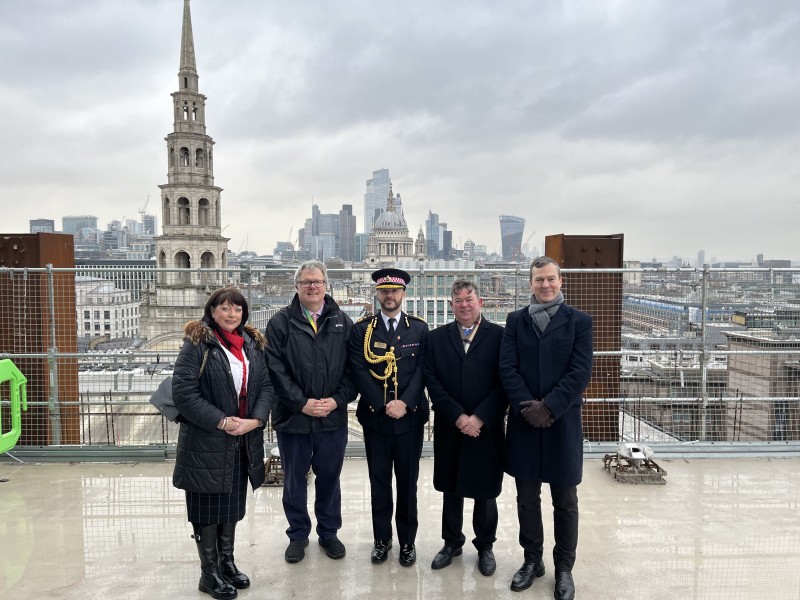
A protest outside Iran’s diplomatic mission in London escalated on Saturday when a demonstrator climbed on to a balcony and pulled down the Iranian flag, drawing a police response and arrests but no serious disorder…reports Asian Lite News
A man was filmed scaling the balcony of the Iranian embassy in Kensington and removing the national flag during an anti-regime demonstration in central London. Social media footage appeared to show the protester replacing it with the pre-Islamic revolution lion and sun emblem, a symbol commonly used by Iranian opposition groups. The act took place as hundreds gathered outside the embassy to condemn the Iranian government and express solidarity with protesters inside the country.
The embassy later responded online, posting a photograph of the flag restored to its pole with the caption “Iran’s flag is flying high”. The Metropolitan Police said the protest reached an estimated peak attendance of between 500 and 1,000 people on Saturday, with officers maintaining a visible presence around the diplomatic premises throughout the day.
Police confirmed that two arrests were made. One person was arrested on suspicion of aggravated trespass and assault on an emergency worker, while another was arrested for aggravated trespass. Officers said they were also seeking another individual in connection with trespass. In a statement, the force said: “We saw no serious disorder and officers will remain in the area to ensure the continued security of the embassy.” The policing operation focused on preventing escalation and safeguarding the embassy, which is protected under international law.
The London protest formed part of a wider series of demonstrations outside Iranian embassies and consulates across the world. In Berlin, hundreds of demonstrators were seen marching through the German capital, waving Iran’s former imperial flag and carrying images of the exiled crown prince, Reza Pahlavi. Similar rallies have been reported in other European cities, North America and Australia, reflecting the global reach of opposition networks and diaspora communities.
Inside Iran, the demonstrations began on 28 December and have since developed into the most significant challenge to the Islamic Republic for several years. What initially started as anger over the country’s struggling economy has broadened into open defiance of the political system and its leadership. Protesters have taken to the streets in cities and towns across the country despite a heavy security presence and reports of violent repression.
The foreign secretary, Yvette Cooper, praised Iranians who have continued to demonstrate in the face of the crackdown and said those speaking out against the government of supreme leader Ayatollah Ali Khamenei should not face “the threat of violence or reprisals”. She said: “It takes real courage to speak up in an authoritarian system, especially for young women, but it should not require courage just to make your voice heard. These are fundamental rights: free speech; peaceful assembly; and the exercise of those rights should never come with the threat of violence or reprisals. That is why the UK, France and Germany made the statement we did, and we urge the Iranian authorities to listen.”
Earlier in the week, the prime minister, Keir Starmer, condemned the killing of protesters in Iran and urged Tehran to “exercise restraint” amid an intensifying crackdown on demonstrations. His comments came as international concern mounted over the scale of the violence and the restrictions imposed by the authorities.
At least 62 people are reported to have been killed during weeks of unrest, while around 2,300 people have been detained, according to figures cited by activists and human rights groups. The Iranian authorities have not provided comprehensive official casualty figures. In response to the protests, Iran’s leaders have shut down access to the internet and restricted international telephone calls, measures that have made it harder to verify events on the ground and communicate with the outside world.
A UK government spokesperson said: “We are deeply concerned by reports of violence against protesters in Iran who are exercising their legitimate right to peaceful protest and are monitoring the situation closely.” The statement echoed similar expressions of concern from European allies and human rights organisations.
Reza Pahlavi, the exiled son of the former shah of Iran, has sought to galvanise opposition by calling on protesters to take to the streets over the weekend and seize control of their towns. Based in the United States, Pahlavi, 65, used social media to urge supporters to hoist the pre-1979 lion and sun flag, which was used during his father’s rule. He said the Islamic Republic would be brought “to its knees”, adding: “Our goal is no longer merely to come into the streets; the goal is to prepare to seize city centres and hold them.”
In London, the demonstration outside the embassy ended without major violence, but the images of a flag being torn down on a diplomatic building underscored the intensity of feeling among protesters. Police said officers would continue to patrol the area to ensure security, as the situation in Iran and the international response to it remain highly charged.