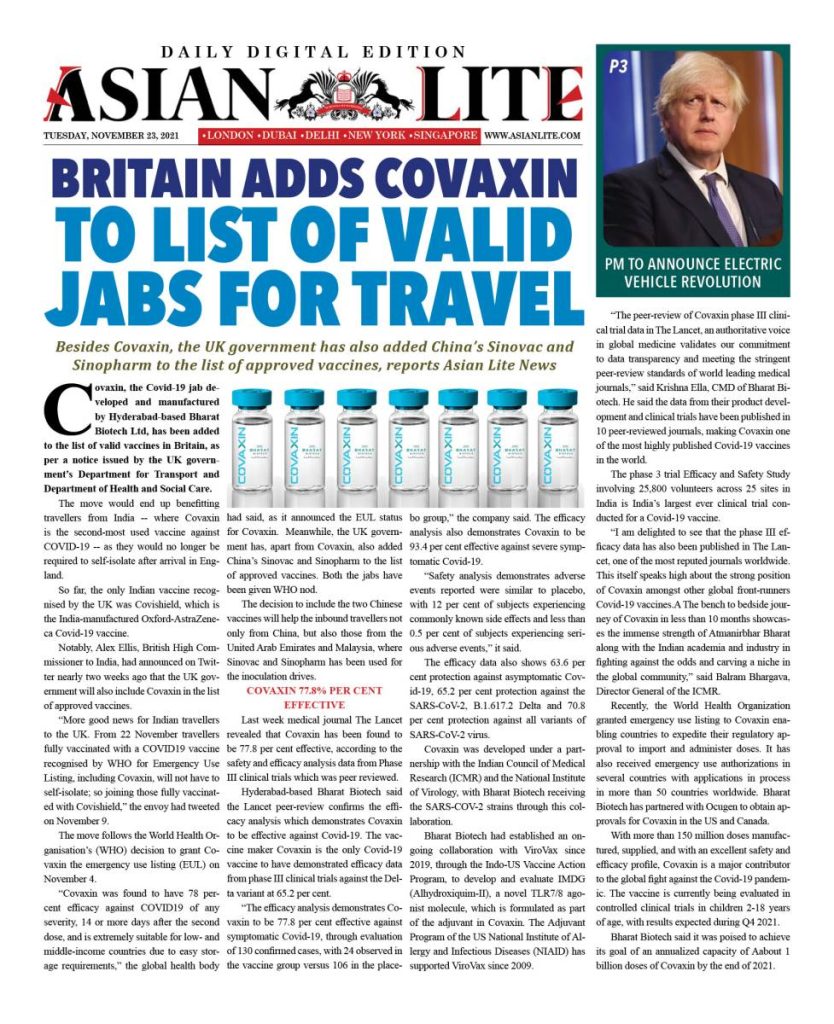
Besides Covaxin, the UK government has also added China’s Sinovac and Sinopharm to the list of approved vaccines, reports Asian Lite News
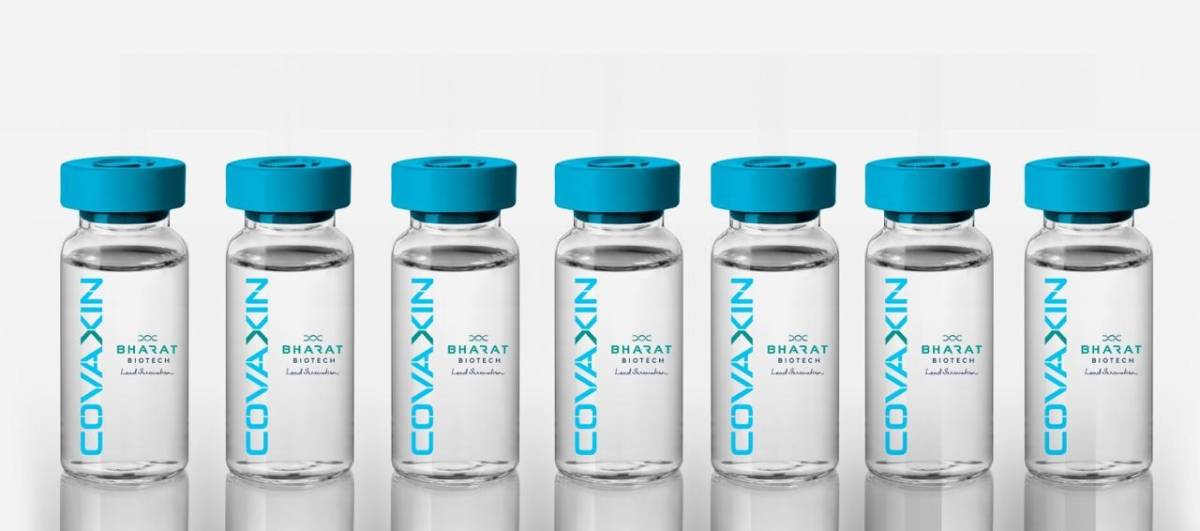
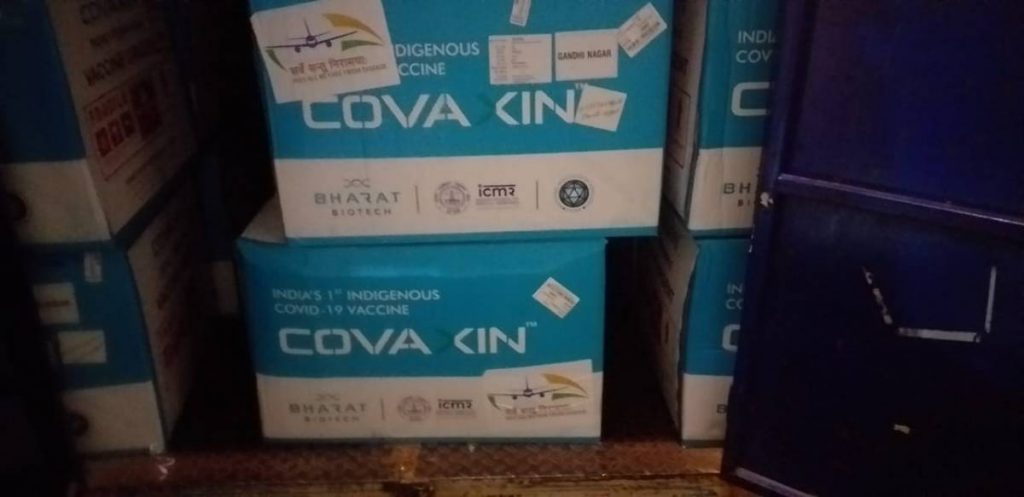
Covaxin, the Covid-19 jab developed and manufactured by Hyderabad-based Bharat Biotech Ltd, has been added to the list of valid vaccines in Britain, as per a notice issued by the UK government’s Department for Transport and Department of Health and Social Care.
The move would end up benefitting travellers from India — where Covaxin is the second-most used vaccine against COVID-19 — as they would no longer be required to self-isolate after arrival in England.
So far, the only Indian vaccine recognised by the UK was Covishield, which is the India-manufactured Oxford-AstraZeneca Covid-19 vaccine.
Notably, Alex Ellis, British High Commissioner to India, had announced on Twitter nearly two weeks ago that the UK government will also include Covaxin in the list of approved vaccines.
“More good news for Indian travellers to the UK. From 22 November travellers fully vaccinated with a COVID19 vaccine recognised by WHO for Emergency Use Listing, including Covaxin, will not have to self-isolate; so joining those fully vaccinated with Covishield,” the envoy had tweeted on November 9.
The move follows the World Health Organisation’s (WHO) decision to grant Covaxin the emergency use listing (EUL) on November 4.
“Covaxin was found to have 78 percent efficacy against COVID19 of any severity, 14 or more days after the second dose, and is extremely suitable for low- and middle-income countries due to easy storage requirements,” the global health body had said, as it announced the EUL status for Covaxin.
Meanwhile, the UK government has, apart from Covaxin, also added China’s Sinovac and Sinopharm to the list of approved vaccines. Both the jabs have been given WHO nod.
The decision to include the two Chinese vaccines will help the inbound travellers not only from China, but also those from the United Arab Emirates and Malaysia, where Sinovac and Sinopharm has been used for the inoculation drives.
Covaxin 77.8% per cent effectiv
Last week medical journal The Lancet revealed that Covaxin has been found to be 77.8 per cent effective, according to the safety and efficacy analysis data from Phase III clinical trials which was peer reviewed.
Hyderabad-based Bharat Biotech said the Lancet peer-review confirms the efficacy analysis which demonstrates Covaxin to be effective against Covid-19. The vaccine maker Covaxin is the only Covid-19 vaccine to have demonstrated efficacy data from phase III clinical trials against the Delta variant at 65.2 per cent.
“The efficacy analysis demonstrates Covaxin to be 77.8 per cent effective against symptomatic Covid-19, through evaluation of 130 confirmed cases, with 24 observed in the vaccine group versus 106 in the placebo group,” the company said.
The efficacy analysis also demonstrates Covaxin to be 93.4 per cent effective against severe symptomatic Covid-19
“Safety analysis demonstrates adverse events reported were similar to placebo, with 12 per cent of subjects experiencing commonly known side effects and less than 0.5 per cent of subjects experiencing serious adverse events,” it said
The efficacy data also shows 63.6 per cent protection against asymptomatic Covid-19, 65.2 per cent protection against the SARS-CoV-2, B.1.617.2 Delta and 70.8 per cent protection against all variants of SARS-CoV-2 virus.
Covaxin was developed under a partnership with the Indian Council of Medical Research (ICMR) and the National Institute of Virology, with Bharat Biotech receiving the SARS-COV-2 strains through this collaboration.
Bharat Biotech had established an ongoing collaboration with ViroVax since 2019, through the Indo-US Vaccine Action Program, to develop and evaluate IMDG (Alhydroxiquim-II), a novel TLR7/8 agonist molecule, which is formulated as part of the adjuvant in Covaxin. The Adjuvant Program of the US National Institute of Allergy and Infectious Diseases (NIAID) has supported ViroVax since 2009.
“The peer-review of Covaxin phase III clinical trial data in The Lancet, an authoritative voice in global medicine validates our commitment to data transparency and meeting the stringent peer-review standards of world leading medical journals,” said Krishna Ella, CMD of Bharat Biotech.
He said the data from their product development and clinical trials have been published in 10 peer-reviewed journals, making Covaxin one of the most highly published Covid-19 vaccines in the world.
The phase 3 trial Efficacy and Safety Study involving 25,800 volunteers across 25 sites in India is India’s largest ever clinical trial conducted for a Covid-19 vaccine.
“I am delighted to see that the phase III efficacy data has also been published in The Lancet, one of the most reputed journals worldwide. This itself speaks high about the strong position of Covaxin amongst other global front-runners Covid-19 vaccines.A The bench to bedside journey of Covaxin in less than 10 months showcases the immense strength of Atmanirbhar Bharat along with the Indian academia and industry in fighting against the odds and carving a niche in the global community,” said Balram Bhargava, Director General of the ICMR.
Recently, the World Health Organization granted emergency use listing to Covaxin enabling countries to expedite their regulatory approval to import and administer doses. It has also received emergency use authorizations in several countries with applications in process in more than 50 countries worldwide. Bharat Biotech has partnered with Ocugen to obtain approvals for Covaxin in the US and Canada.
With more than 150 million doses manufactured, supplied, and with an excellent safety and efficacy profile, Covaxin is a major contributor to the global fight against the Covid-19 pandemic.
The vaccine is currently being evaluated in controlled clinical trials in children 2-18 years of age, with results expected during Q4 2021.
Bharat Biotech said it was poised to achieve its goal of an annualized capacity of Aabout 1 billion doses of Covaxin by the end of 2021.