October 22, 2024
3 mins read

India a deserving G4 member for UNSC seat, says German envoy

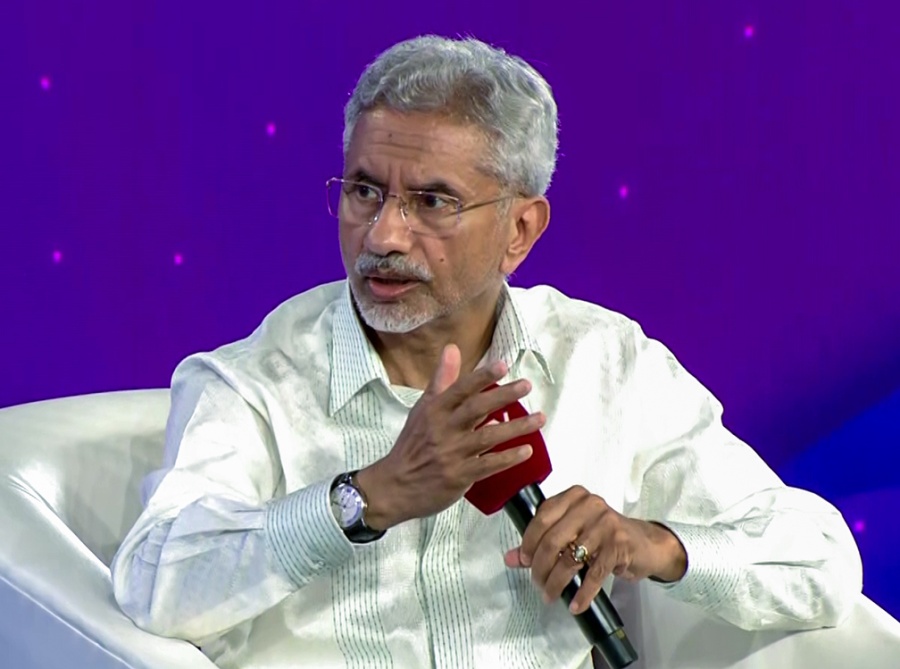
Talking about the India-Canada row, Jaishankar said it was an unfortunate situation considering that both countries have a long relationship…reports Asian Lite News

India is an important part of the world equation and along with other G4 members a deserving candidate for a seat in the UN Security Council, said Ambassador of Germany to India and Bhutan Philipp Ackermann on Monday.

Speaking at a session on “Geo-Political Disruptions: Emerging Powers vs Existing Powers” at the NDTV World Summit 2024 here, Ambassador of Germany to India and Bhutan Ackermann said there appeared to be a lack of willingness and preparedness on the part of China and Russia on the issue of reform in the UNSC.

“Everybody says that there should be a larger UNSC but it is more of a lip service, they do not have real intention to do so,” said the German Ambassador while calling upon G4 partners not to give up hope. We have to keep on fighting, India, Germany, Japan and Brazil belong to the table,” he said.

Talking about the India-Canada row, he said it was an unfortunate situation considering that both countries have a long relationship. “They should be able to find a way,” he said.

Ambassador of Brazil to India Kenneth H. da Nobrega hailed India’s leadership in pushing for the agenda of the Global South as it has a cultural heritage and it is focusing on the 21st century challenges. “The vision of PM Modi regarding leadership of the Global South is admirable and Brazil is willing to be a partner,” he said.

The Brazilian Ambassador also highlighted his country’s commitment to work with India in the field of countering climate change. “India is moving very fast to achieve green targets and Brazil is sharing its bio-fuel success story with it,” he said.

Ambassador Nobrega said one-size-fits-all solutions would do the trick and Brazil believed in technological neutrality in the field of renewable energy. I

The German Ambassador added by saying, “Without India, the fight against climate change is senseless.” India’s former permanent Representative of India to the UN Syed Akbaruddin suggested a reset in the manner in which G4 engages with others on the issue of reform in the UNSC.

Outlining the challenges that may be thrown up in coming years, he said countries would need to forge partnerships to counter challenges which may be thrown up by non-state players or which are trans-boundary.

Talking about West Asia challenges, Ashok Malik, Partner & Chair of India Practice, The Asia Group, said India could plan for a role in the post-conflict times.

“We should be planning for the day after. Israel, the Arab world and India, as a stakeholder, could play a role in maybe post-conflict Gaza, post-conflict Lebanon,” he said, adding that spaces were opening up as Iranian proxies get pushed back.

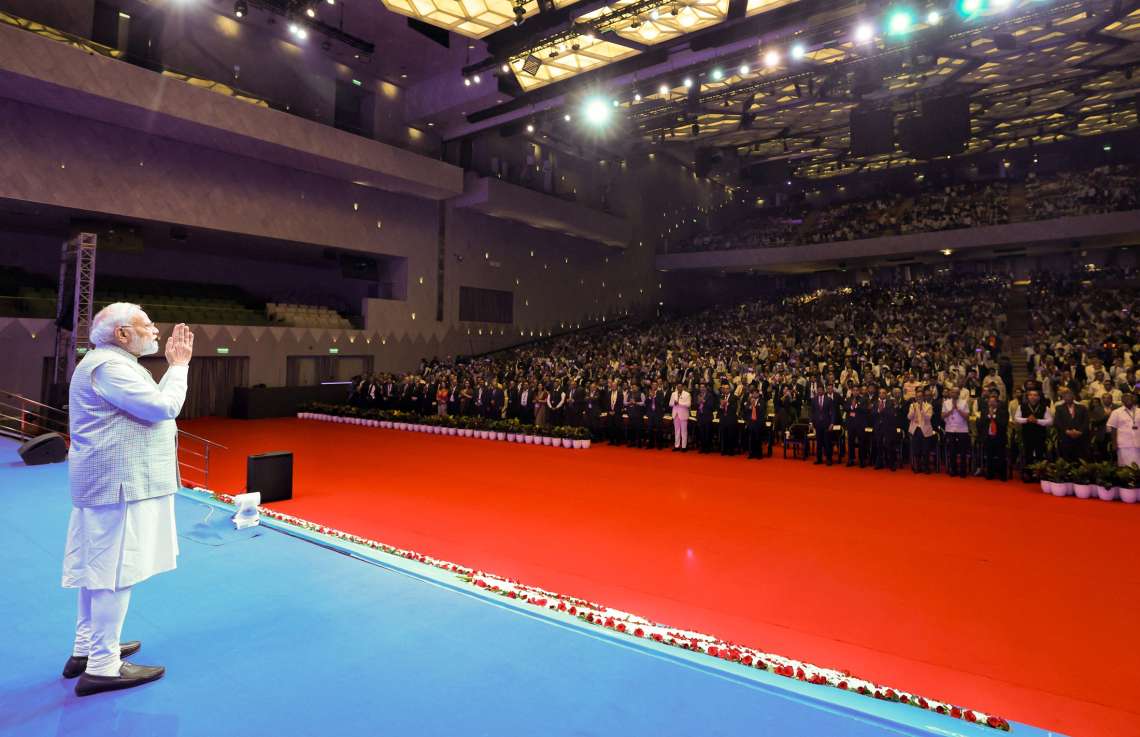
Earlier, during his inaugural address at the summit, Prime Minister Narendra Modi said India did not build relations on a “taken-for-granted” basis, highlighting that trust and reliability were the foundations of the country’s relations with the global community.

“Our progress brings joy to the world and not jealousy,” said PM Modi, in a veiled message to China which is often criticised for its perceived expansionist policies and predatory lending.

ALSO READ: Russia Has Never Harmed India’s Interests: Jaishankar
Previous Story

Jaishankar slams Canadian ‘double standards’

Next Story

Indian Navy’s fast attack craft INS Kalpeni in Colombo

Previous Story

Jaishankar slams Canadian ‘double standards’

Next Story

Indian Navy’s fast attack craft INS Kalpeni in Colombo

Latest from -Top News

Pakistan Risks Overstretching Itself in Yemen War

Pakistan’s expanding military role in Saudi Arabia amid the Yemen conflict could strain its defence resources and fragile finances…reports Asian Lite News Desk Pakistan’s military involvement in the war in Yemen may prove unsustainable because of mounting financial pressures and competing security demands, according to a new report. Islamabad’s growing military presence in Saudi Arabia risks stretching its defence resources while exposing the country to greater strategic and economic challenges. An article by Andrew Wilson in One World Outlook describes Pakistan’s involvement as a case of “fiscal and strategic overreach”, arguing that the country lacks the financial flexibility to sustain an expanded military commitment. Pakistan’s external finances depend heavily on an International Monetary Fund (IMF) programme, financial support from Gulf countries and remittances from Pakistani workers in the region. The report argues that deeper military involvement in the conflict could place additional pressure on these sources of financial stability. It also warns that deploying troops and military equipment abroad could weaken Pakistan’s capacity to address security challenges along its eastern border and deal with two domestic insurgencies. The move could also draw Islamabad into a conflict it has sought to approach cautiously. A Reuters report in May, citing Pakistani security and government sources, said Islamabad had deployed around 8,000 troops, a squadron of approximately 16 aircraft, mostly JF-17 fighter jets, two drone squadrons and a Chinese HQ-9 air-defence battery to Saudi Arabia. According to those sources, Riyadh was financing the deployment, with Pakistani personnel operating the equipment. The sources also said a confidential agreement contemplated the possibility of deploying up to 80,000 troops. Islamabad has not confirmed those figures, although it has acknowledged its military presence in Saudi Arabia, including the deployment of fighter jets at King Abdulaziz Air Base from April. The One World Outlook article argues that Saudi financial support can cover allowances and operating expenses but cannot easily replace military equipment needed elsewhere or resolve the political and strategic challenges of participating in the Yemen conflict. Pakistan’s defence budget is another concern. For the 2026-27 financial year, the federal government allocated PKR 3 trillion, or approximately $10.8 billion, to defence services. The allocation represents an 18 per cent increase from the original PKR 2.55 trillion provision and amounts to around 2.1 per cent of projected gross domestic product (GDP). Defence spending accounts for approximately 16 per cent of the federal government’s PKR 18.8 trillion expenditure. Military pensions are budgeted separately at PKR 822 billion, while debt servicing costs stand at approximately PKR 8 trillion, more than two-and-a-half times the defence allocation. The report argues that these competing financial obligations leave little room for additional military expenditure without placing further pressure on public finances. Pakistan’s reliance on IMF assistance also limits its fiscal flexibility. The country must meet the conditions attached to the programme, including a primary budget surplus target of 2 per cent of GDP and continued restraint on development spending. According to the article, these requirements make it difficult for Islamabad to finance an additional military commitment without compromising other budgetary priorities. Pakistan’s economic indicators offer limited reassurance. Economic growth for the 2025-26 financial year is estimated at between 3.6 and 3.7 per cent, while inflation reached approximately 10.3 per cent in September following an energy price shock. Foreign exchange reserves stood at around $21.5 billion at the end of September. Although this marks an improvement from the low levels recorded in 2023, the report notes that the reserves cover only a few months of imports. Financial assistance from Gulf partners remains central to Pakistan’s external stability. The article says Islamabad holds approximately $8 billion in Saudi deposits at its central bank. In July, the State Bank of Pakistan said Riyadh had extended the maturity of $5 billion in deposits to December 2028, easing the country’s immediate external financing requirements. A further $3 billion deposit was also extended in the spring. However, the article argues that these arrangements provide temporary relief rather than long-term financial independence, particularly as regional conflict threatens the stability of the Gulf economies on which Pakistan relies. The report concludes that Pakistan faces a difficult balance between supporting Saudi Arabia militarily and preserving the financial and military resources needed to address its domestic and regional challenges.
Go toTop

Don't Miss

Railways renews MoU with Switzerland to boost cooperation

Before the signing of the MoU, a Joint Working Group

Patrushev calls on PM Modi

Nikolai Patrushev also attended the Meeting of the Secretaries of