Dr. Sharon P Thomas, Dr. Aswin Prasanth, and Dr. Kannan Balakrishnan
When Waiting Becomes a Life
Every evening, somewhere in the world, someone hesitates before locking the front door. A parent pauses at the sound of footsteps outside. A spouse glances at an unfamiliar number flashing on the phone. A child wonders whether the face fading in an old photograph would still be recognizable after twenty years.
To an outsider, these are ordinary moments. To families of the disappeared, they are rituals of hope.
Most forms of loss have a chronology. There is a beginning, an ending, and eventually—however painful—a way of making peace with what has happened. Death is devastating, but it carries a terrible certainty. A funeral is held, condolences are offered, and memory slowly begins transforming grief into remembrance.
Enforced disappearance denies even that possibility.
A person leaves home and never returns. Someone is taken away in the middle of the night. A journalist disappears after an assignment. Days turn into months, months into years, and the ordinary rhythm of life begins to break down. There is no confirmation of death, no body to bury, no final goodbye.
There is only waiting.
The United Nations defines enforced disappearance as the deprivation of a person’s liberty by, or with the authorization, support or acquiescence of the state, followed by a refusal to acknowledge the person’s fate or whereabouts. Unlike many other crimes, it is considered a continuing violation of human rights because it does not end until the truth is known.
Yet legal definitions can explain only what disappearance is. They cannot fully capture what it does.
Its deepest violence lies not only in taking a person away, but in imprisoning everyone left behind within uncertainty.
The Violence of Not Knowing
Imagine reading a novel where the final chapter has been torn out. You know the characters, their hopes, and their struggles, but the ending has vanished. Every conclusion remains possible, yet none can be confirmed.
Families of the disappeared live inside that missing chapter.
Psychologists describe this experience as ambiguous loss, a term developed by family therapist Pauline Boss to describe losses that remain unresolved because there is no certainty. The person is physically absent but psychologically present. The mind struggles to accept what the heart cannot prove.
Unlike ordinary grief, ambiguous loss has no clear beginning and no natural end. Every rumour creates hope. Every unfamiliar photograph becomes a possibility. Every unexpected knock at the door becomes a question.
Human beings survive tragedy partly because they create rituals around it. Funerals, memorials, prayers, anniversaries, and graves do not remove sorrow, but they give sorrow a place. They allow families to acknowledge what has happened and slowly rebuild their lives.
Disappearance suspends these rituals.
Families often cannot mourn because mourning feels like accepting a death that has not been confirmed. Yet they cannot continue as if nothing happened because absence reshapes everything. Hope and despair become constant companions.
The missing person is gone, but the family remains emotionally tied to the moment of disappearance. For the world, time moves forward. For them, it circles around one unanswered question.
Living with Ghosts
Long before psychologists named ambiguous loss, literature understood its emotional landscape.
In Sophocles’ Antigone, the central conflict is not simply death but the denial of burial. Antigone risks her life to recover her brother’s body because she understands that without acknowledgement, a person’s place in the moral community remains incomplete. To deny someone a grave is also to deny recognition of their humanity.
Shakespeare’s Hamlet begins with another unresolved absence. The ghost of Hamlet’s father returns because truth has been buried with him. The haunting is not merely supernatural; it represents the way concealed violence continues to disturb the lives of the living.
Modern literature returns repeatedly to this idea. Toni Morrison’s Beloved, though rooted in the trauma of slavery, explores how unresolved suffering survives across generations. What is denied or forgotten does not disappear; it returns through memory, silence, and the lives of those who inherit the past.
Families of the disappeared often describe a similar experience—not as a supernatural haunting, but as the quiet persistence of memory.
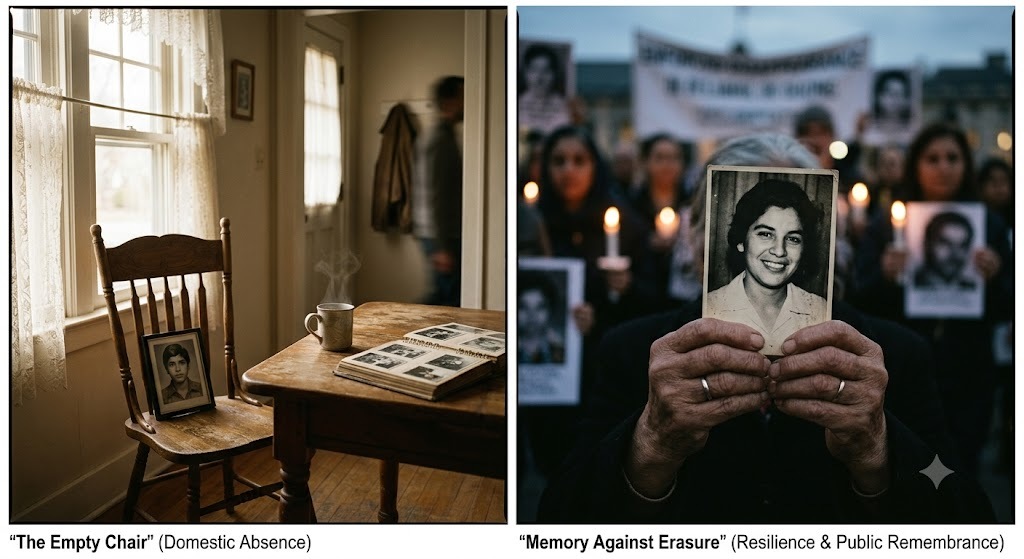
A winter coat remains hanging by the door. A favourite meal continues to be prepared out of habit. A birthday remains marked on the calendar. During family gatherings, someone says, “If she were here,” or “He would have loved this.”
The missing become invisible companions.
Cinema has captured this haunting with remarkable power. Costa-Gavras’ film Missing, inspired by the disappearance of an American journalist during Chile’s military coup, follows a father’s search for his son. What begins as a search for one person becomes a portrait of how uncertainty slowly destroys ordinary life.
Patricio Guzmán’s documentary Nostalgia for the Light offers another unforgettable image. In Chile’s Atacama Desert, astronomers search the skies for traces of distant stars while women search the earth for the remains of relatives who disappeared during Augusto Pinochet’s dictatorship. One group looks into the universe’s past; the other searches the ground for traces of human lives.
Both are acts of memory.
The film reveals a profound truth: disappearance creates ghosts without requiring the supernatural. The missing continue to inhabit homes, conversations, dreams, and photographs because their stories have no ending.
The Empty Chair at the Table
When someone disappears, the tragedy does not belong only to that person.
Every family is built upon invisible routines. Someone remembers birthdays, pays bills, cares for elderly parents, tells children stories, or gathers everyone around the dinner table. These ordinary acts create the structure of everyday life.
When a person disappears, that structure begins to collapse.
A spouse becomes the sole provider while still searching for answers. Children inherit responsibilities before they are ready. Elderly parents lose not only emotional companionship but also the support they expected in old age.
Sociologists describe the family as society’s smallest institution. When one person disappears, the institution itself changes. Relationships are reorganized around absence.
A wedding becomes complicated when one parent is missing. A house cannot easily be transferred without legal recognition of death. A family cannot fully celebrate or fully grieve when one place at the table remains empty.
The law often intensifies this uncertainty. Without official confirmation of death, families may struggle to access inheritance, pensions, insurance benefits, or property rights. Institutions designed to provide certainty often demand the very proof that disappearance has denied.
The result is that disappearance does not simply interrupt one life.
It suspends many others.
Memory Against Erasure
Across continents, families of the disappeared have discovered that memory itself can become a form of resistance.
In Argentina, during the military dictatorship between 1976 and 1983, thousands of people disappeared. Refusing to accept silence, mothers began gathering every Thursday in Buenos Aires’ Plaza de Mayo carrying photographs of their missing children. Their quiet walks became one of the most powerful symbols of resistance in modern history.
The photographs were more than personal memories. They were public statements.
This person existed.
This life mattered.
The Mothers of Plaza de Mayo understood what many governments attempting disappearance underestimate: erasing a person requires controlling not only information but also memory.
Families across the world have preserved their own archives. They keep letters, photographs, clothing, notebooks, and personal objects. These things become evidence of lives that might otherwise be reduced to statistics.
A photograph carries a special power. As Roland Barthes wrote in Camera Lucida, every photograph carries the message: “This has been.” For families of the disappeared, photographs carry an even heavier meaning. They become both remembrance and testimony.
They do not merely show who someone was.
They insist that someone was.
The Right to Be Remembered
When families of the disappeared are asked what they want, the answer is often simpler than expected.
They want justice, but before justice, they want truth.
Where are they?
What happened?
Can we bring them home?
The search for answers reveals something fundamental about human dignity. People need not only to live; they need to be recognized. Philosopher Hannah Arendt argued that one of the most devastating forms of oppression is removing people from the shared world in which their existence is acknowledged.
Disappearance attacks that recognition.
It attempts to place a person outside the categories through which society understands life and death. The missing person becomes neither fully present nor fully gone.
This is why families insist on names.
A name resists anonymity.
A story resists silence.
A grave resists erasure.
Memory is not simply nostalgia. It is a moral responsibility. Philosopher Paul Ricoeur argued that remembering is connected to justice because forgetting can allow suffering to disappear from history.
Enforced disappearance is therefore not only about locating missing people. It is about preserving the truth that their lives mattered.
Why Some People Never Really Disappear
Perhaps the greatest irony of enforced disappearance is that it seeks to erase a person from public life, yet often makes that person impossible to forget.
The disappeared continue to live in family rituals, photographs, stories, and memories. They remain present in the empty chair that no one removes, in the belongings carefully preserved, and in the questions passed from one generation to the next.
Their absence becomes a presence.
The opposite of disappearance is not simply discovery.
It is acknowledgement.
It is the recognition that a life was lived, that it mattered, and that it cannot be erased by silence.
Every society builds monuments to the dead because remembrance is one of the ways human beings affirm their shared humanity. Enforced disappearance attacks that impulse by denying even the certainty of loss.
Yet it also reveals the strength of memory.
Memory survives not because it is stored only in archives or carved into monuments. It survives because people carry it—in conversations, rituals, photographs, and stories.
A person can be hidden.
A body can be buried in secret.
A file can be destroyed.
But as long as someone continues to ask, “Where are they?”, the disappearance is not complete.
The question itself becomes an act of hope.
And hope, however fragile, is often where memory begins.
Dr. Sharon P Thomas is an Assistant Professor and Academic Coordinator of the Department of Forensic Science at JAIN (Deemed-to-be University), Off-Campus Kochi, Kerala, India.
Dr. Aswin Prasanth is an Assistant Professor in the Department of Languages at JAIN(Deemed-to-be University), Off-Campus Kochi, Kerala, India.
Dr. Kannan Balakrishnan is an Assistant Professor and Head of the Department of Forensic Science at JAIN (Deemed-to-be University), Off-Campus Kochi, Kerala, India.