New Delhi eases trade tensions with Washington while cautiously opening investment channels linked to Beijing…reports Asian Lite News Desk
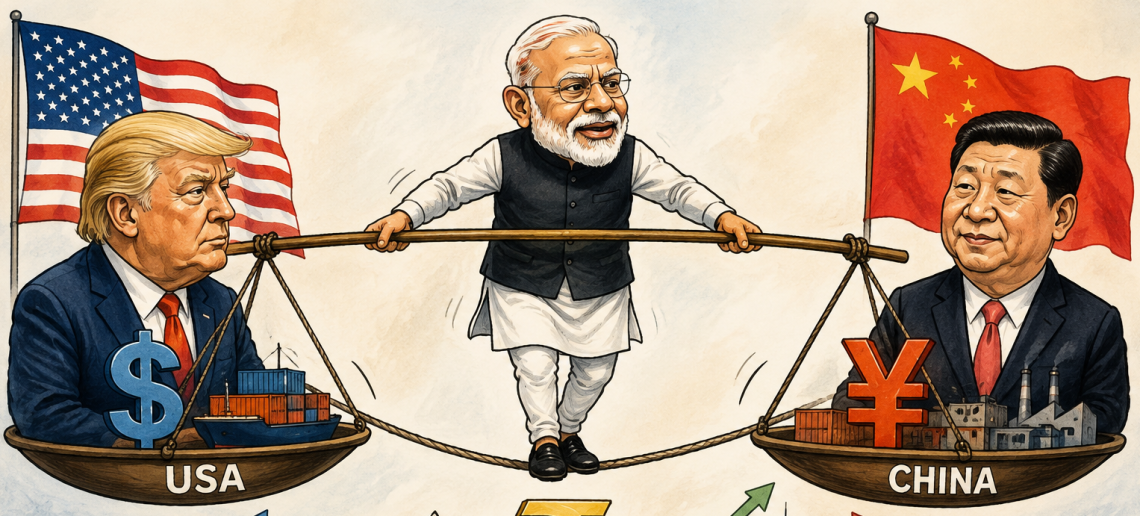
India has moved to rebalance its economic engagement with the US and China in 2026, securing a negotiated settlement to its tariff dispute with Washington while cautiously easing restrictions on certain Chinese-linked investments for the first time since the 2020 border clashes, according to an analysis.
The twin developments reflect New Delhi’s broader effort to diversify its sources of capital, trade and investment amid a more uncertain global economic environment, wrote Alok Kumar Kanojia in an article published by Geopolitical Monitor.
India’s economic relationship with the US saw the first major breakthrough. On February 2, Prime Minister Narendra Modi and President Donald Trump agreed during a telephone conversation to reduce reciprocal tariffs on Indian goods to 18 per cent from 25 per cent, while scrapping an additional 25 per cent punitive duty linked to India’s purchases of Russian oil.

Both governments have since publicly maintained that the arrangement would remain in place regardless of the outcome of the US Supreme Court’s deliberations on tariffs.
Washington subsequently imposed separate Section 301 duties of 10 per cent on certain products, although around 45 per cent of Indian exports remain outside their scope. Quartz surface products have also been subjected to safeguard tariffs of up to 55 per cent.
Despite these measures, the overall tariff environment is now lower and more predictable than it was a year earlier, the analysis noted.
Meanwhile, New Delhi has taken a cautious step towards reopening some investment channels involving Chinese capital.
On March 10, the Union Cabinet amended Press Note 3, the 2020 policy that required all investments from countries sharing a land border with India to undergo mandatory government approval.
The revised framework does not permit unrestricted direct Chinese investment, which continues to require prior clearance. However, it creates an automatic approval route for entities with non-controlling Chinese beneficial ownership below 10 per cent and establishes a 60-day approval timeline for selected manufacturing sectors.
The sectors covered include capital goods, electronic components and solar manufacturing inputs such as polysilicon and ingot-wafer products.
By late August, the government had reported approximately Rs 4,896 crore in foreign direct investment across 29 projects under the eased norms, covering sectors including information technology, pharmaceuticals, data centres and manufacturing.
The policy shift has coincided with a gradual improvement in economic engagement between New Delhi and Beijing. China lifted export restrictions on rare-earth magnets, fertilisers and tunnel-boring machines in August last year, while border negotiations have gathered momentum in 2026.
National Security Advisor Ajit Doval’s visit to Beijing this week for the first Special Representatives dialogue on the boundary dispute in five years also marked a significant step ahead of the BRICS summit that New Delhi is scheduled to host next month.
Viewed separately, the developments represent two distinct diplomatic tracks — a trade settlement with Washington and a cautious economic opening towards Beijing. Taken together, however, they point to India’s attempt to reduce overdependence on any single source of foreign capital or export demand.
The shift comes as India’s growth outlook faces increasing pressure from geopolitical tensions and global policy uncertainty.
The UN’s mid-year outlook projected India’s economic growth at 6.6 per cent in 2026, down from an estimated 7.4 per cent in the previous year. Earlier, S&P had projected growth of 7.1 per cent for FY27, supported by steady exports and a recovering investment cycle.
Both projections depend significantly on India’s ability to continue attracting foreign capital and sustaining external demand.
Overseas investors poured a record $4.2 billion into Indian government bonds in June, marking the strongest monthly inflow since August 2024. The surge came as inflation fell to 2.1 per cent and the Reserve Bank of India described domestic economic conditions as entering a “Goldilocks” phase.
According to the analysis, a more predictable tariff regime with the US could help reduce external uncertainty and limit currency and bond-market volatility.
At the same time, the relaxation of Press Note 3 could make it easier for multinational companies with minority Chinese ownership to invest in India’s manufacturing sector without facing lengthy discretionary approval procedures.
Such changes could prove particularly significant for companies seeking to develop supply chains outside China while continuing to rely on Chinese components, equipment or minority capital.
However, the durability of India’s economic rebalancing will depend on factors beyond New Delhi’s direct control, including the future of US trade measures and whether renewed India-China border talks produce substantive progress.
For India, whose growth model continues to rely heavily on foreign investment and export demand, maintaining multiple economic channels with major global powers could itself represent a significant strategic shift, the analysis concluded.